

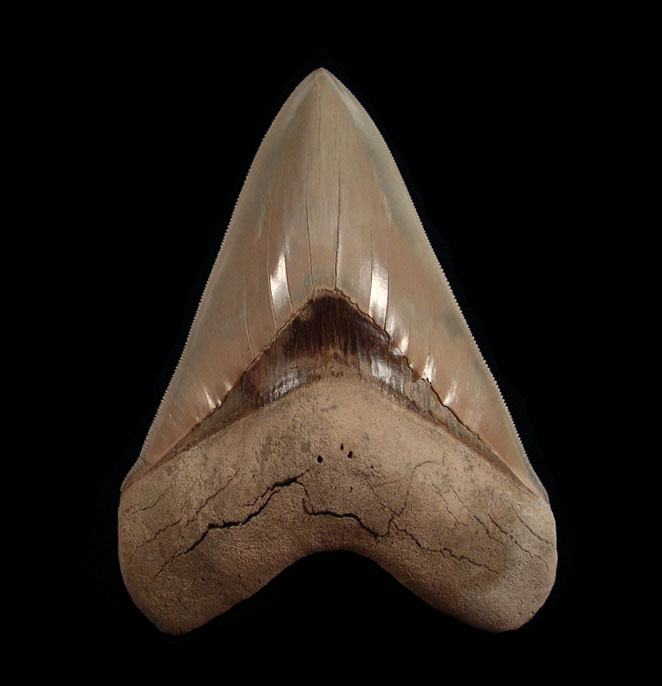
There are rare fossils that spark curiosity, and then there are fossils that ignite obsession. Among seasoned collectors, few treasures carry the same weight as a Lee Creek Megalodon tooth. These teeth are not just remnants of a giant predator; they’re symbols of prehistoric dominance, geological wonder, and sheer collecting prestige. To own one is not simply to possess a fossil, it is to hold a chapter of Earth’s history that has become increasingly rare, almost unattainable, and endlessly admired.
In this blog, we’ll explore why our Lee Creek Megalodon teeth collection is coveted by collectors worldwide, what makes them stand apart from other localities, and why the closure of their source has elevated them into legendary status.
The Legend of Otodus Megalodon
Otodus megalodon, often shortened to simply Megalodon, ruled the oceans from roughly 15 million to 2 million years ago. As the largest predatory shark to ever live, estimates suggest lengths of up to 60 feet or more, making even today’s great white shark seem modest. With its colossal size came equally massive teeth, many of which reached 5–7 inches in length, with some rare specimens exceeding this benchmark.
But beyond size, the Megalodon’s teeth are marvels of function. Wide triangular crowns, sharp serrations, and robust roots allowed the shark to crush bone and shear flesh effortlessly. They were built for predation on whales, sea turtles, and large fish—apex features for an apex predator. Owning one of these fossils isn’t just about admiration of natural history; it’s about holding evidence of a predator that dominated Earth’s oceans for millions of years.
The Uniqueness of Lee Creek Fossils
While Megalodon teeth can be found in several parts of the world, Lee Creek specimens stand in a league of their own. The phosphate mine near Aurora, North Carolina—commonly referred to as “Lee Creek”, is one of the most renowned fossil localities in North America. Here, the Miocene Pungo River Formation and the Pliocene Yorktown Formation yielded some of the highest-quality shark teeth ever discovered.
What makes them distinct?
Exceptional Preservation: Lee Creek sediments preserved teeth with sharp, intact serrations and minimal wear, allowing collectors to admire their original cutting edges.
Striking Aesthetics: Their wide triangular crowns are highly symmetrical, often showcasing hues of blue, tan, or gray that set them apart from specimens found elsewhere.
Diverse Species Representation: While Megalodon is the star, the site also produced remarkable Otodus chubutensis teeth, which are transitional ancestors of Megalodon.
For collectors, it’s the combination of quality, beauty, and rarity that makes Lee Creek teeth indispensable in any serious display.
Why “No Repair” Matters
Fossil collectors are aware that restoration is a common practice in the marketplace. Many Megalodon teeth from other localities undergo repair work, broken roots rebuilt, enamel touched up, or cracks stabilized. While this is accepted practice, it inevitably lowers authenticity.
Lee Creek Megalodon teeth, however, are celebrated for their authenticity with no restoration or repair. Collectors can confidently showcase these fossils, knowing they are unaltered pieces of history. Each serration, each edge, each mineral-stained hue is genuine, which adds immeasurable value.
In a market where authenticity dictates desirability, this feature alone sets Lee Creek teeth apart from the rest.
The Prestige of Scarcity
The crown jewel of Lee Creek collecting lies in its scarcity. Since 2008, the phosphate mine has been closed to public collecting. This single fact has transformed these fossils from fascinating curiosities into near-legendary artifacts. Unlike other fossil sites where fresh finds replenish the market, Lee Creek is frozen in time, no new legal collecting means no new supply.
Collectors understand what this means: every Lee Creek Megalodon tooth that changes hands today becomes more valuable tomorrow. The limited pool has elevated them from collectible fossils to investment-grade treasures. For this reason, acquiring one has become both a personal triumph and a long-term preservation of value.
A Tooth That Tells a Story
Every Lee Creek tooth carries a story beyond its age. The layers of the Pungo River and Yorktown Formations capture transitions between epochs, revealing how marine ecosystems shifted over millions of years. When a collector displays a Lee Creek Megalodon tooth, they aren’t just showing size or beauty, they’re telling the story of a vanished predator in a vanished sea.
It’s a conversation starter, a centerpiece, and often the highlight of any fossil cabinet. Guests are instantly drawn to it, asking the inevitable question: “Is that really from a Megalodon?” The pride of saying yes, and it’s from Lee Creek, is unmatched.
The Competitive Edge Among Collectors
In fossil-collecting circles, bragging rights matter. Collectors take pride not only in what they own but also in where it comes from. A Megalodon tooth from South Carolina or Peru is impressive, but mention Lee Creek and the respect level instantly rises.
Why? Because the name itself has become synonymous with top-tier specimens. Having one in your display signals knowledge, dedication, and an appreciation for the finest in fossil collecting. It’s the equivalent of having a rare mint in coin collecting or a first-edition in literature, elite, respected, and aspirational.
Why Every Collector Wants One
So why, ultimately, does every serious collector dream of owning a Lee Creek Megalodon tooth?
Rarity: The mine’s closure guarantees scarcity.
Quality: Wide crowns, full serrations, and stunning enamel preservation.
Authenticity: No restoration or repair enhances both trust and value.
Prestige: The name Lee Creek alone carries immense weight in collecting circles.
Historical Significance: A direct connection to the apex predator of prehistoric seas.
To sum it up, these fossils embody the perfect intersection of science, beauty, and rarity, qualities that collectors crave above all else.
Conclusion: The Crown Jewel of Fossil Displays
For those who collect fossils, the dream is always to own something that not only captures natural history but also holds undeniable prestige. The Lee Creek Megalodon tooth is that dream realized. It’s more than enamel and dentin, it’s a timeless piece of Earth’s narrative, an irreplaceable fragment of deep time, and a fossil that will never again be unearthed in legal collecting.
Whether displayed as a showpiece in a cabinet or treasured as a family heirloom, our Lee Creek Megalodon tooth transforms a collection from interesting to extraordinary. And that is why, without question, every collector wants one in their display.
Explore our fossil collection today!






