

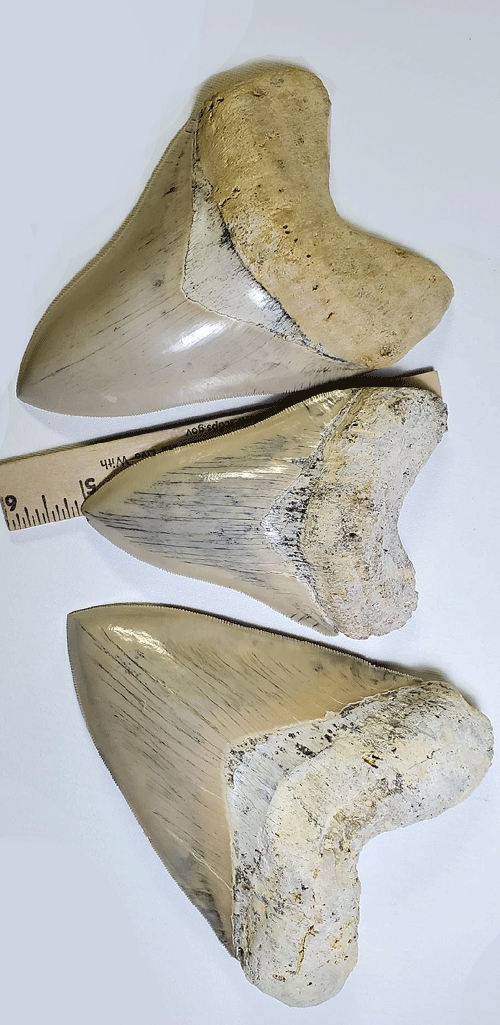
It starts with a photo in an online listing, jagged edges, dark enamel, a tooth the size of your palm. Your pulse quickens. Could this be it? A genuine Megalodon tooth, millions of years old, the remnant of a shark so massive it made great whites look like minnows. The seller claims it’s authentic. The price seems fair. And yet, something tugs at the back of your mind.
That hesitation isn’t paranoia, it’s survival. The world of fossil collecting is full of treasures, but it’s also littered with clever forgeries designed to fool the eager and the inexperienced. The best way to avoid becoming another cautionary tale is to learn the difference between the relics that tell the ocean’s oldest stories and the replicas that tell none at all.
What follows is your field guide, built for the modern fossil hunter, so you can spot a fake Megalodon tooth before it finds its way into your collection.
Understanding the Market for Megalodon Teeth
Fossilized Megalodon teeth are highly sought after for both scientific and personal collections. Their size, rarity, and connection to one of the ocean’s most legendary predators make them valuable—sometimes extraordinarily so. A well-preserved, large tooth can command thousands of dollars. That kind of money naturally attracts counterfeits, and modern manufacturing can produce replicas nearly indistinguishable to the untrained eye. Some are made for decoration and clearly labeled as replicas, but others are designed to deceive, complete with forged paperwork or artificially aged finishes.
The surge in online fossil sales has amplified the problem. Without physically handling the specimen, buyers rely entirely on photos, descriptions, and the seller’s honesty. This makes it vital to know exactly what to look for before committing to a purchase.
Natural Wear and Asymmetry
A real Megalodon tooth isn’t a showroom-perfect object. It’s been through predation, loss, burial, and mineralization. Serrations are often uneven, the crown might be chipped, and one edge can appear more worn than the other. These irregularities are the result of natural processes, not manufacturing defects, and they are one of the clearest indications of authenticity.
Genuine Fossil Coloration
Millions of years underground cause teeth to absorb minerals from their environment, which infuse them with rich, deep tones. True specimens can appear in colors from dark black to sandy brown, steel gray, or even a rare blue hue. More importantly, these colors blend and transition naturally.
You might see marbling, streaks, or gradients that seem to be part of the tooth itself, not applied to its surface. Replicas often mimic these shades but fall short, paint may sit on top rather than seeped within, and color changes might look abrupt or unnaturally uniform.
Mineral Texture and Gloss Variations
The enamel on a fossil tooth has areas where mineral infill is more concentrated and others where erosion has softened the gloss. This creates a subtle interplay of matte and shiny surfaces. Real fossils never have the consistent, factory-perfect shine often seen in resin or ceramic fakes. Instead, the surface reflects light differently depending on where you look, hinting at its complex geological history.
Weight and Density
A genuine Megalodon tooth has heft. Over millions of years, organic material is replaced by minerals, giving the tooth a density similar to stone. Even smaller genuine teeth feel solid in the hand, while fake Megalodon teeth often feel lighter than they should. When possible, compare the weight to a known authentic tooth of similar size.
Temperature Response
Mineralized fossils tend to feel cool to the touch at first, much like stone or ceramic. Resin and polymer replicas generally adapt quickly to your body temperature. This isn’t an infallible test, but can be a subtle supporting clue.
Root and Serration Detail
The root of a real tooth usually has a grainy, porous texture and may show tiny pits or cracks from the fossilization process. Serrations on authentic specimens, even if worn, typically appear as individually distinct notches. On replicas, serrations may seem too sharp and uniform or too rounded and vague, depending on the casting method.
Tactics Scammers Use
Online counterfeiters are resourceful, and knowing their methods can help you spot a trap before you step into it.
Resin Casting from Real Teeth – The replica inherits the shape and damage marks of the original, making it harder to detect unless you notice repeating patterns in multiple listings.
Artificial Aging – Using paint, stains, or even burying replicas in soil to mimic natural weathering.
Uniform Gloss Coating – A clear resin or lacquer layer that makes the tooth “pop” in photos but looks unnatural under proper lighting.
Fake Documentation – Certificates printed on fancy paper but issued by no reputable source.
Misleading Descriptions – Phrases like “Megalodon-style” or “inspired by” are buried deep in fine print, making buyers believe they’re getting a genuine fossil.
In-Person Authentication Techniques
If you’re fortunate enough to inspect a specimen before purchase, use these approaches:
Weight in Hand – You should feel a dense, almost stone-like mass.
Tap and Listen – Gently tapping against a known mineral object should produce a sharp, stone-like sound, not a dull thud.
Magnification Inspection – Under a jeweler’s loupe, authentic teeth reveal mineral granularity and complex surface patterns. Fakes tend to show casting bubbles, mold seams, or overly smooth areas.
Building Relationships with Trusted Dealers
While learning to authenticate fossils is invaluable, the most reliable safeguard is buying from sources with strong reputations. Long-standing fossil dealers, museum-affiliated sellers, and well-regarded private collectors have reputations to protect and are less likely to risk selling counterfeits. Some may even offer lifetime authenticity guarantees, which can add peace of mind to your investment.
Networking within fossil-collecting communities can also help. Experienced collectors often share seller recommendations and warn each other about known scams. These relationships can guide you toward safe, trustworthy transactions.
Preserving Your Authentic Finds
Once you have a verified Megalodon tooth, preservation matters. Store it away from direct sunlight, as UV exposure can alter surface appearance. Keep it in a stable, low-humidity environment to prevent cracking. Handle with clean, dry hands, and consider displaying it in a protective case to safeguard it from accidental drops.
Conclusion – Your Fossil, Your Story
Owning a real Megalodon tooth is about more than collecting; it’s about stewardship of Earth’s history. Every authentic specimen carries a narrative that stretches millions of years into the past, linking you to a world that no longer exists. In a marketplace crowded with fake Megalodon teeth, your knowledge is the best protection.
If you’re ready to invest in genuine Megalodon fossils, start with trusted, verified sources. We offer carefully authenticated specimens backed by detailed provenance, so you can buy with total confidence.
Browse our latest collection and bring a true piece of prehistoric power into your hands, without the risk of a fake stealing your story.






