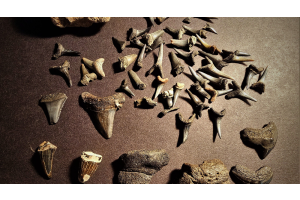
Some discoveries make headlines; others rewrite chapters of Earth’s history. The unearthing of the world’s largest Megalodon tooth along Chile’s fossil-rich coastline belongs firmly to the latter. It is not just a remarkable find, it is a tangible relic from an age when oceans roared under the reign of an apex predator whose size and power dwarfed the imagination.
The largest Megalodon tooth ever found, gleaming under the Chilean sun after millions of years in hiding, speaks with silent authority about a creature that once ruled the seas and challenges modern science to uncover more of its story.
Unearthing a Giant in Chile’s Coastal Terrain
This historic find emerged from Chile’s rugged and geologically rich coastal zones, regions long celebrated by paleontologists for their bounty of marine fossils. The expedition was no accident; it was a carefully orchestrated mission that united geologists, paleontologists, and local experts in a shared pursuit of knowledge. They navigated rocky outcrops, shifting sands, and harsh coastal winds to reveal this prehistoric treasure.
The tooth itself is awe-inspiring: massive in both length and width, with serrations still visible along its edges, despite the passage of eons. Measuring among the largest ever documented, it provides an unmistakable testament to the sheer scale of the Megalodon that once carried it in its jaw. This is not just a fossil, it’s a scale marker for an oceanic giant.
Megalodon: The “Big Tooth” Apex Predator
The name “Megalodon” comes from the Greek for “big tooth,” but such a translation hardly captures the creature’s scale. This prehistoric shark dominated the oceans from approximately 23 to 3.6 million years ago. Conservative estimates place its length at up to 60 feet, though some scientists suggest even larger figures based on the dimensions of the largest teeth discovered.
Unlike any modern predator, the Megalodon was built for absolute dominance. Its bite force is estimated to have exceeded 40,000 pounds, capable of crushing the bones of large whales with ease. Fossil records reveal it preyed on a variety of marine life, from seals to giant cetaceans, cementing its role as the undisputed ruler of Miocene and Pliocene seas.
The Significance of the Chile Tooth
The Chile Megalodon tooth stands out not just for its size but for what it represents in paleontological research. Larger teeth are directly correlated with larger sharks, and this specimen points to an individual at the upper extreme of known Megalodon dimensions. Such a find is invaluable, it allows researchers to refine size estimates, feeding behavior models, and evolutionary timelines for the species.
Additionally, its preservation is exceptional. The tooth’s enamel retains a degree of luster, and the root structure is remarkably intact. This suggests rapid burial and stable geological conditions, factors that aid scientists in reconstructing the environmental conditions of ancient Chilean waters.
Chile’s Coastline: A Paleontological Treasure Chest
Chile’s coastal geology is a tapestry woven with millions of years of marine history. The collision of tectonic plates, shifting ocean currents, and periodic sea-level changes have created layers rich in preserved marine life. Fossils from whales, dolphins, and ancient sharks regularly surface here, making it a destination for researchers and fossil enthusiasts alike.
In this context, the largest Megalodon tooth ever found is not entirely surprising, but it is deeply exciting. It reinforces Chile’s status as a global hotspot for marine paleontology and draws renewed attention to the need for conservation of fossil sites under threat from erosion, development, and climate change.
Insights into Ancient Marine Ecosystems
From a scientific perspective, this tooth offers a snapshot of ancient ocean ecosystems. Megalodons were apex predators, meaning their population size and health were closely linked to the abundance of prey and the stability of marine food webs. A tooth of this size suggests that during its lifetime, the seas off present-day Chile teemed with large prey species—likely including baleen whales, which flourished in warm, nutrient-rich waters.
By studying isotopes in the tooth’s enamel, researchers can infer the shark’s diet, migratory patterns, and even ocean temperatures during its lifetime. These findings could help answer long-standing questions about why the Megalodon eventually vanished, paving the way for today’s great white sharks to ascend the predatory throne.
Bridging the Gap Between Past and Present
Beyond academic circles, the Chile Megalodon tooth captures the public imagination. It is a tangible link between the modern world and an era when marine giants shaped ocean life. Museums and educational institutions are already expressing interest in showcasing the fossil, to inspire the next generation of scientists, divers, and ocean advocates.
Such discoveries also highlight the fragility of our current marine ecosystems. The Megalodon’s extinction serves as a poignant reminder that even the most dominant species can vanish when environmental conditions shift beyond their capacity to adapt. In today’s oceans, many top predators face similar challenges due to climate change, overfishing, and habitat loss.
Looking Ahead: Future Research Opportunities
While this tooth already offers a wealth of information, it also raises new questions. Could additional remains of this massive shark be hidden nearby? Is it possible that this region was once a breeding ground for Megalodons? Future expeditions will likely focus on mapping the surrounding area, employing ground-penetrating radar and drone surveys to identify potential fossil beds.
If more specimens are found, scientists could reconstruct more detailed life histories, potentially even determining the age, sex, and health conditions of individual sharks. Such knowledge would deepen our understanding of Megalodon’s evolutionary path and ecological role.
Final Thought
The unearthing of the largest Megalodon tooth ever found in Chile is more than an isolated paleontological triumph, it is a story of perseverance, scientific curiosity, and the enduring mysteries of the deep. It affirms Chile’s place on the map for significant marine fossil discoveries and sets a new benchmark for Megalodon research worldwide.
In the grand sweep of geological time, the Megalodon’s reign was brief, but its legacy is etched into the very stones of our planet. This tooth, gleaming and massive, is both a relic of an ancient predator and a beacon for the scientific journeys yet to come.
If this discovery sparks your curiosity about Earth’s ancient oceans, don’t stop here. Explore our collection of authentic Megalodon teeth, rare marine fossils, and expert research articles that bring the prehistoric world to life.