In our field, understanding the difference between damage and true growth anomalies is both a science and an art. We often encounter specimens that challenge perception and redefine how natural formation is understood. Among shark teeth, particularly those belonging to the Otodus genus, pathological examples tell fascinating stories hidden within their irregular forms. These rare fossils can easily be mistaken for damage, yet they represent genuine biological variations that occurred during the shark’s life.
Our dedication to uncovering these unique details helps others appreciate the subtle distinction between damage and pathology. Collectors searching for a pathological megalodon tooth for sale often find that these teeth reflect not damage, but rare natural formation shaped by the forces of evolution.
When Nature Creates Its Own Mysteries
A pathologic tooth is not a broken remnant of prehistory but a biological curiosity that speaks of adaptation. The catalog from which this information is drawn refers to such specimens as “true oddities of nature.” They are rare examples of how growth can deviate from the ordinary path without any external interference. Each irregular ridge or twisted cusp reveals the living history of an animal shaped by environmental and biological factors.
Unlike fossils altered by geological stress, pathologic teeth preserve the shark’s original enamel, capturing the authentic pattern of its life. Each twist and curve reflects the shark’s internal development rather than an external accident. Their smooth surfaces and fluid transitions show natural variation rather than harm. Observing them closely reminds us that what might appear imperfect at first glance can, in fact, reveal the most extraordinary details of nature’s craftsmanship.
The Illusion of Damage
It is common for collectors to mistake a growth anomaly for damage. The human eye tends to favor balance and predictability, so an asymmetric or warped specimen often appears broken. In fossil collections where uniformity is valued, an unusual tooth may seem misplaced. Yet these irregularities are usually the defining traits that reveal their uniqueness.
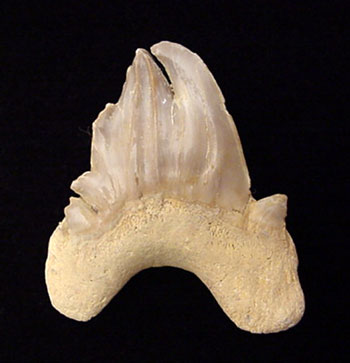
Certain Otodus teeth in the catalog highlight how confusion can arise. One is described as having a “split crown,” where the tooth divides into two connected sections. To an untrained observer, this could look like a fracture. Another example shows a “split and twisted” crown divided into three sections. While this appearance could suggest damage, the formation occurred while the shark was alive. The pattern of twisting follows the tooth’s natural growth lines, proving that it is an authentic anomaly rather than a post-mortem flaw.
Some teeth also display compression, either horizontally or vertically, giving them a flattened look. To someone unfamiliar with pathology, compression might seem to result from crushing during fossilization. However, these compressed crowns developed naturally, revealing that variation in growth often mimics the visual patterns of physical stress. The same principle applies to the rare pathological megalodon tooth for sale specimens seen in similar collections, where each irregularity tells a genuine biological story.
The Subtle Art of Recognition
Recognizing a pathologic tooth requires time, practice, and an eye for continuity. True anomalies maintain a smooth and uninterrupted surface. Even when the shape seems distorted, the enamel remains unbroken. There are no rough edges or missing fragments, indicating that the tooth grew in this way rather than breaking later.
Another aspect that helps in identification is the alignment of the irregularity. Growth anomalies often follow a logical anatomical pattern, maintaining a connection between each part of the tooth. For example, in a split crown, both halves grow in parallel, joined at the root. In contrast, an actual break would produce random separation with uneven edges.
The texture and flow of the surface are also important clues. Damage leaves sharp or uneven surfaces, while pathologic features appear smooth and continuous. The enamel polish remains consistent across the entire tooth, reinforcing that it formed organically. Each smooth curve or compressed ridge captures the rhythm of natural growth, allowing observers to separate actual pathology from accidental breakage.
When the Rare Becomes Remarkable
Pathologic shark teeth are among the rarest fossil discoveries. The catalog describes them as “among the most bizarre and rare shark teeth to exist.” This rarity enhances their significance both scientifically and aesthetically. Each tooth represents a biological event frozen in time. Unlike typical specimens, these teeth record moments when the shark’s natural development took an unexpected path.
Such fossils offer insight into prehistoric life, showing that even apex predators experienced irregularities in growth. Their distinctive shapes become tangible evidence of adaptation and survival. For collectors, owning one of these specimens provides a direct link to an ancient world where biological imperfection created beauty. The fascination surrounding these teeth lies
not in their flaws but in the authenticity of their story.
The Art of Imperfection
There is a certain poetry in imperfection. A twisted crown or compressed root becomes an emblem of nature’s individuality. Each irregular tooth embodies the idea that life often bends the rules of uniformity. The distinctiveness of a pathologic tooth lies not in its deviation but in its expression of natural growth.
When viewed closely, these anomalies transform into intricate patterns of formation. They are reminders that ancient life was complex, unpredictable, and endlessly varied. Every pathologic specimen, whether from an Otodus or a megalodon, serves as a bridge between science and artistry, showing how natural irregularity can create timeless fascination.
Closing Reflection
The study of pathological shark teeth brings an appreciation for the beauty within irregularity. What some might perceive as damage often turns out to be evidence of natural development. Through detailed observation, it becomes clear that these fossils are not broken remains but masterpieces of biological formation.
Each specimen stands as a silent record of life that once thrived in the prehistoric oceans. The smooth enamel, the aligned distortions, and the deliberate curves reveal that these anomalies are far from accidental. Collectors who explore pathologic examples, including those seeking a pathological megalodon tooth for sale, uncover the deeper narrative of growth, survival, and adaptation. These remarkable fossils remind us that nature’s irregularities are not imperfections; they are the stories that continue to shape the understanding of ancient life.