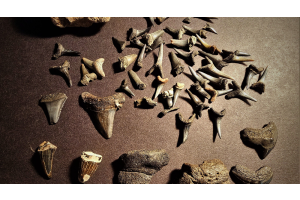
The fossilized teeth of the mighty Megalodon are more than relics—they are monuments to a creature that shaped the ancient seas. Each tooth, measured in centimeters, tells a story. Some stretch beyond 18 cm, while others appear smaller yet remain extraordinary. As collectors and enthusiasts, we pause in awe, wondering how such striking variations arose. The truth is that megalodon tooth size depended on several factors—the tooth’s position in the jaw, the shark’s age, and the role each tooth played in this apex predator’s life. These nuances turn fossil hunting into an interpretive journey that continues to fascinate us.
Let’s explore these dimensions more closely and see why no two Megalodon teeth are ever quite the same.
The Magnitude of Megalodon Teeth
When we think of Megalodon, we imagine enormity—the largest predatory shark to have ever existed, with teeth that could exceed 18 cm in height. But not every specimen reflects the maximum scale. Some are considerably smaller, hovering between 5 and 10 cm, and this range is not accidental. Just as a cathedral has arches, pillars, and windows of varying dimensions, so too did the Megalodon’s mouth hold teeth of many sizes. These differences were not flaws of nature; they were part of an intricate system designed for efficiency.
Position in the Jaw: Anterior vs. Posterior
The placement of a tooth within the jaw dictated much of its size and shape. Anterior teeth, set at the very front, were designed for grasping and slicing with dramatic precision. These teeth, often the largest, commanded attention not only because of their sheer height but because they anchored the shark’s ability to strike.
Posterior teeth, resting further back along the jawline, tended to be smaller and more angled. Their purpose was no less vital, though—they guided prey into the mouth and aided in the grinding process. In comparing the two, one begins to see why the Megalodon’s dental array could appear almost like a sculpted mosaic, each centimeter carrying its function. Thus, the size of megalodon teeth becomes a narrative shaped by biology as much as by time.
The Influence of Age on Tooth Size
Just as rings in a tree reveal its years, teeth reflect the age of the shark. Juvenile Megalodons, while already formidable, bore smaller teeth that seldom reached the grandeur of their elders. As these young giants matured, their teeth expanded in both size and strength, adapting to the prey that marked each stage of their life.
Adult specimens, fully grown, yielded the most prominent teeth—monuments in fossilized enamel and dentin. But even among adults, the size spectrum was broad. Environmental conditions, food availability, and natural wear shaped what was preserved. It is in these subtle differences that collectors uncover the pulse of the ancient seas, piecing together how one shark’s life contrasted with another.
Measuring Teeth in Centimeters
Collectors often emphasize exact dimensions, noting that centimeters provide a universal measure of awe. When a specimen exceeds 15 cm, it is celebrated as one of the largest in existence, while smaller finds remain prized for their rarity and exceptional preservation. Recording the megalodon tooth size in cm allows researchers and enthusiasts alike to catalog fossils with precision, aligning each artifact with its place in the greater story.
The act of measuring is more than arithmetic—it is ritual. To hold a tooth against a scale and watch the number rise is to experience the reverence of time itself. Each mark of measurement transforms a fossil from an object into a voice from the Miocene seas.
The Drama of Function and Form
Beyond raw dimensions, tooth design mirrored function. Serrated edges, worn by millennia, once ripped through flesh and bone. The curvature hinted at leverage, while thickness signaled resilience. Larger anterior teeth commanded spectacle, but smaller posterior teeth whispered of the mechanics behind the predator’s feeding strategy.
Variation, then, was not random but essential. Each centimeter of enamel carved a role in survival. To examine these fossils today is to see both artistry and brutality woven into natural design. It reminds us that variation itself is evidence of a living, breathing force that once swam with unrivaled dominance.
Fossil Preservation and Its Impact
Not all teeth are lost in the same way. Some are fractured, others eroded by sand and currents. A tooth originally measuring 12 cm might now present as 10 cm due to ancient wear or modern recovery conditions. This adds yet another layer of variation to consider. Preservation affects not only size but also the sharpness of serrations and the brilliance of coloration.
Thus, the teeth we encounter today are echoes, each shaped by both geological and biological forces. To measure them in centimeters is to honor both their original scale and the passage of time that has refined them into relics of beauty.
Collecting with Awareness
For collectors, size is often the first marker of rarity and value. Yet understanding why one tooth measures 6 cm while another reaches 17 cm enriches the experience. It turns acquisition into education and ownership into stewardship. The act of collecting becomes less about possession and more about preserving a lineage of natural history.
Each fossil, regardless of size, bears weight. A smaller posterior specimen may tell us as much about feeding mechanics as a massive anterior trophy. Together, they form a narrative far greater than any single piece.
Reflecting on the Immensity of the Past
Standing before a case of Megalodon teeth, one cannot help but feel a sense of awe. The differences in size mirror the differences in purpose, age, and fate. From the tiniest preserved edge to the colossal 18 cm marvels, each fossil embodies a fragment of the ancient ocean’s voice.
We are left with questions as grand as the fossils themselves. What seas did these teeth cut through? What creatures fell prey to their serrated grip? And how many stories remain buried beneath layers of sand and time, waiting to be measured, cataloged, and revered?
Conclusion
Variation in Megalodon tooth size is not just a detail—it is a record of survival and the grandeur of prehistory. From towering anterior blades to smaller posterior forms, each centimeter reflects purpose and adaptation. Age marked the journey from juvenile to apex adult, while fossil preservation added time’s artistry.
As we measure megalodon tooth size in cm, we trace more than numbers—we touch the echoes of the ocean’s greatest predator. In studying these fossils, we preserve the memory of the seas they once ruled and honor relics that connect us to an age of giants.
If these ancient relics inspire you as they inspire us, please contact us to explore, measure, and honor the history of the Megalodon.