The mighty Megalodon, the largest shark to have ever lived, continues to inspire awe through the massive teeth it left behind. These fossilized remnants are more than just relics—they are windows into a prehistoric ocean where a predator of astonishing size once ruled. When we hold one of these teeth, the question naturally arises: how big can a megalodon tooth get? Measuring these fossils is not just about size; it is about tracing the story of a giant and the science that helps us understand it. We’re drawn to these fossils not only for their grandeur but for the deep history they preserve.
Let’s explore how science approaches the fascinating task of measuring these legendary teeth.
Why Measuring a Megalodon Tooth Matters
Size speaks volumes in paleontology. Each tooth reflects not only the scale of the shark but also its role in the ecosystem millions of years ago. By accurately measuring the tooth, researchers can estimate the overall size of the shark, compare specimens from different regions, and map the evolutionary history of this ancient predator. Collectors, too, find meaning in precise measurements, as every millimeter can influence a fossil’s rarity, value, and historical significance.
Careful documentation of these measurements also ensures fossils are preserved with scientific integrity for future study. In this way, every measured tooth becomes part of a larger narrative that connects science, history, and human curiosity.
The Basics of Tooth Anatomy
A Megalodon tooth is not a simple triangle of enamel. Its structure tells us exactly where it belonged in the shark’s jaw. The crown, sharp and imposing, once sliced through prey. The root, broad and sturdy, anchored the tooth in the jaw. Then there are the serrations, fine ridges that acted like saw teeth, perfect for tearing through flesh.
When scientists measure a Megalodon tooth, they consider these parts carefully because each angle and curve holds clues about the shark’s anatomy. The proportions between these features can even reveal whether the tooth came from the front, side, or rear of the jaw. Each placement carried a unique function, adding to the precision and efficiency of this ancient predator.
Standard Measuring Techniques
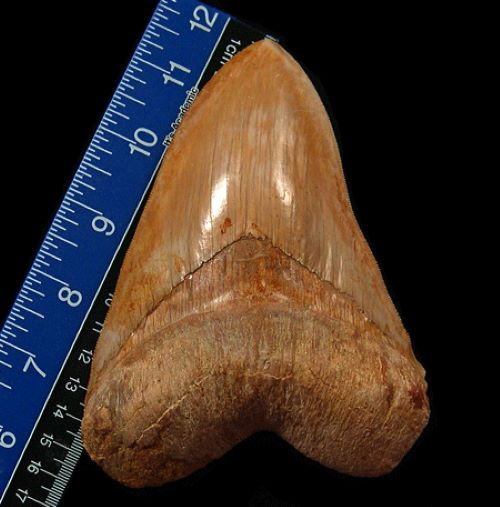
The most common approach is straightforward: measure the slant height from the tip of the crown to the farthest corner of the root. This length is the standard reference point used by both paleontologists and fossil collectors. It ensures consistency when comparing specimens across different locations or collections. Some researchers also record the width across the root and the depth of the crown, which together create a more complete picture of the tooth’s overall scale.
This precision enables experts to compare fossils from regions such as North Carolina, Peru, and Indonesia, highlighting differences in size and coloration that contribute to the Megalodon’s global story. For collectors, knowing these dimensions ensures accuracy when documenting or displaying a fossil.
Exploring the Range of Tooth Sizes
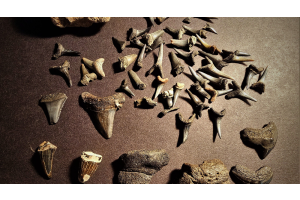
Not every Megalodon tooth towers at seven inches or more. In fact, the range of sizes is part of what makes these fossils so fascinating. Some teeth measure under three inches, reflecting younger sharks or smaller teeth from the rear of the jaw. Mid-sized teeth, often four to five inches long, provide a balance between function and size, showing how the shark’s dentition adapted for different roles in hunting. At the other extreme are the massive teeth, which exceed six or even seven inches, capturing the imagination and symbolizing the shark’s accurate scale.
This broad spectrum reminds us that each tooth is a snapshot of the shark’s life—whether from a juvenile still growing into its role as a predator or from a fully mature giant dominating ancient seas. For both scientists and collectors, documenting this diversity enriches the overall understanding of Megalodon’s biology and evolutionary history.
Connecting Tooth Size to Shark Size
The burning question for many enthusiasts remains: how big can a megalodon tooth get? The most prominent teeth discovered measure over seven inches, indicating that sharks may have reached lengths of 60 feet or more. While exact formulas vary, paleontologists often employ mathematical models that correlate tooth size with body length.
These estimates are not flawless—after all, no complete Megalodon skeleton has ever been found—but they provide a remarkable glimpse into just how immense this species was. Each oversized tooth becomes a tangible reminder of a predator that dwarfed nearly every creature in its path. For fossil lovers, holding such a tooth feels like having a fragment of prehistory that defies imagination.
Regional Variations and Color Stories
Megalodon teeth are not uniform. Fossils from North Carolina often exhibit rich, copper-red hues, while those from Indonesia are known for their vibrant coloration. These differences arise from the unique minerals present in the sediments where the teeth fossilized. Measuring these teeth not only confirms size but also preserves the geological story of the environments that shaped them.
Each tooth is both a scientific artifact and a natural work of art, telling a story that spans millions of years. The colors themselves act like signatures of the oceans where these giants once swam. For collectors and researchers, this makes every specimen a distinct chapter in the Megalodon’s global legacy.
Challenges in Measurement
While measuring may sound simple, fossilized teeth pose challenges. Some are incomplete, worn, or broken, requiring scientists to reconstruct the original dimensions. Others are distorted by geological pressures that have been exerted over millions of years. Researchers rely on experience and comparison with better-preserved specimens to make informed estimates.
This careful process is part science, part interpretation, and part appreciation for the rarity of intact fossils. Every adjustment made in these reconstructions ensures the fossil’s story remains as accurate as possible. In this way, even fragmented teeth continue to contribute valuable insights into the life of the Megalodon.
Why Collectors Value Accuracy
For collectors, accurate measurement is not just a technicality—it is part of the excitement of owning a piece of prehistory. A difference of a few millimeters can change how a specimen is cataloged and appreciated. Collectors treasure the moment of placing a caliper or measuring tape against a tooth, knowing they are touching a relic of an apex predator that once dominated the seas.
Each recorded measurement connects the present with an ocean that no longer exists but whose stories remain etched in stone. It turns the act of collecting into a dialogue with the past, where numbers on a ruler bring ancient history into sharper focus. In this way, every measured tooth becomes both a scientific record and a deeply personal experience.
Science Meets Romance
Measuring a Megalodon tooth is more than a calculation—it is a bridge between fact and fascination. The process combines mathematics with imagination, science with wonder. Holding such a tooth invites us to picture the vast ocean landscapes of the Miocene and Pliocene epochs, where the Megalodon swam as master of its domain. Measuring it adds definition to that vision, turning awe into understanding. Each precise measurement deepens the connection between human curiosity and prehistoric life. In this way, science transforms an ancient fossil into a story that still speaks to us across millions of years.
Conclusion
The science of measuring Megalodon teeth is both practical and poetic. It brings order to the study of fossils while fueling the imagination of collectors and researchers alike. Each measurement captures the scale of a predator so immense that only fragments of its story remain. And when we ask, How big can a megalodon tooth get?, we are really asking to connect with a time when giants ruled the oceans. That question, and the care taken to measure these fossils, keeps the Megalodon alive in both science and storytelling.
For those interested in authentic Megalodon fossils, contact us today to learn more, explore available specimens, and expand your collection responsibly.