

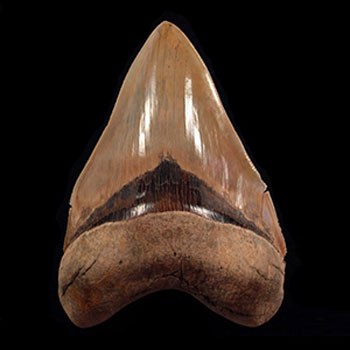
There’s a strange moment that happens when your fingers wrap around something sharp, stone-cold, and unmistakably ancient—something that doesn’t belong in this century, or even the last hundred centuries. You’re crouched over a riverbank or waist-deep in murky blackwater, and the world around you falls away. That moment, when your eyes meet the jagged edge of a fossilized giant, feels like stepping straight into a rip in time.
And this isn’t exaggeration for effect. Anyone who’s spent time finding a megalodon tooth knows it’s not just about fossils. It’s about chasing ghosts and chasing the colossal predators that once ruled the oceans. Chasing a version of Earth that has been buried under layers of silt and time. When we say megalodon tooth hunting is a kind of time travel, we mean it quite literally.
The Prehistoric Predator That Never Really Let Go
Long before any mammal dared walk on two legs, a creature cruised the oceans that made even great white sharks look like toddlers on a swim floatie. Megalodon was big—not just “wow, that’s large” kind of big, but “how-is-that-possible” big. Imagine a shark stretching nearly sixty feet long, with jaws wide enough to crush a small car and teeth as long as your hand. Now imagine that beast vanishing... with barely a trace.
We don’t have skeletons. We don’t have full fossilized remains. What we have are teeth. Thousands of them, buried in ancient sea beds, riverbanks, and cliff sides. These are the relics that turn everyday people into passionate hunters. The thrill of megalodon tooth hunting isn’t just about the find; it’s about the connection to something so massive, so powerful, and so far removed from our modern world that it almost feels mythical.
The Environment Is Part of the Spell
Megalodon teeth are not like seashells that wait to be retrieved from the surface. You must put in effort for them. There are moments when that entails plunging into blackwater rivers, where sunlight hardly reaches the surface and each stride feels like a dance with nature. At other times, it involves spending hours sorting through pebbles and silt along a blustery beach.
You don't find something by chance. You deserve it. You learn to read the landscape, not in a romantic or lyrical sense (although, let's face it, it is somewhat romantic), but rather in the same way that experienced hunters or fishermen read the direction of the wind or the flow of the water. You begin to notice the indicators over time. A specific gravel colour. a shift in the slope. Something tooth-shaped flashed just below the surface. Then all of a sudden it's there. A wonderfully preserved prehistoric serrated edge that silently awaits the start of a new tale.
No Two Teeth Are Ever the Same
Every single tooth carries its personality, its own mineral makeup, its own scars from time. Some are jet black, polished by centuries of pressure. Others are streaked with iron reds, fossilized in a different kind of earth, shaped by a different story. One might be a pristine six-incher with clean lines and flawless serrations, while another is half-broken but unmistakably authentic.
And in that uniqueness lies the obsession. Once you’ve been bitten by the thrill of finding a megalodon tooth, the hunt doesn’t really end. It just changes. You begin chasing different shapes, rarer sizes, and more unusual colors. You start comparing formation layers and geological timelines. Your weekends start revolving around tide tables and sediment dumps. You even start questioning your dentist about enamel strength, just for fun.
We’ve met collectors who planned entire vacations around the best rivers for fossil hunting. We’ve seen first-time hobbyists go from one accidental find to building personal museums in their garages. And all of it—every single dusty, muddy, exhilarating second—comes back to the same spark: time travel, in your hand.
Where You Hunt Changes the Story
Let’s be real here. Not all hunting grounds are created equal. Some places offer sandy strolls and pleasant weather. Others demand wetsuits, dive certifications, and an appetite for adrenaline. South Carolina’s blackwater rivers are legendary not just for their yield, but for the sense of adventure that comes baked in. Florida’s Peace River is quieter, but still hides ancient secrets just below the surface.
Maryland’s Calvert Cliffs will put your legs to work, and North Carolina’s Aurora Fossil Museum has been known to deliver big finds straight out of their sediment piles. Each of these places carries its own flavor, its own story, its own version of history ready to be uncovered. And as much as you’re digging through layers of soil, you’re also peeling back layers of time. That’s what makes megalodon tooth hunting feel like you’re doing something more than just collecting fossils. You’re chasing ancient coastlines, submerged worlds, and forgotten monsters.
The Madness Behind the Magic
You might start out curious. Maybe you saw a photo online or walked past a fossil booth at a local fair. Then you go looking. You dig. You find something. And before long, you’re hooked. It’s not just the size of the tooth. It’s not even its value. It’s the way time folds around it. The way your modern fingertips press against something millions of years old. The way your breath catches just a little each time you think, “This used to be inside a shark the size of a bus.”
The more you hunt, the deeper you fall. It becomes a ritual. It becomes therapy. It becomes a quiet kind of madness—the good kind—that pulls you away from emails and traffic, and into something much older, slower, and more honest.
And we get it. We understand that rush. We’ve lived it ourselves.
What If You Can’t Get to the River?
Let’s say your calendar’s booked, or your nearest blackwater river is three states away. That doesn’t mean you can’t step into history. That’s why we do what we do. We take pride in sourcing authentic, certified megalodon teeth from the best fossil-rich locations, bringing the hunt directly to your hands. Whether you’re building a display, adding to a serious collection, or just gifting someone their first real fossil, we’ve got you covered.
Our selection features a range of specimens—different colors, sizes, conditions—all hand-checked and ready to ship. No fakes. No fillers. Just real pieces of prehistory, waiting for their next chapter. We believe every tooth should feel like a discovery, not just a purchase.
And if you’re new to the hobby? Even better. We’re happy to guide you through. You’ll be speaking the language of serrations, bourrelets, and root formations in no time.
When You Hold Time in Your Hands
There’s a particular weight to a megalodon tooth. Not just the physical weight—though yes, some of them are heavy—but the emotional one. It’s like holding the echo of a roar. You turn it over in your palm, you study the edges, and you realize that this wasn’t just part of a shark. It was part of an ecosystem. Part of a world before ours. And somehow, it survived all that. Long enough to find you.
So the next time you feel that familiar pull toward mystery, power, and deep-sea adventure, don’t ignore it. Whether you’re setting off into the rivers yourself or browsing from your living room, finding a megalodon tooth is still one of the most intimate ways to connect with Earth’s wildest history.
It’s not just a fossil. It’s time travel in your pocket.






