

You can tell a lot about a person by the kind of fossil they choose to own. Some go for the small, subtle ones—a nice little trilobite to sit quietly on a shelf. Nothing wrong with that. But then there are the people who walk straight past the modest options and stop at the display with the heavy hitters. The ones with serrations like saw blades and roots thick enough to rival a coffee mug. They don’t ask if it’s real. They ask where it came from, how old it is, and if they can hold it.
A big megalodon tooth doesn’t whisper ancient history. It growls it. And that’s precisely why it ends up front and center, on desks, mantels, or anywhere guests are likely to stop mid-sentence and stare. You’re not just buying a fossil. You’re claiming a piece of time that’s older than mountains, older than some continents.
So, the real question isn’t just how much a megalodon tooth costs. It’s: what makes one stand out from the rest? Because in a world full of shark teeth, the ones worth collecting don’t just look sharp—they are sharp. And the difference? We know it when we see it.
The Megalodon: Apex Predator of Mythic Proportions
Megalodons don’t need much help making an impression. Their teeth do the talking—and usually, they say something along the lines of, “You were never at the top of the food chain.” This wasn’t a slightly-larger-than-average shark. It was a prehistoric juggernaut with jaws wide enough to swallow a grizzly whole, and a bite force that didn’t nibble—it demolished. Fossil records suggest these beasts stretched past 50 feet, but it’s their teeth that keep us coming back: thick, triangular weapons, many over six inches long, serrated like nature’s own carving knives.
You don’t look at a megalodon tooth and think “shark.” You think monster. And rightfully so.
That’s where the legend begins—because finding a fossilized big megalodon tooth is like finding a fingerprint left by a beast from another time. Not every fossil delivers that kind of raw, goosebump-raising power. The ones that do? Those are the collector’s pieces.
Bigger Isn’t Always Better—Unless It’s Also Beautiful
Size certainly plays a role in the value of these ancient shark teeth, though not in isolation. A six-inch specimen automatically catches attention, but there’s more to it. Condition, symmetry, enamel quality, and origin all play critical roles in determining what turns a large tooth into a museum-worthy piece.
When people ask us how much a megalodon tooth is, we have to resist the urge to answer with another question: “Which one?” Because just like gemstones or fine art, no two megalodon teeth are alike—and the pricing reflects that nuance.
What Drives a Tooth’s Value?
Collectors don’t just want any tooth. They want the tooth. And these are the details that separate the exceptional from the forgettable.
Size and Shape Working Together
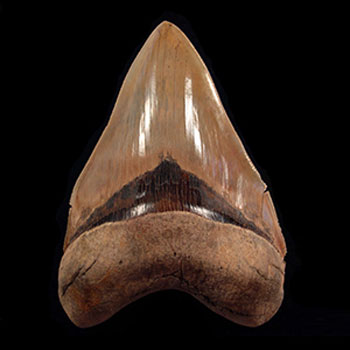
Yes, six inches is a magic number in the megalodon world. However, a tooth that reaches that length and maintains a wide crown, intact tip, and symmetry that suggests it once sat in the prime position of a predator’s jaw—now that’s rare. When the width is over four inches and the thickness makes it feel more like a small brick than a fossil, you’re looking at the kind of piece that commands top dollar and instant envy.
Serrations That Still Mean Business
The edge of a tooth tells a story. Fine, sharp serrations that are fully intact hint at a tooth that saw little wear before it was lost and buried. These details matter. If the serrations are worn down or chipped away, that tooth might still be big, but it’s lost the edge—literally and figuratively—that makes it stand out. Some of the specimens we feature come with serrations so pristine, you’ll wonder how the ocean let them go untouched.
The Bourlette: Fossil Fashion Statement
Often overlooked by casual buyers, the bourlette—the darker band between the crown and root—is a detail that seasoned collectors obsess over. A large, sharply defined bourlette gives the tooth visual contrast and adds to its desirability. When combined with vibrant, mineral-rich coloring, this feature is part of what makes our collection so eye-catching.
Color and Character
You might think color is just aesthetic, but in the world of fossil collecting, it can indicate origin, age, and mineral content. Indonesian teeth, for example, often have incredible golden, gray, or even blue-hued enamel due to the sediment they fossilized in. North Carolina’s copper-red teeth are equally iconic. The more vibrant, rare, or well-preserved the color, the more distinguished the tooth.
Our Teeth Don’t Just Speak—They Roar
Let's now discuss what makes our selection unique. We aren’t just a fossil retailer. We’re fossil curators. Each big megalodon tooth in our catalog has been hand-selected, meticulously examined, and professionally vetted. You won’t find restoration or fake polish here. You’ll find full roots, crisp serrations, wide bourlettes, and enamel so clean it looks like time forgot to touch it.
We only deal in the best of the best—authentic, natural, and often near-museum quality. These aren’t the dull, worn-down teeth you see floating around auction sites with questionable provenance. When you choose from our selection, you’re buying with confidence and clarity.
Most of our six-inch specimens come with a custom display stand and identification card, so you’ll never have to explain to guests what they’re looking at. Though once they see it, they’re definitely going to ask where you got it.
Display-Ready and Conversation-Approved
A fossil this captivating doesn’t belong in a dusty drawer or a half-lit corner. It deserves a spotlight. Owning one of these enormous teeth is about more than just prestige, regardless of whether you’re an experienced fossil hunter or a first-time buyer hoping to add something unique to your house or place of business. It has to do with presence.
People are going to ask enquiries. They will hunch over. They will ask questions such as “Where did you find that?” or “Is that real?” Knowing that the tale you’re clinging to took millions of years to come to you will make you smile.
Not Just for the Experts
You don’t have to be a paleontologist or lifelong fossil collector to appreciate a truly spectacular megalodon tooth. Many of our customers are simply people with a fascination for the ancient world, a love of natural history, or a desire to own something that genuinely feels one-of-a-kind.
That’s the beauty of these pieces. They bridge time. They capture imagination. They make ancient history personal.
So when someone asks you how much is a megalodon tooth, you’ll have more than a price—you’ll have a story. A physical remnant of an ancient marine monster. Perhaps a relic that transcended time itself, as well as empires and mountains.
What to Look for When Choosing Yours
If you’re ready to invest in a big megalodon tooth, these are the essential features you’ll want to evaluate:
● Length and Width: A true six-incher with a wide crown? That’s what legends are made of.
● Enamel Quality: Look for shine, structure, and absence of peeling.
● Root Integrity: A complete, unbroken root enhances value and visual impact.
● Serration Detail: Razor-sharp edges and intact tip serrations are ideal.
● Bourlette Condition: A well-defined, large bourlette is a bonus.
● Coloration: Rarity of color enhances both aesthetic and monetary value.
Our collection checks all these boxes—and then some.
We Know the Chase is Part of the Fun
Half the joy of owning a fossil is finding the right one. There’s a thrill in the hunt, and we’re here to make that part smooth, exciting, and transparent. We add new specimens often, including rare finds from Indonesia, Georgia, and North Carolina. Each one is photographed in high detail, described with precision, and accompanied by the background you need to make an informed choice.
When your chosen piece arrives, it’s more than a delivery—it’s the start of a lifelong fascination.
Final Thoughts Before You Take the Plunge
Holding a fossil that once sat inside the jaw of a sea monster is a unique kind of power. It makes you pause. It reminds you that we are part of a much longer story. And that maybe, just maybe, some treasures really are worth digging for.
If you’ve ever caught yourself wondering how much is a megalodon tooth, the better question might be: what is it worth to hold history in your hand? This isn’t just a fossil, it’s a conversation. A presence. A memory of something massive and untouchable that once ruled the sea. And the right big megalodon tooth doesn’t just speak for itself—it roars with prehistoric authority. Let us help you find the one that speaks to you.






