

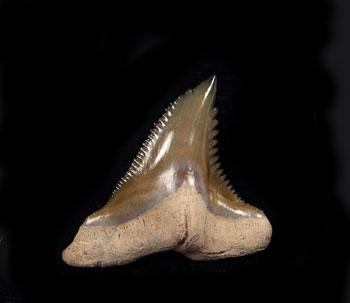
In the world of fossil collecting, few discoveries ignite excitement quite like a Hemipristis tooth. Known as the “Snaggletooth shark,” this species has left behind some of the most visually captivating and scientifically intriguing fossils found across ancient seas. From the sharp, serrated crowns to the dramatic variation in tooth positions, Hemipristis teeth embody the perfect intersection of rarity, beauty, and prehistoric power.
Fossil dealers, who evaluate specimens with both a scientific and commercial eye, hold Hemipristis teeth in particularly high regard. They know that when it comes to collector demand, these teeth check all the boxes: they’re hard to find, impressively sized, and often preserved in near-perfect condition. The result? A fossil that commands attention and drives value, unlike almost any other shark tooth.
Let’s explore why our Snaggletooth sharks (Hemipristis) are so highly sought after, breaking them down into three key elements: rarity, size, and condition.
Rarity: Scarcity Across Space and Time
The first factor fossil dealers weigh is rarity, and Hemipristis teeth stand out as scarce treasures. Unlike more common shark species such as Carcharhinus, Hemipristis is far less frequently encountered in fossil beds. This scarcity immediately raises their desirability.
Hemipristis fossils are found in select, world-renowned localities:
Bone Valley, Florida – is celebrated for its vibrant coloration and high-quality preservation.
Lee Creek, North Carolina – producing Miocene and Pliocene specimens with exceptional detail.
Sharktooth Hill, California – a Miocene hotspot known for its density of marine fossils.
South Carolina and Morocco – additional sources where Hemipristis teeth are unearthed, each offering unique coloration and context.
The age range of these fossils also adds to their mystique. Hemipristis teeth span from the Eocene through the Pliocene (roughly 56 to 2.6 million years ago). That means each specimen is not just a fossil, it’s a preserved fragment of evolutionary history, representing sharks that once dominated oceans for millions of years.
Because supply is naturally limited and collecting localities are increasingly restricted by environmental protections, Hemipristis teeth remain scarce. Dealers know this scarcity keeps demand consistently high, making them highly valuable in the fossil marketplace.
Size: Big Teeth, Big Impact
The second factor fossil dealers emphasize is size. Snaggletooth sharks, especially the extinct Hemipristis serra, were formidable predators that could grow to lengths of 6 meters. Their large size is reflected in their teeth, which often dwarf those of other species.
Teeth measuring 1.5 inches or more are considered particularly impressive, often earning “showpiece” status in collections. A Hemipristis tooth of that size is not just a fossil, it’s a statement. The large, triangular crowns with serrated edges immediately communicate the animal’s predatory power.
Size plays an important role in fossil valuation for another reason: visibility. Larger teeth are well-suited for display in cases and collections, drawing the eye with their dramatic presence. Dealers recognize this appeal, which is why they prize specimens at the upper end of the size spectrum. Simply put, bigger teeth equal bigger value.
Condition: Perfect Serrations and Striking Enamel
Perhaps the most crucial factor in determining value is condition. Hemipristis teeth are renowned for their remarkable preservation when found in the right sediments. Fossil dealers especially look for three elements:
Serrations – Hemipristis teeth are famous for their razor-sharp, saw-like serrations. When these edges remain crisp and intact after millions of years, they dramatically increase the tooth’s appeal and market value.
Enamel Quality – Smooth, glossy enamel without chips or erosion is a hallmark of a top-grade specimen. Dealers know collectors gravitate toward teeth that show little wear.
Coloration – Locality often influences coloration, with Bone Valley producing golden, black, and white contrasts, while Summerville, South Carolina, may yield lighter, sandy hues. These color variations not only enhance visual appeal but also authenticate the tooth’s origin.
A Hemipristis tooth that combines sharp serrations, unblemished enamel, and vivid coloration is the fossil dealer’s dream, rare, striking, and nearly impossible to replicate. Authenticity is always guaranteed through trusted dealers, further adding to their allure.
The Importance of Variation: Different Tooth Positions
One unique aspect that amplifies the fascination of Snaggletooth sharks is the variation in design depending on tooth position.
Upper jaw teeth – broad, triangular, and ideal for slicing through prey.
Lower jaw teeth – narrow, curved, and adapted for gripping and holding.
This variation adds educational and aesthetic value, making them even more desirable for collectors who enjoy displaying a set that demonstrates these functional differences. Fossil dealers often highlight this diversity as a selling point, knowing it elevates Hemipristis teeth above more uniform shark species.
Species Diversity: More Than One to Collect
Two known species of Hemipristis add to the intrigue for collectors and dealers alike. The most sought-after is Hemipristis serra, characterized by its large, imposing teeth from the Miocene period. Earlier species from the Eocene provide a rarer, older alternative. Together, they span millions of years of evolutionary history, offering collectors variety while maintaining a tight supply.
Dealers value this diversity because it appeals to different types of collectors: those seeking large and dramatic display pieces, as well as those seeking rarer, older species for their scientific and historical interest.
Conclusion: Why Hemipristis Teeth Reign Supreme
When fossil dealers discuss value, they repeatedly return to three critical factors, rarity, size, and condition, and Snaggletooth sharks excel in all three.
Their scarcity across specific fossil beds ensures consistent demand.
Their size commands attention and creates impactful display pieces.
Their condition, with sharp serrations and brilliant enamel, makes them unforgettable.
Add in the fascination of varying tooth positions, vibrant coloration, and authentic provenance, and you have a fossil that isn’t just a collector’s item, it’s a treasure. Dealers know it, collectors know it, and every Snaggletooth shark that surfaces on the market reinforces its reputation as one of the most desirable shark fossils ever unearthed.
For fossil enthusiasts and serious collectors alike, our Hemipristis teeth are more than just remnants of an ancient predator; they are a testament to the remarkable evolution of marine life. They are a timeless investment in natural history, proof that some sharks never stop making waves, even millions of years after their last swim.
Browse our collection of Hemipristis shark teeth and secure a piece of prehistoric power before these rare treasures disappear into private collections forever.






