

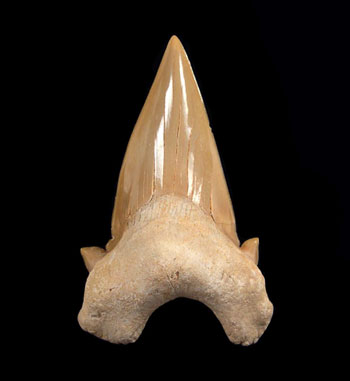
Power, elegance, and survival instincts define the great predators of Earth’s history. Among them, one shark stands as a symbol of dominance during the Early Eocene seas, Otodus obliquus. Known for its massive, triangular teeth flanked by sharp side cusps, this ancient shark was both a terror of its age and the ancestor to some of the most iconic predators that ever lived.
Collectors today prize our Otodus teeth for sale as striking fossil not just for their beauty, but for the story they tell of evolution, adaptation, and supremacy in the oceans nearly 50 million years ago.
A Predator Born for the Early Eocene
The Early Eocene epoch, roughly 50 million years ago, was a period of warmth and abundance. Seas teemed with fish, marine mammals were just beginning to diversify, and sharks were rapidly evolving into new forms. Otodus obliquus emerged during this time as one of the first great mackerel sharks. Stretching an estimated 30–40 feet in length, it ruled warm, shallow seas that covered parts of what we now call Africa, Europe, and North America.
What set this shark apart was not only its size but its specialized dentition. Its teeth, often over three inches in length, showcased broad triangular crowns and large side cusps that acted like gripping tools—perfect for seizing slippery prey. These distinctive features make the fossils instantly recognizable and highly sought after by collectors.
Anatomy of a King
Otodus teeth for sale are not subtle. They command attention with their sheer size and bold geometry. The crown is wide and sharply triangular, often reaching impressive dimensions. The roots are massive, anchoring the tooth for powerful bites. Most striking are the side cusps, sharp extensions on either side of the crown that gave the shark added efficiency in holding prey.
Some specimens even show multiple smaller cusplets, adding an extra flourish of evolutionary experimentation. Unlike the serrated teeth of later sharks, O. obliquus teeth were smooth-edged, suggesting a diet focused on large fish rather than armored prey. This design made the shark an apex hunter, perfectly adapted to its environment.
Size and Power
Estimates based on tooth size suggest that Otodus obliquus reached lengths similar to, or even exceeding, those of modern great white sharks. Some paleontologists believe it could have grown up to 12 meters (nearly 40 feet), placing it among the giants of its time. Its speed and agility would have been formidable, enabling it to pursue fast-moving prey across vast stretches of ocean.
The shark’s reign was not brief, either. Fossils spanning millions of years reveal that this species dominated the seas for an extended period before giving rise to even larger and more specialized descendants.
Evolutionary Legacy
Perhaps the most fascinating aspect of Otodus obliquus is its place in shark evolution. Paleontologists regard it as one of the earliest ancestors of the megatoothed lineage, which ultimately gave rise to the legendary Carcharocles megalodon. Transitional forms between O. obliquus and later species, such as Otodus Auriculatus, show gradual changes, particularly the development of serrations along the tooth edges.
This evolutionary progression is a story written in fossil teeth, a clear record of adaptation as sharks grew larger, stronger, and more specialized over time. Owning an Otodus obliquus tooth is like holding the opening chapter of one of prehistory’s most extraordinary sagas.
Why Collectors Prize Otodus obliquus
Not all fossils command the same respect in collections, but Otodus obliquus is universally considered a showpiece. Here’s why:
Visual Impact – The bold triangular crown and pronounced cusps make these teeth instantly eye-catching.
Accessibility – While large specimens in perfect condition are rare, smaller examples are common enough to be obtainable, allowing both new and seasoned collectors to acquire them.
Historical Significance – As the “king” of its time and a direct ancestor of megalodon, this species represents a vital link in shark evolution.
Geological Abundance – Rich fossil beds, especially in Morocco, have provided collectors worldwide with access to these remarkable teeth.
Authenticity Guaranteed – Reputable fossil dealers highlight their commitment to offering genuine, well-preserved specimens with minimal restoration.
For many enthusiasts, a collection of fossil Otodus teeth for sale feels incomplete without the commanding presence of Otodus obliquus.
Where Fossils Are Found
One of the reasons these fossils remain accessible is the abundance of deposits in North Africa, particularly Morocco. Phosphate mines in the region have yielded countless specimens, ranging from heavily worn fragments to pristine collector-quality teeth. Other finds have been discovered in the United States, Belgium, and Kazakhstan, revealing the widespread distribution of the species across the prehistoric seas.
Still, while common in number, true top-quality specimens, large, well-preserved, and minimally repaired, are much rarer. These are the treasures that fossil enthusiasts prize most.
The Collector’s Perspective
For fossil collectors, Otodus obliquus offers a unique opportunity. The teeth balance beauty, history, and attainability in a way few other fossils do. A single large specimen with sharp cusps and an intact root can serve as the centerpiece of an entire display. Smaller teeth, still striking, make excellent introductions to the world of fossil collecting.
Beyond the aesthetics, each tooth is a conversation piece—a tangible fragment of a predator that once dominated seas filled with life very different from today’s. Unlike delicate fossils that require specialized preservation, these shark teeth are hardy and enduring, a trait that mirrors the resilience of sharks themselves.
A Glimpse into Deep Time
What makes holding one of these teeth so compelling is the direct connection to a world long gone. Fifty million years separate us from Otodus obliquus, yet the evidence of its reign survives in extraordinary condition. Each tooth is a silent witness to battles fought in ancient seas, to an ecosystem where size and speed determined survival, and to the evolutionary path that eventually produced some of the most feared predators in Earth’s history.
Conclusion: A King Worth Remembering
Otodus obliquus was more than a shark, it was an evolutionary pioneer, a ruler of the Early Eocene oceans, and the forebear of giants. Otodus teeth for sale, with their striking triangular crowns and proud side cusps, embody the drama of deep time. They remind us that long before megalodon captured human imagination, there was already a shark commanding the seas with unrivaled power.
For collectors, our fossils are not just artifacts. They are statements of history, beauty, and survival. To own one is to hold a piece of prehistoric royalty, a fitting crown for any fossil collection. Don’t just admire the story of this prehistoric king, make it part of your collection today.
Explore our available Otodus obliquus teeth collection and claim your piece of Eocene history.






