

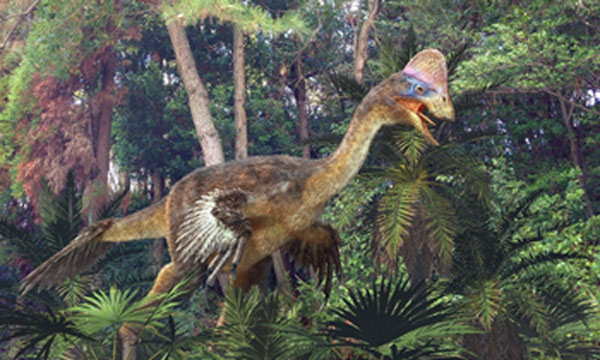
The fossil record is not silent. It speaks through texture, through shape, through absence. Among its most eloquent messengers is Anzu wyliei—an oviraptorosaur whose name echoes myth but whose presence is rooted in science. Its discovery didn’t just add another species to the Cretaceous roster. It reframed what we thought we knew.
Nicknamed the “Chicken from Hell,” this towering, feathered theropod moved with power and grace. Thirteen feet long. Six hundred pounds. Its beak was toothless, its limbs elongated, and its claws—those dramatic, crescent-shaped weapons—were both brutal and beautiful. And today, some of those very claws endure, not as relics, but as rare opportunities. You’ll find Anzu claws for sale in our collection, but they are far more than curated bone. They are artifacts of revision, moments of meaning, and physical symbols of paleontology’s evolution.
Anzu and the Allure of the Oviraptor
To appreciate Anzu is to unlearn what came before. For decades, oviraptorosaurs were labeled as thieves—egg snatchers caught red-handed near nests that weren’t theirs. That tidy villain story crumbled when new fossil evidence emerged, and among the most pivotal was Anzu.
Rather than a petty scavenger, Anzu revealed a creature of complexity. Likely a devoted guardian, not a plunderer. It wasn’t the criminal of the fossil beds—it was their misunderstood protagonist. That shift didn’t happen in a lab report alone. It happened through the tactile discovery of bones and claws, through careful fieldwork and reexamination. With Anzu, the narrative didn’t just evolve. It matured.
This redefinition matters because it mirrors something we often overlook: the way science corrects itself. To own a specimen like an Anzu claw is to hold a symbol of that progress. A physical embodiment of intellectual humility—of new evidence reshaping old ideas.
The World Anzu Inhabited
Understanding the symbolic weight of Anzu requires stepping into its world—the Hell Creek Formation, a once-lush ecosystem that blanketed parts of modern-day Montana, North Dakota, and South Dakota. Far from being a barren wasteland, Hell Creek teemed with life: towering conifers, flowering plants, and a dramatic cast of Cretaceous contemporaries.
There were tyrannosaurs, of course. Ceratopsians in herds. Hadrosaurs migrating through fern valleys. Even early mammals scuttling through the undergrowth. And among them moved Anzu—bipedal, alert, omnivorous. It likely browsed on plants, hunted small prey, and perhaps raided unguarded nests. Or it may have laid its own, circling back to defend them with those famously curved claws.
This was not a dinosaur confined to an archetype. It lived with nuance. And those claws didn’t just slash—they balanced, grasped, tested, and communicated. They were tools of a creature participating in the world with startling intelligence.
When you encounter Anzu claws for sale, you’re not just seeing a fossil isolated from its origins. You’re glimpsing a survivor of sediment and pressure, of time and chaos, from a landscape that once vibrated with life and volatility.
Why the Claws Matter
Bones that reveal a creature’s identity are not the same as those that reveal how it moved, hunted, or survived. The latter is where Anzu’s claws fall. These are more than just evolutionary decorations. They are tools of interaction—items that suggest precise foraging, nesting behaviour, or protection from the harsh late Cretaceous habitats.
In particular, the manus claws are impressive. They have a maintained curvature that suggests time-frozen motion. They were intended for communal signalling, foraging among forest litter, or grasping—possibly even cradling—eggs. We are giving more than just fossils when we put Anzu claws up for sale. We are offering pieces of intent—anatomical knowledge.
Some collectors are drawn to the aesthetics—the sharp arc, the textured patina, the raw form that tells its own story even without words. Others are compelled by the science—the anatomical details that link this creature to birds, to behavioral studies, to evolutionary timelines. Either way, there’s power in holding something that once shaped the survival of a living thing.
Sourcing and Preservation—No Compromises
A fossil’s story is incomplete if its origin is unclear. That’s why every specimen we share has a provenance rooted in transparency. Legally excavated from private lands in regions like Montana and the Dakotas, each Anzu claw undergoes thorough evaluation and, when necessary, careful restoration.
We restore cautiously, never sacrificing the original structure or patina, where erosion has taken its toll, usually at the tips. Our aim is to respect what the earth has kept, not to perfect fossils. This degree of attention to detail is what distinguishes a cornerstone specimen from a collectible. A claw bears its age and authenticity when it joins your collection.
The fossil trade, when done ethically, allows for stewardship—not exploitation—of rare material. Every claw we place into a collection is documented, verified, and treated as the scientific and cultural object it is. We don’t traffic in novelties. We handle narratives.
That’s part of why our Anzu claws for sale stand apart. They’re not just catalog entries. They are verified ambassadors of a vanished world.
The Collector’s Role in Deep Time
People collect fossils for many reasons—some personal, some professional, some poetic. There’s the thrill of owning something ancient, yes. But deeper than that is the quiet reverence many feel when placing a claw, a tooth, or a bone into their hands.
It’s an instinctual connection to deep time. A reminder that we, too, are part of a larger story. That the earth was once ruled by creatures so strange, so majestic, that holding a single claw feels like gripping the edge of a dream.
For scholars, it becomes part of research. For curators, a gateway to public engagement. And for collectors, it’s often a love letter to childhood awe—the kind ignited by field trips, museums, or that first dusty fossil found in a gravel bed.
Whatever the reason, the result is the same: a relationship with prehistory that feels intensely personal.
An Object That Asks Questions
There are fossils you place on a shelf and admire in passing. Then there are fossils that ask you to stop. To wonder. An Anzu claw belongs to the latter.
Its form commands attention, but its meaning invites dialogue. You might be a curator shaping an exhibit, a professor teaching evolutionary nuance, or a collector seeking that one piece that makes the rest feel complete. Whatever your lens, the claw holds its own as a conversation piece. Its presence is as intellectual as it is physical.
That’s why collectors return to our offerings. They’re not searching for more objects. They’re searching for resonance. And that’s exactly what our Anzu claws for sale are curated to deliver.
We Sell Significance, Not Just Fossils
To hold a claw from Anzu wyliei is to touch a question answered. It is a counterpoint to past assumptions, a fragment of clarity that survived extinction and time. And in the presence of such a piece, one doesn’t merely admire. One contemplates.
When you browse our catalog and see Anzu claws for sale, you are not selecting a fossil in the traditional sense. You are choosing a threshold between myth and evidence. A segment of deep time, sealed in sediment, now set into your hands. That is what we offer—not just objects, but access. Not merchandise, but memory.
We don’t sell fossils. We offer significance.
To become the next custodian of an Anzu claw is not merely to acquire—it is to listen. To recognize that the past doesn’t stay buried. It lives in texture, in weight, in curvature. It lives in fossils that were never meant to be forgotten.
Let the next chapter of Anzu’s story begin with you.






