

At our fossil collection, we proudly offer specimens that connect people to ancient history. Among the fossilized treasures we provide, none receives as much admiration as the Megalodon teeth discovered in Chile.
We take pride in presenting these remarkable pieces that have fascinated collectors worldwide. With their earthy coloration, impressive preservation, and the rare conditions of their origin, each Chile Megalodon tooth we offer holds a natural beauty that continues to leave a lasting impression.
An Earthy Spectrum of Color
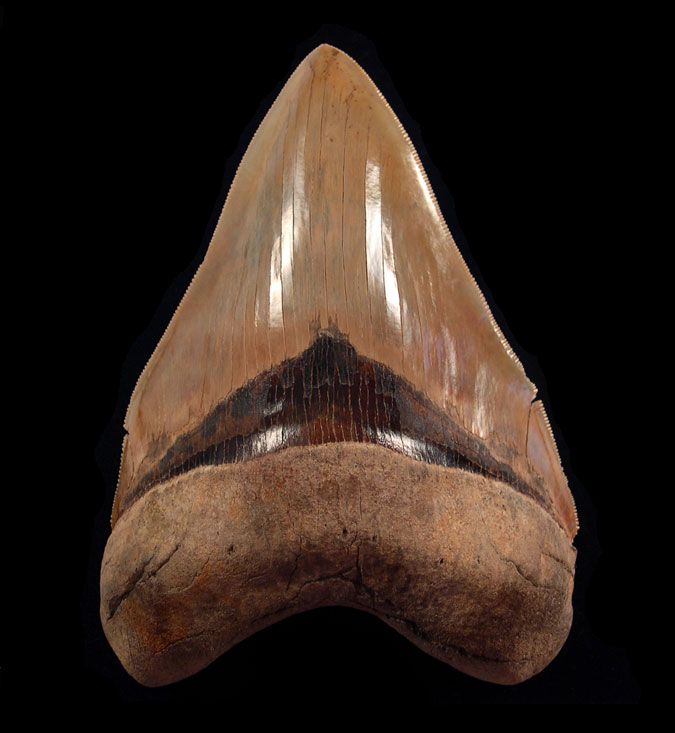
The coloration of Chilean Megalodon teeth can often distinguish them from others. Where many fossilized shark teeth tend to appear in muted grays or faded browns, Chilean examples frequently show an attractive mix of light tan, brown, and reddish hues. These tones are not added or altered — they are the result of mineral content present during fossilization within the Bahia Inglesa Formation.
For example, one tooth is described as having a “gorgeous light tan colored crown with no enamel peel.” Its bourlette is a deep, rich brown and nearly complete. The root is said to have an “excellent red-brown color” with clearly defined articulation and is “100% complete.” These contrasting tones between crown, bourlette, and root create a naturally layered appearance that enhances visual appeal.
These colors were formed as minerals gradually replaced organic material over time. In this Chilean region, fossilization happened under ideal conditions, allowing the teeth to retain their vivid, earthy tones.
Preserved by Time and Earth
These teeth are found in the Bahia Inglesa Formation along the coast of northern Chile. This geologic region dates back roughly 4 to 6 million years, spanning the upper Miocene to early Pliocene era. At the time, the area was covered by shallow seas where the Megalodon once thrived. As the sea eventually receded, the remains of marine life became embedded in land-based sediment.
Unlike underwater environments that can erode or damage fossils, this dry landscape helped protect the structure and appearance of these teeth. As a result, teeth from this formation often retain their complete crowns, roots, and serrations.
One tooth is described as having “razor-sharp serrations,” “no repair or restoration,” and being “100% complete.” This level of preservation is not commonly found in fossils of similar age and size. The exceptional condition of these specimens contributes significantly to their continued appeal.
Each Chile Megalodon tooth highlighted from this region shows how geological history, sediment quality, and stable environmental conditions work together to protect these ancient remains.
No Longer Sourced from the Wild
Teeth from this region are no longer being collected. The Caldera phosphate mining area in northern Chile, once a productive fossil site, was closed to fossil extraction in 2006. The entire fossil zone is now protected, and collection is no longer permitted. This change means that all Chilean Megalodon teeth available today come from private collections made before the restriction.
As a result, availability has declined. New discoveries cannot be added to the market, and the existing supply continues to shrink. Collectors and enthusiasts recognize the rarity of these fossils, which adds to their significance. The closure of the site gives each tooth a distinct backstory — a relic of a place that can no longer yield its secrets.
A Place in Collections
Collectors appreciate fossils that combine visual appeal with structural integrity. Chilean Megalodon teeth offer both. Their naturally vibrant color, intact crowns and roots, and clearly visible serrations make them substantial additions to fossil collections.
Some examples feature color contrasts between the light tan crown and the dark brown bourlette. Others display a deep red-brown hue across the entire tooth. Enamel is often described as “high quality,” with gloss and texture still visible after millions of years underground.
These qualities allow the teeth to serve not only as fossils but also as striking display pieces. Whether in a glass case or mounted in a study, a well-preserved tooth from Chile draws attention and admiration. The presence of natural beauty combined with historical importance helps elevate these specimens within any collection.
Time, Sediment, and Stability
The preservation seen in these fossils is not accidental. Over millions of years, specific environmental conditions allowed these teeth to remain intact. Minerals within the Bahia Inglesa Formation gradually replaced organic material in the teeth, helping them maintain their original form. Because the region remained undisturbed by water flow or other pressures, the teeth retained their edges, enamel, and color.
Structural features like serrations remain visible, offering insight into how these massive sharks once fed. Crowns remain strong, roots are full, and the bourlette often stays clearly defined. These elements, when combined, help tell the whole story of how the teeth once functioned and how nature protected them after the Megalodon’s extinction.
A Fossil with History
Each Chilean Megalodon tooth is a product of place and time. Unlike some collectible items that can be produced or replicated, these teeth are naturally formed and historically specific. Once removed from their sediment layers, they become permanent artifacts of a prehistoric world.
With no more specimens being unearthed from the region, the value of existing teeth is tied not only to appearance and condition but also to their connection to a protected environment. Their story is complete, sealed within the fossil’s form, color, and composition.
These specimens are now found only in fossil collections, museum holdings, or educational institutions. Each one reflects the journey of a marine predator, the quiet of millions of years underground, and the fortune of careful recovery before the site became inaccessible.
Conclusion
Chilean Megalodon teeth are recognized for their rich coloration, excellent preservation, and limited availability. Their light tan crowns, deep brown bourlettes, and strong root structures are shaped by mineral-rich sediments and time.
With the closure of the Caldera fossil site, each example on the market today becomes more valued for both what it shows and what it represents. A Chile Megalodon tooth offers a connection to a prehistoric world and remains one of the most visually compelling fossil specimens available.






