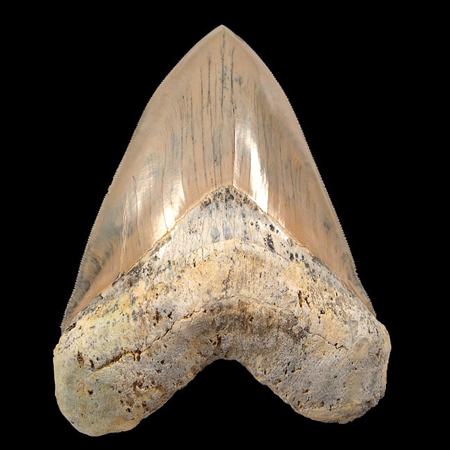
When we encounter a Megalodon tooth, it immediately draws us into the mystery of prehistory. Our fascination grows as we try to imagine the size of the shark that carried such a massive structure. We are compelled to ask how much this Megalodon tooth of 7 inches can reveal about the anatomy and overall scale of a species that once ruled the seas.
While the impressive size of the specimen does provide some important insights, it also leaves researchers with unanswered questions. Variability, estimation methods, missing data, and uncertainties all shape how this discovery is understood.
What a 7-Inch Tooth Can Indicate
Most Megalodon teeth that have been found measure between 3 and 5 inches. A 7-inch tooth can be seen as rare and extraordinary. That rarity is why it tends to receive significant attention when it is discovered or made available for study. Its size clearly highlights the fact that Megalodon could grow into an apex predator with enormous strength.
Preservation and wear patterns
The enamel, serrations, and surface details on this kind of specimen can show how effective these teeth were in feeding. Serrated edges were built for tearing flesh, while wear patterns may record the physical demands of hunting in prehistoric oceans. Imperfections and surface marks can also provide information on prey interaction and the forces each bite had to withstand.
Hints about body size
The source points out that a tooth of this size does offer a hint about overall body length, with some estimates suggesting that Megalodon may have reached around 60 feet. Larger teeth often correspond to larger sharks, so the presence of a specimen measuring 7 inches supports the idea of extraordinary size. Still, the description as a “hint” reminds us that such evidence is suggestive rather than definitive.
What the Tooth Leaves Unanswered
Not all teeth from one shark would have been identical in size. Dimensions varied depending on where each tooth was located in the jaw. Without knowing where this 7-inch tooth originated, it is difficult to match it precisely to the total body length. A front tooth could measure differently from one positioned along the sides, so the same jaw could have contained teeth of several different sizes.
Differences among individuals
Factors such as age, nutrition, and environmental conditions could have created significant variation among Megalodons. A 7-inch tooth may reflect an older or tremendous individual. It could also represent an upper-range example within normal variation. Without a complete skeleton, the extent of this variation cannot be measured with certainty.
Limitations of estimation methods
The 60-foot length often associated with Megalodon is produced by applying formulas that relate tooth size to body size. Those formulas are based on modern sharks, but living species do not perfectly represent the proportions of Megalodon. Every method is shaped by assumptions about scaling that may or may not hold true for this prehistoric shark. As a result, estimates remain plausible but uncertain.
Gaps in the fossil record
Fossils survive in uneven ways. Geological conditions determine whether a tooth remains intact or disappears over time. Huge teeth are rare, which means the dataset of 7-inch specimens is extremely limited. A lack of evidence does not prove larger teeth never existed, yet the scarcity of giant examples restricts what can be concluded. Preservation bias leaves gaps that science may never fully fill.
Uncertainty in body proportions
Tooth size is a single measurement, and it does not capture the whole body. Proportions, cartilage structures, and growth patterns are largely unknown because they do not fossilize well. Reconstructing an entire shark from one tooth assumes that Megalodon shared proportional rules with modern sharks. Those assumptions are necessary for estimation but are also a source of error.
The Questions That Remain
Even with a rare specimen such as a 7 Megalodon tooth, significant questions remain open:
● What was the absolute maximum size that Megalodon could reach?
● Was a 7-inch tooth representative of typical adults, or did it reflect exceptional individuals?
● Did certain regions or populations produce sharks that grew larger due to environmental differences?
● How accurate are the formulas that link tooth size to total length?
These questions show that one large tooth, while impressive, cannot settle the debate.
Why the Uncertainty Matters
Estimating size does more than satisfy curiosity. It plays a role in shaping how we understand Megalodon’s behavior, its feeding needs, and its position in ancient marine ecosystems. Overestimates might exaggerate its role, while underestimates could diminish it. Balanced interpretations depend on acknowledging what is known and what remains uncertain. A 7-inch tooth delivers valuable information, but it also highlights the limits of inference.
The significance of this uncertainty extends into how reconstructions are presented to the public. Museum exhibits, documentaries, and educational resources often need to simplify numbers for clarity. Yet behind every simple figure is a wide range of possibilities. By recognizing the uncertainty in estimates, researchers can present a more accurate picture of how science works. It is less about providing one fixed answer and more about showing the range of outcomes that evidence allows.
The Dual Role of the 7-Inch Tooth
This specimen can be seen as both a key and a puzzle piece. It confirms that Megalodon produced huge teeth with structural designs suited to tearing apart prey. It also provides physical evidence strong enough to survive for millions of years. At the same time, it shows the challenge of drawing conclusions from incomplete remains. A single tooth inspires awe, but it cannot tell the whole story on its own.
Closing Reflection
The 7 Megalodon tooth is a discovery that excites interest not only for its rarity but also for the mysteries it carries. It represents the power of a predator long extinct and the limitations of fossil evidence. Variability, estimation methods, missing data, and uncertainties ensure that each new find brings both knowledge and questions.
In the end, the tooth shows how fragments from the past can connect us to a time when giants ruled the oceans, while still keeping their ultimate size hidden in mystery. Every specimen adds to the narrative, reminding us that science is constantly working with pieces, not complete pictures. The 7-inch tooth is an extraordinary piece, but the full scale of Megalodon continues to remain out of reach. The story of this predator is one of both evidence and absence, where every discovery is meaningful, but every gap keeps the mystery alive. For that reason, each new fossil should be appreciated as part of an ongoing process of piecing together the life of one of the ocean’s greatest predators.