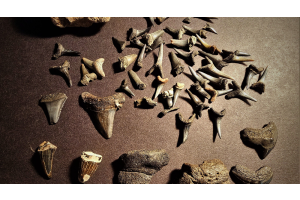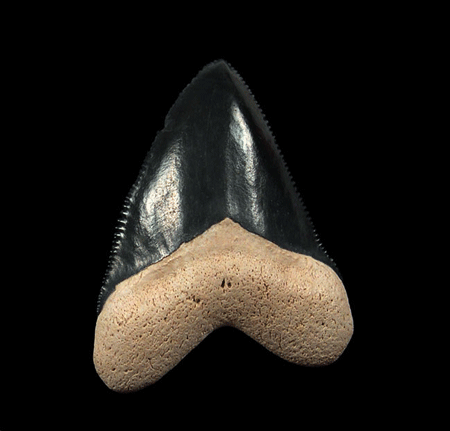
At our organization, we take pride in helping others explore the fascinating world of ancient marine predators. When we examine the anatomy of baby megalodon teeth compared with adults, we can see how these massive sharks developed across their lifespan.
By studying the differences in serrations, enamel quality, size, and robustness, we allow ourselves to uncover the remarkable ways in which their teeth adapted for survival. This exploration of baby megalodon tooth size helps us appreciate the growth process from juvenile to adult.
Small but Mighty
Baby megalodon teeth are described as much smaller than adult specimens, which could reach an astonishing seven inches in length. Even though they were reduced in scale, these early teeth still stood out compared with the teeth of other marine animals of the same era.
Their smaller size influenced other features, including enamel coverage and crown strength, but they were by no means weak. These early structures provided the foundation for the growth that would follow. Juveniles relied on them for adequate feeding, showing that size alone did not determine functionality.
Serrations from the Start
One of the most defining features of megalodon teeth is the serrated edge, and this trait was present from the very beginning. Baby teeth already carried these sharp ridges, which were essential for slicing and tearing prey.
This detail shows that even young megalodons had feeding strategies in place, relying on teeth designed for cutting through flesh. Although the source does not explain whether serrations became sharper or more widely spaced with age, the presence of these edges in both young and adult specimens demonstrates their importance in hunting.
Strength in Structure
Another key point lies in the robustness of the teeth. Baby megalodon teeth may have been smaller, but their enamel was already durable and strong. This resilience suggests that they were capable of withstanding the pressures of feeding and the demands of their environment. While adult teeth were naturally thicker and heavier, the smaller version was still fully functional.
The difference here was one of scale, not function, as both baby and adult teeth were reliable tools for survival. In fact, the durability of these early teeth reinforces how evolution provided young sharks with adequate resources right from the start.
Anchored for Growth
Every tooth relies on a stable root to remain effective, and baby megalodon teeth were no exception. Their roots were strong enough to anchor the crown, allowing the tooth to perform its role. The article mentions that these teeth contained growth rings, similar to those in tree trunks, which reveal age and development patterns.
Although the exact ratio of root to crown is not detailed, it is clear that the balance was sufficient to support the shark at its juvenile stage. In adulthood, larger crowns would have been supported by even stronger roots, reinforcing the same principle on a larger scale.
Enamel Built for Survival
Enamel is the shield of a tooth, and even baby megalodon teeth carried this protective layer in impressive quality. Their enamel was described as strong and textured, providing both durability and the cutting power that serrations required. This detail demonstrates that juveniles were not passive creatures but active hunters capable of sustaining themselves.
As the shark matured, enamel layers would have become thicker to support larger crowns and more formidable feeding challenges, but the underlying strength was already in place from the very beginning.
Rings That Tell a Story
Perhaps one of the most fascinating discoveries in baby teeth is the presence of growth rings. Much like the rings in a tree trunk, these lines provide a timeline of development. They allow scientists to estimate age and track how quickly a juvenile may have grown.
These markers also offer clues about diet and environmental conditions, creating a record of life stages that helps explain how a small predator grew into the largest shark to have ever lived. This makes the baby megalodon tooth size an essential detail in reconstructing growth patterns.
What Remains Unknown
While the article provides valuable insights, specific details are not specified. For example, the exact spacing or sharpness of serrations is not compared between juveniles and adults. Similarly, enamel thickness is not measured, nor are root-to-crown ratios provided.
These missing details mean that our understanding is still developing, and there is room for further exploration of these differences. Ongoing fossil studies may provide more precise answers, giving researchers the chance to refine what is currently known.
A Tale of Two Life Stages
In summary, baby megalodon teeth can be viewed as smaller versions of adult teeth, already equipped with the serrations, enamel strength, and structural robustness that defined the species. Adult teeth took these features and amplified them, growing larger and more powerful to handle massive prey.
What remains constant across both stages is the functional design, which was efficient enough to support survival throughout the shark’s life cycle. These similarities show that evolution did not need to redesign the structure as the shark grew; scaling up was enough to ensure dominance.
Why It Matters
Understanding these differences allows us to piece together the life history of megalodons. Baby teeth show that feeding strategies were already established at an early stage, while adult teeth reflect the expanded power needed for large-scale predation. Growth rings provide evidence of how quickly these sharks developed, while enamel and serrations demonstrate how nature equipped them for survival.
Together, these insights create a fuller picture of how one of history’s most formidable predators evolved from its smallest form into an ocean giant.
Final Thoughts
Baby megalodon teeth may not match the impressive size of adult specimens, but they hold equal importance in understanding the story of this shark’s life. Their serrations, strong enamel, and growth markers reveal that the foundations for predation and survival were already present at birth.
As the shark grew, those same features scaled up, culminating in the massive teeth that continue to fascinate scientists and collectors today. By comparing baby and adult specimens, we can better appreciate how baby megalodon tooth size connects early development with the power of adulthood, revealing continuity across every life stage.