

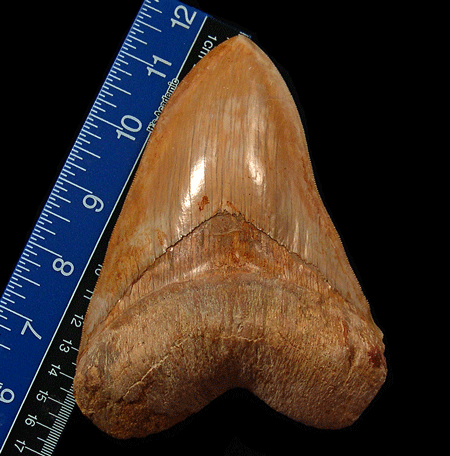
When we study the ancient oceans, we often rely on fossils that allow us to step back in time and explore the lives of creatures long extinct. Among the most fascinating of these remains are the massive teeth of the Megalodon. These fossils give us a chance to analyze predator-prey dynamics, marine balance, and extinction events in remarkable detail. By carefully measuring megalodon tooth size, we are able to provide insights that help us reconstruct how prehistoric marine ecosystems actually worked.
The Magnitude of Megalodon Teeth
Megalodon teeth could range from about seven centimeters in juveniles to eighteen centimeters or more in adults. These measurements are not only records of growth but also important indicators of feeding strategies and ecological roles. A smaller tooth can be linked to juveniles restricted to hunting smaller prey, while the most prominent teeth represent adults that were able to dominate the upper levels of the food chain.
When we measure teeth accurately, we can begin to identify growth stages, feeding capacity, and the ecological impact of individuals at different life stages. Without precise numbers, interpretations about Megalodon’s role in marine ecosystems would remain incomplete, limiting our ability to understand how these predators truly shaped their environment.
Predator-Prey Relationships
Predators are typically tied to prey that match their size and strength, and Megalodon was no exception. Smaller individuals, with teeth around seven centimeters, would have been feeding on fish or smaller marine animals, while adults with eighteen-centimeter teeth were able to target whales and other massive creatures. This scaling effect highlights why accurate megalodon tooth size is so significant. By knowing the size distribution of teeth in the fossil record, we are able to estimate how Megalodon populations interacted with prey.
A population rich in large teeth suggests dominance over large prey species, while an abundance of smaller teeth may point to nursery areas where juveniles remained in shallower waters. These distinctions reveal how the predator’s size dictated feeding strategies and shaped broader marine ecosystems.
Ecological Impact on Marine Life
The presence of Megalodon influenced marine life in profound ways. With jaws capable of producing enormous bite forces, adult Megalodons had the power to regulate populations of large prey species. Marine mammals may have developed migration patterns or defensive grouping behaviors in response to this constant predatory pressure.
Smaller predators within the same ecosystem would have had to adapt as well. Competing with a predator of Megalodon’s size likely forced other hunters to adjust their diets or move into alternative habitats. Accurate measurement of tooth size allows us to trace these adaptations, showing how top predators maintained balance and shaped the very structure of their food webs.
Tracing Extinction Dynamics
Extinction is rarely sudden; it is often the result of gradual shifts that erode a species’ survival over time. Tooth size distribution offers a valuable perspective on how Megalodon populations may have changed during their decline. A reduction in the number of larger teeth could point to adult sharks struggling with food scarcity, while an increase in smaller teeth might indicate that juveniles were unable to reach maturity.
These fossil patterns become critical in reconstructing the timeline of extinction. By tracking how tooth size varied, we are able to connect Megalodon’s decline to environmental changes, prey shortages, or broader transformations within the oceans. Tooth size, therefore, provides more than a measure of physical growth; it becomes evidence of ecological stress and eventual collapse.
Why Accuracy Matters
General estimates are not enough when attempting to reconstruct entire ecosystems. Every centimeter of tooth size matters because it directly influences conclusions about body length, hunting capacity, and ecological dominance. Tooth size is tied to body length, which means any error in measurement can lead to miscalculations in overall mass and predatory influence. Consistent measurements also make it possible to compare fossils from different sites or time periods with reliability.
Accuracy is critical when separating juveniles from adults, as thresholds in tooth size define life stages. Confusing these categories leads to flawed reconstructions of population structures. Similarly, ecological models that simulate energy flow and food webs depend on exact data. Inaccurate inputs would weaken these simulations, reducing their usefulness for understanding prehistoric marine life.
The Significance of the 7 cm to 18 cm Range
The known range of seven to eighteen centimeters in tooth size represents more than simple growth. A seven-centimeter tooth points to a juvenile feeding on smaller prey, while an eighteen-centimeter specimen shows the scale of an apex predator dominating the ocean. Fossil collections that contain primarily small teeth may indicate nursery areas, while sites dominated by larger specimens suggest adult habitats in deeper or open ocean waters.
This range helps scientists divide population structures and study habitat use. It also reveals how different life stages of Megalodon interacted with ecosystems in distinct ways. Without accurate measurements, these patterns would remain hidden, and our understanding of the species’ ecological influence would be incomplete.
Reconstructing Prehistoric Marine Ecosystems
Accurate measurements of Megalodon teeth allow researchers to reconstruct how ancient oceans functioned. Tooth size provides direct insight into food web design, as predator size determines prey options. It also indicates the carrying capacity of ecosystems by showing how many large predators could be supported by available prey.
Tooth size can reveal habitat differences, with juveniles likely concentrated in certain protective areas while adults roam more expansive hunting grounds. Shifts in average size through time can also highlight environmental stresses or changes in prey abundance. Each tooth measured and analyzed becomes more than a fossil; it becomes a crucial piece of evidence in rebuilding the living systems of the prehistoric seas.
Conclusion
Megalodon teeth are extraordinary fossils, and their size carries vital meaning. Accurate measurement allows us to interpret predator-prey dynamics, evaluate the ecological influence of apex predators, and trace the path toward extinction. From seven-centimeter teeth of juveniles to eighteen-centimeter giants of full-grown adults, each specimen strengthens reconstructions of prehistoric marine environments.
As paleontologist Henry Gee once noted, “Fossils are not only evidence of what once lived, they are also signposts to the worlds that those creatures created.” By measuring megalodon tooth size with precision, we are able to transform these fossils into clear signposts that guide us toward a deeper understanding of how ancient oceans operated and how the balance of life rose and fell millions of years ago.






