

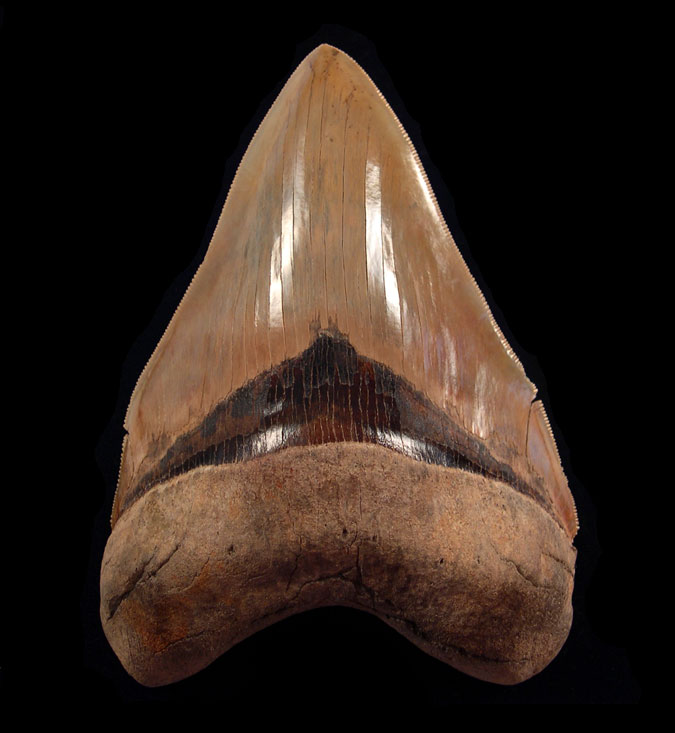
The largest sharks to have ever lived continue to fascinate paleontologists, museum-goers, and fossil collectors alike. Their legacy is carried not in full skeletons but in the massive fossilized teeth that survived for millions of years. A 6 to 7-inch megalodon tooth, when held in the palm of your hand, is more than a relic of the past—it is living proof that this prehistoric shark dominated ancient oceans in ways no other predator could. At Buried Treasure Fossils, we study and share these remarkable specimens not only as collectibles but also as windows into Earth’s deep history.
The Extraordinary Size of Megalodon Teeth
The first striking detail about megalodon fossils is the size of their teeth. While most sharks alive today have teeth measuring only a few inches, the megalodon’s teeth could exceed seven inches. Finding a complete tooth above six inches is exceptionally rare, which makes each specimen highly prized. These fossils are triangular, broad, and serrated—perfectly engineered for tearing through flesh and bone. The scale of these teeth, especially those in the 6 to 7-inch megalodon tooth category, indicates that the animal itself must have been a true giant. Scientific reconstructions estimate that megalodons reached lengths of 50 to 60 feet, more than three times larger than the modern great white shark.
Bite Force Beyond Imagination
Tooth size alone hints at the megalodon’s immense power, but scientists have taken their analysis a step further by calculating its astonishing bite force. By examining the thickness and surface area of fossilized teeth, alongside advanced jaw reconstruction models, they estimate that the megalodon’s bite could reach up to a staggering 180,000 newtons. To truly grasp the magnitude of this force, consider that it far surpasses the strongest bite recorded in modern crocodiles and is vastly more powerful than any terrestrial predator known to science. This bone-crushing ability could shatter bones and penetrate the toughest hides, solidifying the megalodon’s status as the ultimate apex predator of its time.
Diet: Rulers of the Marine Mammal World
The serrated edges of a megalodon tooth provide compelling insights into its formidable feeding habits. These teeth were expertly designed to slice through the flesh of colossal marine mammals, such as whales and dolphins, that roamed the oceans during the Miocene and Pliocene epochs. Fossil evidence reinforces this theory, revealing whale bones adorned with deep bite marks that perfectly match the size and shape of megalodon teeth. While smaller sharks and large fish may have occasionally made their way onto the menu, it was the massive prey that adult megalodons predominantly targeted, solidifying their status as the indisputable apex predator of their ecosystem.
Comparing Megalodon With Modern Sharks
To better appreciate its dominance, it helps to compare megalodon with today’s most iconic shark—the great white. Great whites typically grow to around 15–20 feet, with the largest approaching 23 feet. Their teeth rarely exceed 3 inches. By contrast, the megalodon dwarfed them in every dimension: body size, tooth length, and bite power. While modern sharks are impressive hunters, they lack the overwhelming scale and ecological authority that megalodon wielded effortlessly.
The Role of Tooth Structure in Apex Predation
Beyond size, the structure of the megalodon’s teeth points to evolutionary refinement. Their triangular crown shape provided maximum penetration, while serrations acted like built-in saws for cutting through flesh. The robust roots anchored the teeth firmly in massive jaws. This dental architecture allowed megalodons to attack swiftly and efficiently, minimizing struggle with prey that often weighed several tons. Every aspect of these teeth tells the story of a hunter built for supremacy.
Rarity and Scientific Value of Large Teeth
Although countless megalodon teeth have been unearthed worldwide—from North America to Morocco—specimens exceeding six inches are exceptional. That rarity increases their scientific and collector value. In museums, a large tooth immediately captures attention, serving as both a teaching tool and a centerpiece display. For researchers, teeth of this size provide critical data points for estimating maximum body length, ecological dominance, and geographic distribution of the species.
Fossil Insights From Buried Treasure Fossils
At Buried Treasure Fossils, we have carefully curated a wide selection of authentic megalodon teeth, including rare specimens measuring over six inches. Each tooth is examined for authenticity, quality, and historical context. We provide detailed descriptions about enamel preservation, serration sharpness, and coloration, which vary depending on the geological conditions of where the tooth was found. Some of our specimens come with unique hues—blues, grays, and blacks—that reflect millions of years of mineralization. Collectors and educators alike can appreciate not only their beauty but also their role in understanding prehistoric ecosystems.
Why These Teeth Inspire Awe in Collectors and Learners
Holding a megalodon tooth in your hand is unlike handling any other fossil. Its sheer weight and size spark an immediate connection to the ancient oceans. For collectors, the thrill lies in owning a piece of natural history that represents one of evolution’s most formidable predators. For educators and museum-goers, it is an opportunity to bridge curiosity with science, turning abstract numbers—such as 60-foot body length or 180,000 newtons of bite force—into something tangible. The 6 to 7 inch megalodon tooth is not merely a fossil; it is a conversation starter, a teaching instrument, and a relic of a vanished world.
Authenticity and Collecting With Confidence
One of the challenges in fossil collecting is ensuring authenticity. At Buried Treasure Fossils, we emphasize transparency and quality. Unlike some sources where heavily restored or repaired specimens may be presented without disclosure, we guarantee that our teeth are authentic and accurately described. Our six-inch-plus collection represents some of the best-preserved fossils available, with full roots, sharp serrations, and intact enamel. Many of these rare finds even come with custom stands, making them ideal for display in personal collections, classrooms, or museum exhibits.
Megalodon’s Place in Prehistoric Ecosystems
Beyond its sheer physical power, megalodon played a vital ecological role. As the apex predator, it kept populations of large marine mammals in check, influencing the balance of entire ocean ecosystems. Its extinction, likely linked to climate change and declining prey availability, reshaped marine life, paving the way for modern whales and sharks to flourish. By studying these fossils today, we gain insight not only into one extraordinary species but also into how ecosystems evolve when apex predators disappear.
Conclusion: A Fossil That Speaks of Power and Legacy
A 6 to 7-inch megalodon tooth is more than a collector’s prize—it is proof of an apex predator that once ruled Earth’s oceans. Its size testifies to a shark that reached lengths of 60 feet, its serrated edges reveal a diet of whales and massive marine mammals, and its thickness hints at a bite force unrivaled in the animal kingdom. For academic readers, museum-goers, and STEM educators, these fossils provide an unmatched opportunity to study evolution, extinction, and predator-prey dynamics in prehistoric seas.
At Buried Treasure Fossils, we are proud to share these rare specimens with collectors and learners around the world. Each tooth connects us to the awe-inspiring story of Earth’s deep past. If you’ve ever wanted to hold a piece of natural history in your hand—or inspire others with a fossil that demonstrates true prehistoric power—our collection offers that chance.






