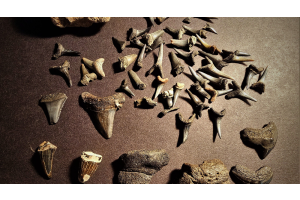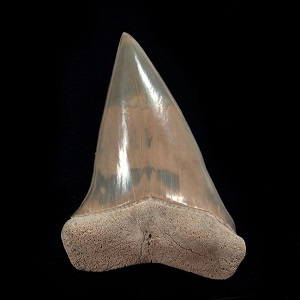
At our fossil collections, we have the opportunity to study and present specimens that continue to shape scientific understanding of history’s largest shark. Ancient oceans once carried the shadow of a predator so immense that its memory can still be seen through fossil remains. The evidence lies in its teeth, preserved across sediments worldwide. Each tooth can act as a window into the scale of this giant shark.
Measurements of length, width, and thickness are used to connect directly to reconstructions of body mass, total length, and jaw strength. When huge specimens are found, such as the biggest megalodon tooth, they must be factored into models, and this process allows reconstructions to be recalibrated, reshaping how the species is understood.
Teeth as Direct Clues to Body Size
Teeth can provide the most reliable pathway to understanding scale. Paleontologists are able to measure crown height and slant height to create formulas that estimate overall length. A tooth measuring five inches may be linked to a shark exceeding forty feet, while a six-inch specimen could point toward a creature closer to fifty-five feet. The slant height, traced along the outer curve from the crown tip to the root, has become the most critical measurement.
Some specimens do surpass earlier expectations. A fossilized tooth measuring 7.48 inches may have belonged to a shark that stretched more than sixty feet. A commonly applied guideline has suggested that every inch of tooth corresponds to about ten feet of body length, so a 6.5-inch specimen could imply a shark close to sixty-five feet in size. Position within the jaw may complicate calculations, since front teeth are usually larger than those set along the sides, yet even with such variation, the presence of massive examples forces perception of overall limits to shift.
This method of analysis also shows how a single fossil can influence broader discussions about prehistoric life. A smaller tooth will confirm existing averages, but an oversized tooth immediately demands explanation and prompts fresh studies. Every fossil, therefore, has a role to play, whether in reinforcing earlier conclusions or in challenging them.
Why Larger Teeth Transform Reconstructions
The discovery of a giant specimen does carry broad implications. A Chilean tooth, preserved with flawless enamel, intact serrations, and an unbroken root, has been used to suggest an individual far larger than what earlier models envisioned. Estimates place its owner at over sixty-five feet in length. Such evidence does redefine upper boundaries of growth and indicates that past reconstructions may have underestimated this shark’s dominance.
Earlier models relied on specimens measuring between four and six inches. These created an impression of a predator immense by any standard but not exceeding a particular range. The Chile specimen does shift that boundary, pointing toward even greater hunting demands and ecological influence. Fossils from regions such as West Java have also shown that growth might have varied depending on local environmental conditions.
Interpretation can still invite debate. A large tooth may reflect an older individual, a difference in jaw placement, or sexual dimorphism rather than an average for the species. Even so, the presence of oversized fossils, including the biggest megalodon tooth specimens known, continues to push researchers toward reassessment of growth capacity and ecological power.
What makes such discoveries so important is that they are not isolated. Each time a new large specimen is recovered, it joins the global fossil record and adds to the dataset used for modeling. Over time, the accumulation of evidence has created a clearer picture of Megalodon’s range, feeding behavior, and overall size limits.
From Great White Comparisons to Advanced Models
Early efforts to reconstruct this shark were built on comparisons with the great white. Scientists would extend ratios between tooth size and body length from living sharks to the extinct giant. While this offered a foundation, it risked underestimating extremes. The fossil record has eventually encouraged the use of more detailed regression models that take into account multiple measurements such as crown length, root width, and tooth thickness.
Accurate results do depend on careful measuring practices. Clean specimens allow calipers to be applied across slant height, crown width, and root spread. Documentation of location, geological context, and age must also be recorded to ensure comparisons remain meaningful. As methods continue to evolve, technologies such as CT scans and 3D modeling can capture fine detail, helping scientists reconstruct bite mechanics and replacement cycles within jaws.
This progression of techniques demonstrates how scientific reconstructions can improve with every decade. Where older models gave a broad picture, newer approaches bring sharper detail. The combination of traditional measurements with advanced imaging allows reconstructions to move closer to the realities of prehistoric oceans.
The Role of Variation and Fossil Collections
Variation among teeth broadens the understanding of how this shark lived. Collections from different parts of the world have revealed differences in size that may be connected to age, sex, or ecological setting. Larger teeth often come from adults that were likely targeting larger prey, suggesting that diet could change over a lifetime.
Access to fossils from different regions can also enrich reconstructions. Comparing massive Chilean examples with others found in North America, Europe, and Asia does help create a fuller picture. Size differences may show how environmental influences affected growth. Regression models that are strengthened by diverse samples reduce the chance of underestimating size and ensure reconstructions reflect the true extremes indicated by the fossil record.
Variation also shows that Megalodon was highly adaptable. Differences in tooth size and shape across regions suggest it could thrive in diverse environments and target a wide range of prey. Such flexibility would have supported its reign as an apex predator across millions of years.
Concluding Thoughts on the Colossal Shark
Teeth remain the foundation of every reconstruction. Measurements taken from slant height and width can provide approximations of length, mass, and bite strength. When a huge specimen is introduced into the record, it does reshape the scientific view of what this shark could achieve. The Chilean tooth is one such example, compelling models to move away from earlier significant white comparisons toward approaches that account for multiple variables.
Every additional inch uncovered from the fossil record matters. With each specimen, understanding grows sharper. New discoveries prompt researchers to update models and reconsider assumptions. As a result, reconstructions of this ancient predator continue to evolve, portraying not a creature bound by earlier limits but one that stretched the imagination of size in the natural world. Among all discoveries, the biggest megalodon tooth stands as the clearest reminder of how colossal this predator truly was.