

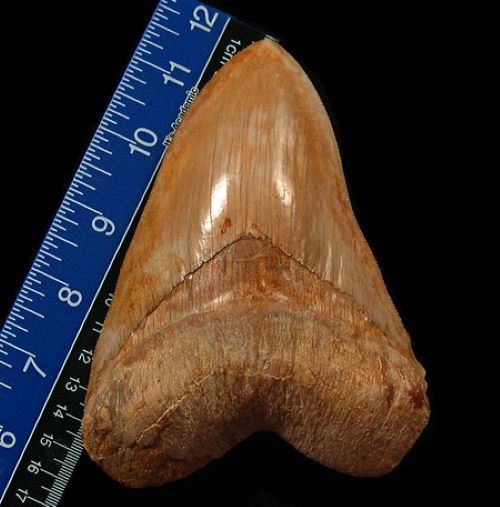
Long before humans ever walked the Earth, the oceans were home to a creature so immense that it continues to haunt our imagination to this day. The megalodon, a prehistoric shark that could reach lengths of 60 feet or more, was the undisputed ruler of the sea. Though the creature itself has long since vanished, the remnants of its legacy still wash ashore—or are uncovered deep beneath layers of sediment. Its teeth, fossilized through time, are the most enduring proof of its existence.
What’s more fascinating is how these fossilized remains offer insight into one of nature’s greatest marvels. Tucked within each tooth is a silent story—a clue about ancient oceans, forgotten prey, and a life that existed on a scale difficult to comprehend. While many admire these teeth for their rarity and beauty, others delve into them for something more profound: a deeper understanding of their significance. Nestled within this intrigue is a term that continues to spark curiosity among scientists and collectors alike—megalodon tooth size.
Let’s explore what these teeth tell us about the incredible creature behind them.
A Fossil That Bridges Time
Picture yourself strolling along a quiet shoreline. The tide gently brushes against your feet. Something half-buried in the wet sand catches your eye—a smooth, dark triangle, much larger than any modern shark tooth. As you pull it from the sand, you’re not simply finding a fossil. You’re holding a piece of history—one that dates back over 3 million years.
Unlike bones, which are fragile and rarely survive the fossilization process, shark teeth are made of dentin and enamel. These hard materials are far more resilient, especially when preserved beneath layers of sediment and minerals. Because sharks continually lose and replace teeth throughout their lives, the ocean floor was once littered with these sharp remnants. In the case of megalodon, the massive size and sheer number of lost teeth have resulted in a rich fossil record.
Collectors and researchers alike are drawn to these fossils not just for their aesthetic value but for the powerful clues they offer. They represent something that existed far beyond our reach, yet they remain tangible in our hands.
A Tooth for Every Role in the Jaw
Megalodon had a jaw built for domination. It’s estimated that the creature had up to 276 teeth in five rows, each tooth designed with a purpose. Some were for gripping prey, others for slicing, and still others for crushing bone.
Interestingly, the size and shape of each tooth varied depending on its location within the jaw. The front teeth, for instance, were generally longer and narrower—optimized for impaling. Side teeth, on the other hand, were shorter and broader, with a design better suited for grinding and tearing through more rigid material. These differences offer clues not only about how megalodon hunted but also how its body evolved for optimal efficiency.
The most prominent teeth—often measuring over six inches diagonally—came from the front of the mouth. These are the ones most highly prized by collectors. But every tooth tells a piece of the story, from the smallest fragment to the rare, near-perfect specimens with serrated edges and intact roots.
Geography Shapes the Story
Though the species is extinct, its reach was truly global. Megalodon teeth have been found on every continent except Antarctica. Some of the richest fossil sites include the East Coast of the United States, parts of South America, and coastal regions in Africa and Asia. These discoveries suggest a widespread distribution—megalodon didn’t just inhabit a single ocean, but likely roamed many, adapting to various conditions.
The environmental diversity of these regions also influences the teeth we find today. Some are deep black from the phosphate-rich waters where they fossilized. Others are golden brown, gray, or even a soft blue—colored by the minerals that slowly replaced organic matter over millions of years.
It’s worth noting that while many of these fossils are recovered through careful excavation, others are found by divers exploring underwater fossil beds. Each method brings different conditions and risks, but all contribute to an ever-growing archive of evidence about this ancient predator.
Measuring Up to History
When people speak of megalodon size, they’re often not exaggerating. The teeth alone are enough to stop someone in their tracks. And yet, it’s not uncommon for people to misunderstand the full scope of these teeth.
The average adult megalodon tooth measures between four and five inches. However, some specimens exceed six inches, and the largest verified tooth to date reaches just over seven inches. For comparison, a great white shark’s tooth typically maxes out at about two to three inches. That’s less than half the size of an average megalodon tooth.
The connection between tooth size and the overall size of the shark is still a subject of scientific study. However, many researchers estimate that for every inch of tooth, the megalodon may have measured roughly 10 feet in length. That means a shark with a 6.5-inch tooth could have been nearly 65 feet long—a size rivaling that of modern whales.
This staggering relationship between scale and biology is part of what makes these fossils so compelling. Holding one gives a sense of how small we are in the face of ancient natural forces.
Fossils That Speak
Many megalodon teeth offer more than just size—they provide evidence of the megalodon's behavior. Some are chipped, notched, or worn, showing signs of use. These marks could result from biting into bone or struggling with massive prey. Other teeth are smooth, their serrations dulled by time or heavy use.
For paleontologists, these details are crucial. They suggest that feeding habits, hunting techniques, and even competition with other marine predators are key factors. Some teeth have been found near fossilized remains of whales and large fish—likely victims of a megalodon’s powerful bite.
In this way, even a single tooth becomes more than a fossil. It becomes a witness, etched with the silent memory of an ancient world.
Collecting a Piece of Prehistory
The popularity of megalodon teeth among collectors has continued to grow over time. While many are satisfied with small, worn examples, others seek pristine specimens with full roots, sharp serrations, and rare coloration. These qualities can have a dramatic influence on value, with premium teeth commanding thousands of dollars.
Collectors often display these fossils in homes, offices, and museums, using them as both decorative pieces and educational tools. For some, it’s a hobby. For others, it’s a lifelong passion. But for all, it’s an opportunity to connect with a time when nature crafted its giants from cartilage and instinct.
Why the Fascination Endures
So why does the megalodon still captivate us? It could be the sheer size, the mystery surrounding its extinction, or the primal fear it evokes. Or maybe it’s simply the wonder of holding something ancient and authentic.
Whatever the reason, there’s no denying the allure. Each tooth, large or small, polished or jagged, is a message from the deep. A token of survival. A reminder that the ocean once carried shadows larger than ships—and that echoes of those shadows still wash ashore.
Final Thoughts on Megalodon Tooth Size
Whether you’re a passionate fossil hunter or someone newly drawn to the ancient world, it’s hard not to be awestruck by the megalodon tooth size. These fossils are more than collectors’ items—they’re storytellers, science tools, and tangible connections to a world long gone.
They remind us of nature’s grand scale, its subtle artistry, and its enduring power through time. And they invite us to keep exploring, keep asking, and keep imagining what else lies buried beneath.
Ready to Begin Your Fossil Journey?
If you’ve ever wanted to own a real piece of prehistory—or simply learn more about the creatures that ruled the oceans before us—there’s no better time than now. Explore an incredible selection of authentic megalodon teeth, each carefully sourced and preserved. Embark on a journey through ancient waters and bring home a story millions of years in the making.
Begin exploring with Buried Treasure Fossils today.






