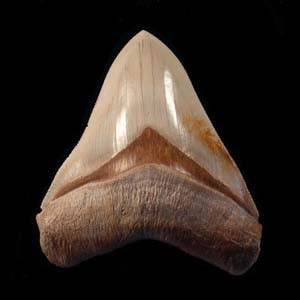
At our fossil collection site, we take great pride in curating remarkable discoveries that bring the ancient world to life. Among these treasures lies a tooth that radiates both mystery and magnificence. Its copper red enamel gleams softly, while its sturdy root anchors it to an age long past. This exquisite specimen, discovered in the Meherrin River area of North Carolina, originates from the “Red Site,” a location celebrated for producing the most vibrant copper-red Megalodon fossils.
Each detail of the enamel and root holds a quiet narrative, offering a glimpse into a creature that once ruled the seas. The story of the Otodus megalodon in Copper Red Site begins here, etched in color, texture, and time.
The Enamel: A Chronicle of Color and Preservation
The enamel of this specimen tells a story through color alone. Its copper-red hue sets it apart from the typical gray or black tones seen in other Megalodon fossils. This deep coloration formed naturally through mineral-rich sediments of the Meherrin River, where iron compounds slowly infused the tooth during fossilization. Over millions of years, these minerals painted the enamel with a metallic brilliance that continues to captivate collectors and enthusiasts today.
Described as being of the highest quality, the enamel shows no cracks or signs of wear. The surface retains its natural smoothness, suggesting it remained protected under ideal conditions during its burial. Each serration remains sharp and complete, preserving the precision of nature’s original design. The fine detailing, including an excellent tip serration, indicates minimal post-burial damage.
Every serration once played a vital role in the life of the Megalodon, slicing through prey in ancient waters. The survival of these edges after millions of years demonstrates the remarkable resilience of enamel as a natural material. Minor variations along the edge are not flaws but reflections of life, faint whispers of movement, strength, and survival preserved through time.
The Bourlette: The Bridge Between Layers
Between the gleaming enamel and the solid root lies the bourlette, a dark brown layer that provides a graceful transition between two distinct materials. In this copper red specimen, the bourlette forms a perfect bridge, subtle yet essential to the tooth’s composition. This region, rich in dentin, reveals how the enamel bonded with the root to create a single, unified structure capable of immense strength.
The consistency of the bourlette’s color and texture confirms the fossil’s authenticity. It is a natural hallmark that forgers find nearly impossible to reproduce. Its dark hue contrasts beautifully with the copper tone of the enamel, enhancing the fossil’s aesthetic appeal. Collectors often look for this feature when identifying genuine Megalodon teeth, as the bourlette represents both biological function and natural artistry.
Within the story of the Otodus megalodon in Copper Red Site, the bourlette acts as the chapter of transformation, a visual and structural bridge connecting the strength of the root with the elegance of the enamel.
The Root: A Foundation Anchored in Time
The root of this copper-red Megalodon tooth remains complete and broad, showcasing nature’s craftsmanship in its purest form. It exhibits no restoration or alteration, making it entirely authentic. The structure reveals how the tooth was once secured within the Megalodon’s massive jaw, ready for action in the primeval ocean.
The width of the root suggests an upper jaw anterior position, where the largest and most powerful teeth were located. Subtle grooves on the lobes tell a tale of movement and wear, etched before fossilization began. These grooves, preserved by layers of minerals, speak to the natural pressures and conditions the tooth experienced over its lifetime and after it was lost to the riverbed.
The completeness of both enamel and root shows that this specimen endured the passage of time almost untouched. The natural texture, slight indentations, and mineral tones all remain in their original state, forming an honest representation of the prehistoric world.
A Story Written in Layers
Every part of this fossil contributes to a layered story that stretches across time. The enamel records a history of mineral exchange. The bourlette connects two distinct substances with seamless precision. The root, strong and wide, holds the entire fossil together, grounding it in the past.
This specimen represents one of the finest examples of copper-red Megalodon teeth from the Meherrin River. Each section, the enamel, bourlette, and root, reflects exceptional preservation. The serrations remain visibly sharp, maintaining the original geometry created by evolution.
Copper-red Megalodon fossils are far rarer than other varieties, such as those from Lee Creek or Bone Valley. The Meherrin River’s unique mineral composition and oxidation process gave rise to the vibrant red hue, an outcome of geological conditions that occurred under precise and rare circumstances. These factors make every copper red tooth a natural masterpiece, unrepeatable in both color and composition.
The Rarity of the Copper Red Megalodon Tooth
Copper-red Megalodon teeth hold special significance for fossil enthusiasts and researchers. They are admired not only for their aesthetic beauty but also for their scientific importance. Each one provides insight into the conditions that shaped prehistoric oceans. The Meherrin River, with its mineral-rich environment, played a vital role in preserving such rare treasures.
When compared with the typical gray or black teeth found elsewhere, copper red specimens carry an otherworldly quality. The deep red tone, highlighted with subtle brown and orange shades, results from iron and manganese compounds reacting with sediment during fossilization. Because these environmental factors are uncommon, each copper-red Megalodon tooth is a limited piece of natural history.
To hold or study such a specimen is to connect with a creature that once dominated the seas. The tooth’s polished enamel, sharp serrations, and natural color capture the essence of a predator that lived millions of years ago yet continues to fascinate the modern world.
Listening to the Fossil’s Whisper
This copper-red Megalodon tooth invites reflection. Its surfaces tell a story not through words but through time. The enamel carries the glow of mineral influence, the bourlette signifies structure, and the root holds the memory of stability. Together, they narrate a silent poem about endurance and transformation.
The Otodus megalodon in Copper Red Site remains one of nature’s finest examples of beauty born from time. Its presence speaks softly yet powerfully, reminding us that even the most ancient fragments of life still carry their voices within stone.
Conclusion
The copper-red Megalodon tooth from the Meherrin River is more than a fossil; it is a masterpiece of natural preservation. Its enamel glows with a metallic hue shaped by minerals in ancient sediment. The bourlette connects enamel and root with precision, while the root itself stays broad, complete, and untouched.
No restoration or enhancement has altered this specimen. Every shade, groove, and serration remains true to its origin. This fossil captures the passage of time, the artistry of geology, and the enduring strength of one of Earth’s greatest marine predators.
In the end, the enamel and root of the Otodus megalodon in Copper Red Site continue to whisper across millions of years, sharing the quiet story of oceans, earth, and transformation. As one thoughtful collector once said, “Every fossil is a message from time, written in silence yet speaking forever.”