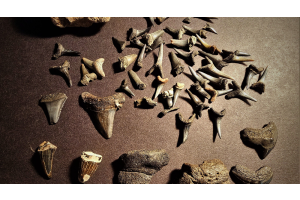
As fossil specialists, we know that every specimen can carry a narrative. When collectors come to us, they often focus on pristine Megalodon teeth with their sharp serrations, heart-shaped form, and symmetry. Yet, we believe that deformed, twisted, or curved specimens also deserve attention.
They may look irregular, but they often reveal stories of survival, unusual growth, or the fossilization processes that shaped them. These teeth allow us to explore history in a way that is as authentic as it is intriguing, whether examining an original fossil or comparing it to a megalodon tooth replica.
Understanding the Benchmark of “Normal”
Megalodon teeth are typically massive, serrated, and free of side cusps. They are often recognized by a balanced, heart-shaped design and cutting edges that were built for handling large prey. Most specimens will measure between 5 and 6 inches, and the most prominent examples rarely exceed 6½ inches in length.
These qualities create the standard reference for identifying what collectors call “odd” teeth. When a fossil shows curvature, irregular serrations, or strange wear marks, it immediately begins to tell a different story.
Signs of Struggle: Wear Patterns and Bite Marks
Some Megalodon teeth will display wear facets or scars that suggest physical struggles. One specimen from Indonesia provides a striking example. It carries a section where the serrations appear shortened and rounded, which is interpreted as a natural wear facet created by striking an opposing tooth. This unusual pattern could mean the shark’s teeth clashed during feeding, leaving lasting evidence of contact. Such irregularities allow us to imagine the realities of feeding behavior, where immense power often causes unexpected results.
Rare Morphologies from Notable Localities
Different fossil beds have been known to produce teeth with shapes that differ from the expected form:
● Sharktooth Hill, California: One specimen shows “Chubutensis-like bumps” at the base of its serrated edge. This rare feature is linked to early Miocene Megalodon teeth, showing that fossils can capture transitional traits between different evolutionary stages.
● Meherrin River, North Carolina: Teeth from the Copper-Red Site are admired for their striking coloration. One such example also carries a bite mark on the display surface, blending visual appeal with evidence of interaction during the shark’s lifetime.
These cases demonstrate how local geology, mineral content, and environment may influence both the look and preservation quality of a specimen.
Color and Preservation: A Geological Signature
Odd features often include color as well as shape. The coloration of a Megalodon tooth can tell as much about its history as its serrations. Fossils may range from jet black to deep red, tan, or blended hues. One South Carolina tooth illustrates this with jet-black enamel and a matching black bourlette, reflecting the mineral composition of the sediment it rested in.
While the symmetry of the tooth remains intact, the preservation of color and gloss adds individuality. When combined with irregular wear or serration patterns, these features become a geological signature, showing how environment and time shaped the fossil’s appearance. Such details are especially fascinating when comparing them side-by-side with a megalodon tooth replica, since the contrast highlights the uniqueness of each authentic fossil.
Growth Variations and Developmental Quirks
Not every irregularity is caused by wear or external forces. Growth variations can create odd-shaped teeth as well. A specimen may display uneven serrations, irregular bumps, or slight curvature, all of which suggest differences in development. These variations could have resulted from the shark’s natural tooth replacement cycle, genetic factors, or early damage.
For example, the bumps observed on some Sharktooth Hill teeth recall traits from earlier shark species, linking anomalies to evolutionary history. Such features allow a collector to see not only the tooth’s role in one shark’s life but also its place within a broader lineage.
Fossilization Quirks After the Shark’s Life
Fossilization also plays a role in creating odd forms. Once a tooth is shed, it becomes vulnerable to geological forces. Sediment type, mineral content, and pressure may influence its final appearance. Some irregularities that seem like deformities may have developed long after the shark’s death.
There are also cases where partial restoration becomes part of the fossil’s journey. For instance, a copper-red North Carolina specimen underwent professional enamel restoration at its center. Such work highlights both the fragility of the fossil and the effort made to preserve its unusual beauty. Restoration is not only a preservation technique—it becomes part of the tooth’s ongoing story.
Collector Appeal of the Unusual
While symmetrical teeth are often favored, irregular specimens can have a strong appeal to collectors who appreciate character and depth. Their value lies not in flawlessness but in the richness of their stories:
● Visual intrigue: Twists, curves, and irregular serrations create variety that captures attention.
● Historical connection: Marks of wear or deformation provide direct evidence of events during the shark’s life.
● Scientific interest: Each irregularity raises questions about feeding habits, environmental pressures, and geological history.
Collectors who focus on these traits may find that their most memorable pieces are those with the greatest quirks.
Changing Perspectives: From Flaw to Feature
In the past, deformed or twisted fossils may have been overlooked. Today, they are increasingly valued for their individuality. Every odd-shaped tooth represents a chapter of survival, adaptation, and preservation. What once might have been dismissed as a flaw now becomes a feature that enriches the fossil’s appeal.
Such specimens remind us that fossils are not static objects. They reflect a mixture of biological activity, environmental conditions, and time. Instead of being judged against a standard of perfection, they are celebrated for their uniqueness and the deeper narratives they carry.
Final Reflection
Odd-shaped Megalodon teeth demonstrate that value is not always found in symmetry. Whether marked by a bite, shaped with bumps, or colored into striking shades by minerals, each unusual specimen speaks of both the shark’s life and the forces that shaped its fossilization.
For collectors, these teeth are more than curiosities. They are artifacts of prehistory that combine natural history, geological transformation, and sometimes human preservation. Twists, curves, and scars transform these fossils into rare treasures that invite closer inspection and thoughtful appreciation. The next time a collector examines one of these pieces—whether authentic or compared against a megalodon tooth replica—the story told will be one of complexity, history, and timeless fascination.