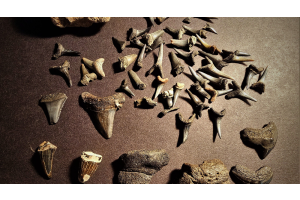
When we look at prehistoric fossils, we often discover far more than their physical form. They can help us understand adaptation, lineage, and the changing dynamics of ancient oceans. For us, a Bone Valley Megalodon tooth holds a special place because our work allows these fossils to be carefully studied and appreciated.
These teeth, found in Florida’s phosphate-rich deposits, are admired for their preservation and vivid colors, yet their value lies equally in the evolutionary story they can help to reveal. In some specimens, transitional characteristics appear, and these details may provide evidence of shifts within the species over millions of years.
The Geological Context of Bone Valley
The Bone Valley region of Florida is part of the Peace River geological system and connects to the Bone Valley Formation. These layers date from the middle Miocene to early Pliocene epochs and act as natural records of history. Phosphate-rich sediments surrounded the fossils and allowed them to be preserved with exceptional clarity while infusing enamel with a wide range of colors.
Because the fossils can be linked with specific geological layers, researchers are able to create a chronological framework. This means that Bone Valley deposits not only produce visually striking fossils but also provide a structured archive for studying ancient sharks and their evolutionary path.
Distinctive Qualities of Bone Valley Teeth
Bone Valley Megalodon teeth carry several features that set them apart. The first is exceptional preservation. The phosphate environment preserved enamel, serrations, and roots in remarkable condition, leaving subtle details intact for close analysis.
The second is coloration. Unlike darker fossils from other regions, these teeth often display lighter hues of gray, tan, blue, green, and orange—tones that reflect the chemical properties of the sediments in which they formed. Finally, some specimens reveal transitional traits such as differences in serration spacing, enamel thickness, or root form. These features may represent evolutionary stages and serve as clues to gradual adaptation within the species.
Scientific Approaches to Studying the Teeth
Bone Valley Megalodon teeth are not only admired but also examined as critical sources of evolutionary evidence. Paleontologists use several approaches to uncover their significance. Morphological comparisons involve analyzing serration patterns, enamel thickness, and root development to identify functional and developmental differences. Contextual dating uses the geological layers of the Bone Valley Formation to trace changes in dental form across time.
Preservation and color also provide valuable insight, as the quality of serrations and enamel, combined with the coloration, assist researchers in understanding both fossilization processes and evolutionary meaning. Each method works together to highlight evolutionary signals in even the most minor variations, whether in cutting ability or root strength.
Why These Teeth Are Scientifically Valuable
The true importance of these fossils lies in what they reveal. Well-preserved serrations and enamel allow for detailed studies of jaw structure and feeding efficiency. Transitional features highlight evolutionary steps, offering rare glimpses of adaptation over millions of years. Geological connections tie these fossils to precise timelines, making it possible to track evolutionary changes layer by layer.
Their role in education is also significant, as they provide students and researchers with a tangible way to explore evolution. In this way, Bone Valley teeth are not only rare specimens but also vital tools in advancing paleontological knowledge.
An Example of Evolutionary Evidence
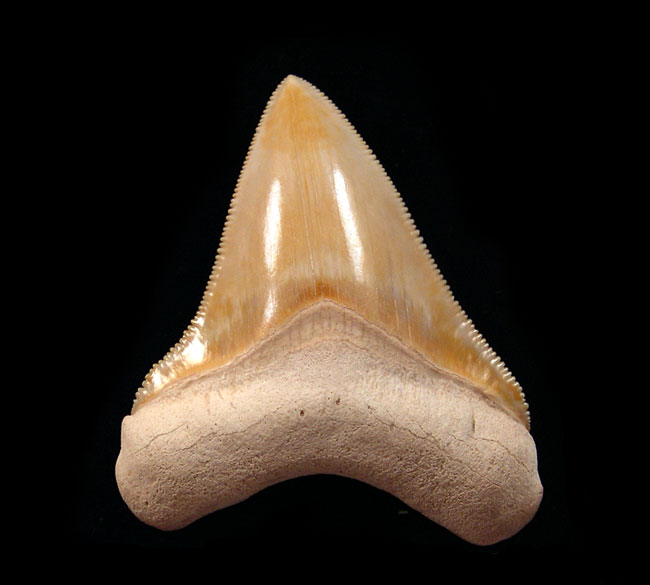
One Bone Valley Megalodon tooth measuring more than three inches illustrates these qualities clearly. Its enamel shows shades of light blue and tan, the bourlette is dark, serrations remain sharp, and the tip is strong. The root is intact, and the tooth has not been restored in any way. This fossil offers multiple insights: enamel durability demonstrates feeding strength, serrations highlight slicing efficiency, and root integrity suggests developmental stability.
Even its coloration provides evidence of chemical interaction during fossilization. Together, these features allow paleontologists to form a more complete picture of how Megalodon lived and evolved in prehistoric oceans.
Transitional Features and Evolutionary Shifts
Evolutionary change often appears in gradual steps rather than dramatic leaps. Bone Valley specimens sometimes capture these small steps in the form of transitional features. Serration patterns may vary, altering the efficiency of cutting. Root structures may show subtle shifts linked to growth or adaptation. Enamel forms may reveal dietary needs or responses to environmental conditions.
Because these teeth are preserved in layered formations, scientists are able to study them in chronological sequence. This makes it possible to observe both individual variation and broader patterns of adaptation within Megalodon’s lineage.
Rarity and the Value of Research
Bone Valley fossils are not commonly recovered due to limited access to mining areas. This rarity increases their importance, since each specimen provides unique data for study. Scarcity, combined with exceptional preservation and color, ensures that these fossils are highly valued by researchers. Every well-preserved tooth adds to the collective understanding of Megalodon’s evolutionary development, making the Bone Valley Formation an essential resource for paleontological study.
Conclusion: Lessons Preserved in Stone
A Bone Valley Megalodon tooth is more than a fossilized remnant—it is a record of adaptation and survival. Its preservation, vivid color, and occasional transitional traits create opportunities for scientists to interpret the lineage of one of history’s most significant marine predators. By studying serrations, enamel, and root form in the context of layered geological deposits, paleontologists can construct a clearer picture of Megalodon’s evolutionary path.
Each fossil is part of a broader story that shows how life responds to changing environments. For us, these fossils serve as reminders that careful study of the past allows our understanding of prehistory to keep growing, strengthening our connection to the natural history written in stone.