

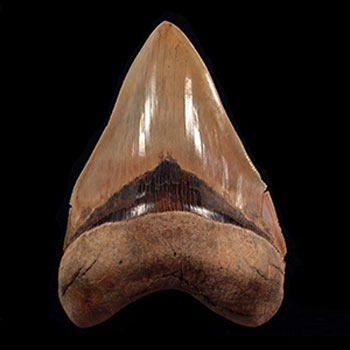
The fossil record has a way of surprising us with specimens that challenge expectations, and in the case of Megalodon teeth, few discoveries are as remarkable as those found in North Carolina. In our collection, we have handled rare examples that display unusual qualities, and we take pride in offering these fascinating pieces to fossil enthusiasts.
These specimens remind us that even in the prehistoric world, anomalies had their own story to tell. Among them, the megalodon tooth found in North Carolina rivers stands out for its rarity and unusual features.
Rare Oddities From the Depths of Time
Megalodon teeth are already among the most striking fossils a collector can encounter, but North Carolina has produced specimens that belong to a category of rarity all their own. The copper-red teeth recovered from sites along the Meherrin River have a coloration unlike that found in other localities. Their rich reddish hue, a result of the unique conditions in the soil, transforms what was once a functional weapon in the mouth of a shark into a dazzling geological artifact.
The word “oddity” applies here not because the teeth were necessarily deformed in life, but because their appearance in the fossil record diverges so clearly from what is usually found. Where most Megalodon teeth retain shades of gray, black, or tan, these copper-red examples are instantly recognizable and treasured for their singular look. They represent the unpredictable outcomes of fossilization and the quirks that nature can create over millions of years.
Interpreting Unusual Features
When collectors encounter a specimen with unusual qualities, it sparks questions about how it came to exist. The twisted angles, surface irregularities, or slight asymmetries sometimes seen in teeth might suggest that an individual shark experienced stress in its jaw, or that growth patterns did not proceed in the typical way. Although the site page highlights shape, serrations, and finish primarily in terms of collector value, the careful observer can also reflect on what those features reveal about the life of the animal itself.
For example, a tooth with a subtle curve or irregular edge could point toward physical stress during feeding or minor injuries sustained while hunting. Megalodon was a predator of massive prey, and its jaws experienced extraordinary force. Teeth were not always uniform or flawless, and that very imperfection tells us that ancient sharks, like modern ones, lived in a world where survival carried physical consequences.
The Copper-Red Teeth of North Carolina
The North Carolina specimens deserve a special spotlight. Described as the “famous copper-red site,” the Meherrin River has yielded teeth that collectors regard as highly desirable because of both rarity and beauty. The soil chemistry in this region is believed to be responsible for the distinctive coloration. As a result, these fossils are not only preserved evidence of prehistoric life but also geological marvels.
For collectors, this rarity elevates the value of each specimen. But for those interested in the story behind the fossil, the copper-red hue adds an extra dimension. It emphasizes how the environment interacts with biology, creating unique outcomes that no two discoveries can replicate exactly. This color shift is an oddity of preservation rather than anatomy, yet it carries the same sense of fascination as a twisted or misshapen example might. In this way, every megalodon tooth found in North Carolina rivers provides both beauty and mystery, embodying conditions that are rare even in the fossil record.
Serrations, Wear, and Clues to Ancient Life
Another area where oddities may appear is in the serrations. Well-preserved specimens often display razor-sharp edges, but some examples reveal wear or irregularity that may have occurred during the shark’s lifetime. These features suggest that the tooth was used actively in feeding, perhaps biting into tough bone or cartilage. Variations along the serrated edge hint at the immense pressure applied during predation.
The North Carolina finds include both pristine specimens and those with visible signs of use. These slight irregularities, far from detracting from the fossil’s significance, enhance its story. They are the traces of real animals in real struggles, offering a window into the harsh realities of prehistoric oceans. Oddities in serrations are thus not merely collectors’ curiosities but valuable evidence of an active predator at the top of its ecosystem.
Restoration and Authenticity
The fossil market places emphasis on authenticity, and collectors must often examine specimens for signs of repair or restoration. The Buried Treasure Fossils page makes clear distinctions between natural preservation and specimens that have undergone repair, providing transparency for buyers. From a scientific perspective, repaired examples still hold interest, but for collectors, untouched oddities carry a special appeal.
The fascination with North Carolina copper-red teeth lies partly in their authenticity. Their unique coloration cannot be replicated artificially, giving them an inherent advantage as natural marvels. In the broader category of pathological or unusual specimens, authenticity ensures that the oddities are genuine artifacts of ancient life and geological processes.
Growth Quirks and Jaw Stress
When examining unusual specimens, whether it is the copper-red teeth of North Carolina or irregular shapes found elsewhere, one theme emerges: they reflect the stresses and quirks of life itself. A slight twist in the crown could suggest uneven jaw pressure. A curved root might indicate developmental variation. Even the most massive predator in history did not produce a uniform set of teeth. Instead, each specimen carried its own history of growth, use, and environmental influence.
Collectors prize these differences precisely because they make each piece unique. But from a paleontological perspective, they also remind us that biology is never flawless. Pathological oddities are records of living systems under strain, adapting, and sometimes producing results that deviate from the norm.
The Role of Collectors
Collectors play an essential role in preserving and showcasing these oddities. By seeking out unusual specimens such as those from the Meherrin River, collectors help ensure that these rare fossils are appreciated and studied. The Buried Treasure Fossils listings highlight both the beauty and the science behind each tooth, creating a bridge between commercial collection and paleontological curiosity.
For collectors, owning a tooth that differs from the standard examples is like holding a piece of prehistoric history that carries its own distinct signature. Whether the oddity comes from coloration, serration wear, or irregular form, it embodies a moment frozen in time.
Conclusion: Oddities With a Story
The North Carolina Megalodon teeth remind us that fossils are never uniform products of the past. Some specimens emerge as rare anomalies, whether through the geological forces that produced copper-red coloration or through irregularities in shape and serration that point back to ancient life under stress.
Each megalodon tooth found in North Carolina rivers is more than a fossil; it is a story etched in enamel, shaped by natural forces both in life and in the ground where it was buried. These oddities embody the unpredictability of prehistoric oceans and continue to captivate those who study and collect them today.






