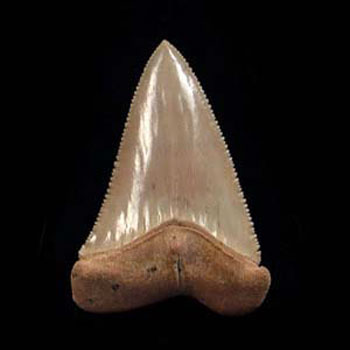
At our service, we have always been fascinated by how shark teeth can tell us powerful stories about survival, adaptation, and evolution. When we place Megalodon's great white shark tooth specimens side by side, the contrast allows us to see two very different paths shaped by time and environment.
Our work with these remarkable fossils gives us the opportunity to show how anatomy itself can reveal the strategies that helped these predators dominate their worlds.
Structural Contrasts
Megalodon teeth can be recognized immediately because they are broad, triangular, and heavily built. These teeth have fine, consistent serrations along the edges, but what makes them particularly impressive is their thickness of enamel and expansive root base. The added weight and durability gave Megalodon the ability to crush through the dense bodies of enormous prey, including ancient whales.
Another distinctive feature is the bourlette, a dark enamel band near the crown’s base. This detail does not appear in Great White teeth, giving Megalodon fossils a unique signature and providing researchers with another way to trace their history.
Great White Teeth: Shaped for Slicing
Great White teeth, while also triangular, are narrower, symmetrical, and sharply serrated. Their design makes them resemble blades that are ready to cut with precision. Instead of sheer force, these teeth were made for slicing through tissue with speed and efficiency. This structural focus reflects the Great White’s strategy as an agile hunter, built to pursue and subdue fast-moving prey.
Anatomy as Ecology
The size and strength of Megalodon's teeth tell us about a predator built for dominance. Their sturdy roots and heavy enamel made them capable of exerting crushing power against immense prey. Serrations along the edges allowed them to tear through thick flesh, completing a design intended to overwhelm.
This anatomy reflects the story of a shark that could dominate prehistoric seas. Megalodon survived by relying on immense power, showing how scale and strength shaped its ecological role.
Great White: The Agile Hunter
Great White teeth tell a different story. Their sharper and more refined serrations were created for quick strikes. Instead of relying on force, they gave the shark the ability to grip and slice swiftly, even against slippery and fast prey.
Another significant difference lies in the way Great Whites replace their teeth. Several backup rows ensure that as soon as one tooth falls out, another quickly takes its place. This renewal system means the shark is never without its most essential survival tools, a remarkable evolutionary advantage compared to Megalodon’s static fossil record.
Evolutionary Evidence in Enamel
Megalodon lived between 23 and 3.6 million years ago, leaving behind teeth that remain some of the largest ever discovered. Their immense size reveals the scale of the predator and the ecological niche it once filled. The enamel, serrations, and root structure show that this shark’s entire existence was built around crushing dominance in prehistoric oceans.
The Great White Continuum
Great White teeth show how evolution has shaped efficiency over time. Fossil records reveal earlier forms, such as Carcharodon hastalis, whose teeth were broader and smoother before gradually developing serrations. These changes highlight how Great Whites adapted step by step into modern, specialized predators.
Their continuous tooth replacement also ensures long-term survival. While Megalodon teeth survive as relics of the past, Great White teeth represent an active process that is still ongoing. The comparison of a megalodon great white shark tooth highlights how one reflects dominance in prehistory, while the other represents resilience in modern seas.
Collector and Scientific Appeal
Collectors value Megalodon teeth for their immense size and deep connection to prehistory. The natural patinas, coloration, and durability make them powerful artifacts that carry millions of years of history. Holding a Megalodon tooth provides a direct connection to an era when colossal predators ruled the oceans.
Great White Teeth: Modern Evolutionary Tools
Great White teeth attract attention for their sharp serrations and polished triangular shape. They are not only visually striking but also scientifically important, as they bridge fossil records with modern species. Specimens recovered from Peru, Chile, and South Carolina often display unique colors and preservation qualities, adding geological depth to their biological significance.
Two Sharks, Two Stories
When compared, the teeth of Megalodon and Great White sharks highlight two very different paths:
● Megalodon teeth represent brute strength, durability, and overwhelming power in the pursuit of enormous prey.
● Great White teeth represent precision, efficiency, and adaptability, enabling them to remain highly effective hunters in diverse environments.
Both reveal how anatomy tells survival stories. One reflects a species that relied on unmatched power but could not withstand changing oceans. The other reflects a predator that continues to endure by adapting to shifting ecosystems.
Closing Reflection
Shark teeth are more than fossils or collectibles. They are records of evolution, written in enamel and serrations. Megalodon teeth, with their massive presence and distinctive bourlette, tell us about ancient seas ruled by crushing predators. Great White teeth, sharp and symmetrical, show us a predator that has refined its design over millions of years and continues to thrive today.
The story of a megalodon great white shark tooth comparison allows us to see two survival strategies preserved in enamel: one frozen in the past, the other still alive in modern oceans. Both continue to inspire fascination and provide remarkable insight into the history of life in the sea.