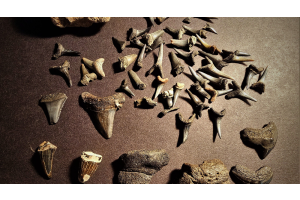
At our fossil shop, we proudly guide collectors through the world of Megalodon teeth and help with questions that naturally arise when a new specimen appears. When a new megalodon tooth is found and enters a collection, it invites curiosity about where it came from and what the location might say about the shark itself. Our goal is to share what these discoveries reveal, where they tend to appear, and how geography shapes the excitement of exploration.
What the Teeth Tell About the Shark
Megalodon was the largest shark that ever lived, with estimates reaching about 60 feet in length. These sharks had massive, heart-shaped teeth with serrated cutting edges, and individual teeth could exceed 6 inches, with some reaching over 7 inches. A record bite force is associated with this predator as well, described as up to 180,000 newtons, which explains why whales and other large marine mammals were part of its diet. The scale of the animal and the structure of its teeth continue to fascinate collectors and researchers, since the teeth are the most visible evidence left behind.
Sharks naturally shed and replace teeth throughout life, which means fossil deposits can contain a large number of specimens accumulated across time. Because this giant shark ranges across the globe, finds can occur worldwide. Teeth appear in coastal waters in different regions, reflecting the broad distribution of the species. These details contribute to the sense that each specimen connects modern hands to an ancient story.
Geography and Known Localities
A wide selection of localities is associated with Megalodon teeth. Off the coast of the United States, finds have been located near North Carolina, South Carolina, Georgia, Florida, and California. On land, Shark Tooth Hill in California has a reputation for fossil shark teeth and remains a name that collectors recognize. Together, these places outline a practical map of excitement for enthusiasts who hope to encounter a piece of prehistory.
In addition to those well-known spots, material has been recovered from Florida’s Bone Valley, North Carolina’s Lee Creek, and multiple states in the Southeast. These localities add variety in size, color, and condition, which are factors worth considering when choosing a specimen. Larger teeth in excellent condition are rarer and tend to command higher prices, while smaller examples can be more accessible for beginning collectors.
Right in the thick of this conversation, a new megalodon tooth found in a coastal setting can reinforce the idea that these sharks once ranged widely. It is not simply a fossil; it is a signpost that points to movement across oceans and through time, with each serration holding evidence of a hunter built for power.
Why Land Feels Rarer
Teeth are commonly identified in coastal waters and in established fossil localities. Land sites such as Shark Tooth Hill attract attention because they offer a concentrated glimpse into prehistoric seas within layers of rock. In contrast, coastal waters continue to reveal material that reflects the widespread presence of Megalodon.
The perception of rarity on land makes sense when the most active mentions are tied to coastal discoveries and coastal-adjacent localities. That pattern naturally leads to a feeling that dry-ground finds are special moments when ancient layers reveal something remarkable.
How Scientists Learn From Teeth
Teeth and spinal centra provide the primary evidence that scientists study, since other parts of the cartilaginous skeleton do not preserve well in salt water. Techniques that analyze growth rings in spinal center allow estimates of age and growth. There is also a record of an ancient breeding ground discovered off the coast of Panama, where teeth pointed to a nursery of juvenile sharks. Newly hatched individuals were estimated to be around 20 feet long, an astonishing size for a newborn, and a helpful perspective on how this species began life.
All of this adds context when holding a specimen. The serrations, the enamel, and the overall shape are not simply features for display. They are clues that allow a reader of the fossil record to infer feeding strategy, strength, and life history. The more one learns to observe, the more each detail contributes to a broader picture of a marine predator that ruled prehistoric seas.
Choosing a Tooth
Quality, size, color, and condition are the primary considerations when selecting a tooth. Larger teeth with excellent preservation are scarce by comparison and therefore tend to be priced higher. Smaller teeth offer a practical way to begin, and they still carry the signature heart-shaped profile and serrated edges that make Megalodon recognizable at a glance.
Whether coming from Florida’s Bone Valley, the Carolinas, Georgia, California, or another noted locality, each authentic piece can tell a story of place, preservation, and time in Earth’s ancient oceans.
Adventure in Every Find
Megalodon teeth represent more than their size and age. They connect modern curiosity to a vast prehistoric ocean and to specific coastlines and land sites that continue to inspire collectors. The excitement builds when a shoreline or a named hill quietly yields a tooth that carries the marks of power in its serrations.
For a conclusion that keeps the conversation warm and inviting, consider this simple line: “Every tooth carries the sea with it, and every shoreline asks another question.” Every new megalodon tooth found adds another chapter to that conversation and invites another look at the map of places where discovery can happen.