

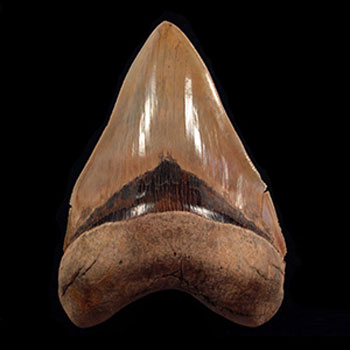
When we hold a Megalodon tooth in our hands, we are touching a fragment of history that has already survived millions of years. It connects us with oceans that once stretched across the globe, where the largest shark ever known ruled with strength and power. Our fascination with these fossils comes not only from their immense size but also from the way they allow us to imagine a world long gone.
At the same time, they raise a question that pulls us into the future: what will happen to a Megalodon tooth in the next 1,000 years? For those who seek to buy megalodon teeth, this curiosity makes each specimen feel like both a relic of the past and a treasure of the future.
The Survivor’s Tale
The reason we are able to study Megalodon teeth today lies in their remarkable ability to endure. The shark’s skeleton, made mostly of cartilage, disappeared with time, but the teeth remained because they were mineralized and eventually fossilized. Layer upon layer of sediment pressed down, while minerals replaced the organic matter. What emerged was not simply a tooth but a relic transformed into stone. These teeth have already traveled across eons, with their enamel and serrations holding steady against the constant forces of nature. Their story, however, is not finished; they are still part of Earth’s ongoing cycle of change.
The Earth’s Shifting Embrace
To understand the next thousand years of a Megalodon tooth, it helps to picture the Earth itself in motion. Tectonic plates rise and sink. Rivers carve new pathways. Winds lift grains of soil and scatter them elsewhere. Though these movements may seem slow to us, they are relentless in shaping the fate of what lies beneath the ground.
A tooth that rests in a cliff face today might be exposed in the centuries ahead as rains and waves wear away the stone around it. Once released, it could lie in the open air, vulnerable to weathering. In other cases, the opposite might occur. Fresh layers of sand or mud may gradually bury the fossil again, wrapping it in another protective coat of sediment. This constant reshaping means that no fossil ever truly remains fixed in place. The Earth has its own rhythm of exposure and concealment, and the tooth will continue to follow it.
The Subtle Marks of Time
Even when buried, a fossil is not entirely shielded from change. If a Megalodon tooth emerges into open air, it will begin to show the gentle but persistent effects of weather. Sunlight can fade the surface, rain can soften the enamel, and wind carrying grains of dust can polish the edges until serrations lose their sharpness. Over centuries, these gradual touches alter the fossil’s appearance.
If the tooth remains underground, it may undergo a different kind of transformation. Mineral-rich water flowing through soil can seep into the fossil, sometimes deepening its color, sometimes introducing cracks or subtle shifts in its structure. Though these changes might be invisible at first, they accumulate across the span of a millennium. The tooth will not disintegrate, but it will continue to evolve, shaped not by the predator that once grew it but by the elements of Earth itself.
For collectors or researchers who may one day buy a megalodon tooth, such changes only add to its story, layering new history on top of ancient oceans.
Condition and Meaning
Not all Megalodon teeth look the same, and the condition of each fossil plays a role in how it is understood. Large teeth with well-preserved enamel and sharp serrations often draw the most attention because of the clarity with which they tell their story. Smaller, fragmented, or heavily worn teeth may seem less striking at first, but they are no less valuable. They too carry evidence of ancient life and reveal the influence of geological processes long after the shark’s extinction.
A thousand years from now, a Megalodon tooth may still retain its familiar triangular shape, though its surface might be smoother or chipped in places. Even then, the fossil will remain a vital piece of evidence. Its details, whether sharp or worn, will still speak about an apex predator that shaped prehistoric seas.
Future Encounters
At some point in the centuries ahead, the fossil will be rediscovered. Perhaps erosion will expose it along a riverbank, where its dark surface will catch the eye of a passerby. It may remain hidden until advanced scanning technologies reveal its outline beneath the soil. However it happens, the moment of discovery will carry with it the same wonder that people feel today.
Future researchers may bring new methods to studying fossils. Microscopic analysis, advanced imaging, and chemical testing might reveal information that is invisible to us now. Even if the tooth bears the wear of centuries, it will still provide knowledge. The enamel might hold clues about growth patterns, and the serrations, even if softened, may still suggest feeding behaviors. Technology may change, but the fossil’s ability to teach will endure.
A Journey Through Time
Imagining a single Megalodon tooth across the next millennium reveals a journey that is both quiet and powerful. Today it rests in soil, solid and sharp. In a hundred years, it might be lifted by a flood, carried along rocks, and reshaped slightly by abrasion. In five hundred years, it may be buried again, with minerals slowly altering its tones. As centuries pass, the land may rise, and the tooth could emerge once more into the air. Finally, a thousand years from now, it may be held again in human hands, its form still unmistakable, though marked by time’s passage.
The Enduring Connection
The story of a Megalodon tooth is not limited to prehistory. It stretches forward as well as backward, linking ancient oceans with future generations. These fossils remind us that life leaves behind traces far stronger than we often realize. Each tooth is a witness to extinction and survival, a fragment that continues to endure while the Earth itself changes shape.
A thousand years from now, the tooth may look different from what it does today. Its enamel may be dulled, its serrations softened, its colors shifted. Yet its essence will remain. It will still be recognized as a relic of the greatest shark that ever lived. It will still connect humanity with the mysteries of deep time. And for those who one day hope to buy a megalodon tooth, it will remain a powerful bridge between what once was and what is yet to come.






