Megalodon teeth are more than just relics from a giant shark that once ruled the seas—they are time capsules that carry millions of years of history. For collectors and enthusiasts, these teeth are prized for their size, beauty, and scientific significance. Yet, in today’s market, spotting a fake megalodon tooth is just as important as appreciating a real one. Beneath the surface of an authentic fossil lies a story that reveals much about Earth’s past oceans, marine life, and even geological changes.
In this blog, we’ll dive into the secrets that Megalodon teeth hold—from the science of their formation to the ways experts identify authenticity.
The Ancient Ocean Predator Behind the Tooth
The Megalodon, whose name means “big tooth,” lived roughly 23 to 3.6 million years ago. These sharks could grow to lengths of 50–60 feet, making them one of the largest predators to ever exist. Their teeth, some reaching up to seven inches, are the main evidence scientists have of their existence. Unlike bones, shark skeletons are made mostly of cartilage, which does not fossilize well. Teeth, however, preserve incredibly well, allowing us a glimpse into the Megalodon’s feeding habits and evolutionary story.
How a Tooth Becomes a Fossil
One of the most fascinating secrets a Megalodon tooth holds is the process of fossilization itself. After a tooth was shed (as sharks constantly replace their teeth), it sank into sediment. Over millions of years, minerals replaced the organic material, transforming the tooth into a fossil. The minerals present in the surrounding environment are what give Megalodon teeth their range of colors—from jet black to earthy browns, and occasionally even shades of blue or green.
This mineral absorption is a natural fingerprint of time and place, which is why genuine teeth always have a complex, natural appearance rather than looking polished or painted. That subtle depth of coloration is one of the best indicators experts use when separating a real tooth from a fake megalodon tooth.
Serrations: Nature’s Perfect Weapon
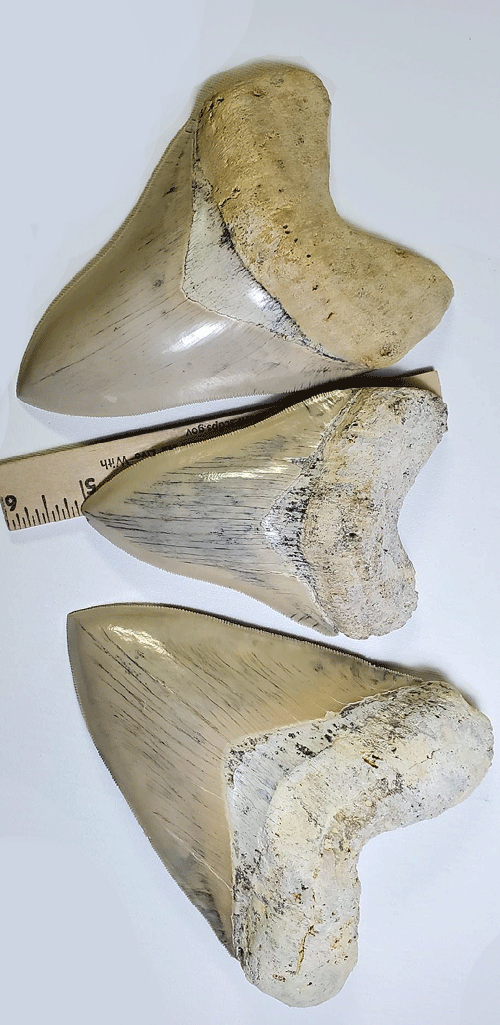
Look closely at the edges of a Megalodon tooth, and you’ll find serrations, similar to a steak knife. These ridges helped the shark slice through prey such as whales, large fish, and other marine mammals. Over time, those serrations wear down. That wear and tear is unique to each fossil and provides clues about the shark’s feeding behavior.
A tooth with serrations that look too sharp, too uniform, or too perfect may raise red flags. Authentic teeth carry imperfections because no two Megalodon meals were ever the same. Collectors often rely on these serrations to judge whether a specimen has the character of authenticity—or if it might be a carefully crafted imitation.
The Weight of Ancient History
Another secret held within a Megalodon tooth is its density. Genuine fossilized teeth feel surprisingly heavy for their size because the organic matter has been replaced by minerals over millions of years. Holding one is like holding a piece of the ocean floor itself. By contrast, replicas often feel light or hollow because they are typically made from resin or composite materials. That weight difference is one of the simplest ways to separate fact from fabrication.
Enamel Clues That Tell a Story
The enamel—the shiny, outer coating of the tooth—also hides important details. Real Megalodon enamel may look glossy, but it will carry microscopic scratches, chips, or texture changes. Over eons, natural erosion, mineral infill, and environmental exposure shape the enamel uniquely. Fake teeth tend to look too perfect, with a manufactured shine that doesn’t match the rugged authenticity of a fossil pulled from ancient seabeds.
Geological Fingerprints in Every Tooth
Beyond its role as a predator’s weapon, a Megalodon tooth reveals the environment it came from. The mineral content, coloration, and even the preservation quality reflect the geological history of the area where it was found. A tooth unearthed in a South Carolina riverbed will look different from one pulled out of a Moroccan desert. These differences provide paleontologists with valuable insights into the shifting seas and landmasses of Earth’s history.
Provenance: The Story Behind the Tooth
One of the most overlooked but crucial secrets is provenance—the story of where and how a tooth was found. Serious collectors and reputable sellers emphasize this because it adds not only value but also credibility. A tooth with a traceable history stands apart from a fake megalodon tooth that lacks documentation. Provenance transforms a fossil from a simple object into a piece of history, rooted in a specific place and time.
Why Fakes Exist and How to Spot Them
The demand for Megalodon teeth has surged, fueling a market where replicas are common. Many are sold as souvenirs or decorative pieces, and while they can be appreciated for what they are, problems arise when fakes are passed off as genuine fossils. Replicas often reveal themselves through:
● Artificial coloration: Paint or dye sitting on the surface instead of embedded in the tooth.
● Too-perfect symmetry: Real teeth are rarely flawless due to natural wear.
● Lightweight: A genuine fossil feels dense and solid.
● Uniform serrations: Machine-made edges lack the organic irregularity of a predator’s tooth.
For anyone considering a purchase, these simple checks can protect you from mistaking a fake megalodon tooth for the real deal.
What Makes an Authentic Tooth So Valuable?
The value of a Megalodon tooth isn’t just in its size or appearance. It’s in its rarity, its scientific contribution, and the connection it provides to a creature long gone. Authentic teeth help researchers understand shark evolution, marine ecosystems of the past, and even climate patterns. For collectors, owning one is like holding a direct link to the prehistoric ocean—a tangible reminder of nature’s power and mystery.
The Emotional Pull of Fossils
Beyond science and collecting, Megalodon teeth hold emotional weight. They capture the imagination, inspiring awe in both children and adults. There’s something humbling about holding a tooth that once belonged to the ocean’s apex predator. That emotional connection is something no replica can truly replicate.
FAQs About Megalodon Teeth
1. How big can a Megalodon tooth get?
Some of the largest teeth found measure over seven inches in length, though most range between three and five inches.
2. Are all colors of Megalodon teeth natural?
Yes, authentic teeth absorb minerals from their environment, resulting in colors like black, brown, gray, or even blue. However, bright or uniform colors may suggest a fake megalodon tooth.
3. Can you find Megalodon teeth today?
Yes, many are found in places like Florida rivers, South Carolina, and parts of Morocco. Fossil hunters still uncover new specimens.
4. Are Megalodon teeth a good investment?
Authentic teeth, especially those with provenance and exceptional size or condition, can be valuable investments in both monetary and historical terms.
A Tooth That Holds the Ocean’s Memory
A Megalodon tooth isn’t just a fossil—it’s a story of evolution, geology, and survival. From serrations worn by ancient meals to colors shaped by minerals, every detail whispers secrets of oceans long gone. But in today’s market, ensuring authenticity is vital. Knowing how to identify a fake megalodon tooth can save you from disappointment and ensure that what you hold is truly a fragment of prehistoric history.
Whether displayed in a collection, studied by scientists, or cherished as a personal treasure, a real Megalodon tooth is a remarkable connection to Earth’s deep past—one that will never lose its sense of wonder.