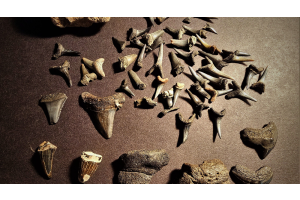
When most people think about fossils, they imagine bones tucked away in museum cabinets, perhaps labeled and dated, admired from behind glass. But then some discoveries feel almost like whispers from the deep—silent, weighty, and steeped in time. One such marvel is the Lee Creek Megalodon tooth, a fossil that carries not just the memory of a prehistoric predator but the allure of its ancient oceanic realm.
Tucked away in the coastal plains of North Carolina, Lee Creek has long been a haven for fossil enthusiasts. And what it offers is no ordinary find. Among its most treasured remains is the tooth of a creature whose legacy still ripples through scientific debate and public imagination.
Now, let's travel deeper.
Why Lee Creek?
Lee Creek, near Aurora, North Carolina, has gained recognition as one of the richest marine fossil sites in the United States. But it's not the quantity alone that draws collectors—it’s the quality. The delicate layers of sediment here cradle fossils so well-preserved that they almost seem intentional. These include marine mammals, mollusks, and, of course, shark teeth.
But the teeth found here are in a class of their own. Their finish, coloration, and structural integrity often make them more desirable than specimens found in other fossil beds. For those seeking authenticity and aesthetic depth in their collection, Lee Creek offers a rare opportunity.
The Megalodon Connection
Once the oceans' most dominant predator, the Megalodon is known primarily through its teeth—massive, triangular, and perfectly engineered for slicing through thick layers of flesh and bone. It’s estimated that this apex predator reached lengths of up to 60 feet, making even today’s great white sharks look modest by comparison.
A Megalodon’s tooth isn't merely a relic—it's a fragment of dominance, evolution, and extinction. Each serrated edge tells a story of survival and supremacy in a time before humans walked the Earth. And from all the places where these remnants surface, Lee Creek contributes some of the most striking examples.
Distinctive Qualities of a Lee Creek Find
Collectors are quick to point out the smooth enamel, sharp serrations, and rich hues often seen in these fossils. The variety of earth tones—from soft caramel to deep charcoal—results from mineral interactions unique to Lee Creek’s geology.
Some teeth possess a bluish-gray tint, as if the ocean were trying to reclaim its relic. Others reveal fossilized feed marks, a thrilling reminder that these were not decorative pieces, but tools used in life-or-death pursuits.
These features elevate a Lee Creek Megalodon tooth from interesting to extraordinary.
A Collector’s Dream
Fossil hunting is as much about patience as it is about curiosity. And in the world of shark teeth, serious collectors know that location plays a significant role in rarity and value. That’s why Lee Creek finds are consistently sought after—not just for display, but for their place in paleontological storytelling.
Beyond their visual appeal, these teeth are often used in academic studies that investigate predator-prey relationships, ocean chemistry, and even extinction patterns. But for the private collector, owning one means having a connection to a world that no longer exists.
It is a piece of history you can hold in your palm.
Not All Fossils Are Created Equal
It’s easy to assume that one Megalodon tooth is like any other. But side by side, their differences become clear. A tooth from Lee Creek often has better preservation and detail than those found in rivers or open ocean deposits. The softer sediments at this site protect the fossils rather than grinding them into dust, helping them retain their original form.
That’s why Lee Creek specimens tend to retain sharper edges, cleaner surfaces, and more distinct root structures than counterparts from rougher environments.
These subtle differences are precisely what make the discerning eye linger.
Storytelling Through Shape and Color
Every fossil tells a tale. Some Lee Creek teeth exhibit wear patterns suggesting repetitive hunting behavior. Others may show a break, likely from a battle with a large prey. These details transform each tooth from a static object into a narrative.
For display or study, this kind of fossil offers more than visual impact—it can support scientific interpretation. And for those drawn to the aesthetics of natural history, this depth adds dimension to the collecting experience.
A Lee Creek Megalodon tooth, then, isn’t simply bought—it’s inherited from time.
The Journey From Earth to Hand
The process of extracting, cleaning, and preserving these fossils involves both science and care. The surrounding sediment must be carefully removed to protect the tooth’s surface. Fossil hunters often spend hours brushing away layers, inch by inch, revealing each ridge and curve.
For those lucky enough to find one firsthand, the moment of discovery is unforgettable. But for most, acquiring one through a trusted source allows them to skip the hunt and go straight to appreciation.
And there’s no shame in that—some relics are better unearthed by experienced hands.
Curiosity That Never Fades
Even after it’s been cleaned and mounted, a Megalodon tooth continues to spark questions. What did this tooth pierce through? What depth in the ocean did it fall to when its owner perished? How long did it rest in silence before someone found it?
These are the questions that make collecting fossils more than a hobby. They make it a bridge between worlds.
Whether displayed in a cabinet or studied under a microscope, the Lee Creek Megalodon tooth reminds us of a world before our own—and the creatures that ruled it.
A Piece of Prehistoric Majesty
For those who seek more than decoration—who crave meaning behind their collectibles—the Lee Creek Megalodon tooth delivers. Its origin, preservation, and mystery set it apart in a world flooded with artificial replicas and over-mined artifacts.
This tooth offers something that feels grounded. Authentic. Mysterious. And a little bit awe-inspiring.
Whether you're a seasoned fossil collector or someone looking to begin their journey with a piece that carries weight—both literal and symbolic—this is where your story might begin.
Ready to Own a Page From Prehistory?
If you're looking for a specimen that blends age, beauty, and a rich geological history, the Lee Creek Megalodon tooth may be the piece missing from your collection.
Take the next step in exploring Earth's ancient story—one fossil at a time. Browse available fossils, explore each unique specimen, and bring home a piece that speaks across time.