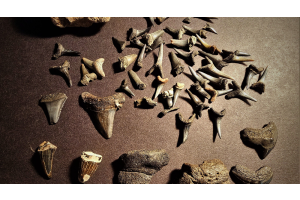
There’s something deeply captivating about ancient ocean giants. Among them, the megalodon continues to dominate imaginations, not only because of its monumental size but also because of the mysteries it left behind. Scientists and fossil enthusiasts alike have spent years studying its legacy—one that’s told not through full skeletons, but through teeth scattered across time.
Within this fossil record, a recent discovery has stirred both excitement and debate: the youngest megalodon tooth found. While older teeth have long helped trace the shark’s immense prehistoric timeline, the youngest fossil unearthed raises new questions. Did the megalodon survive longer than previously believed? And if so, where was its final stronghold?
Before we explore those questions, let’s understand what makes this particular fossil different from the rest.
What Makes This Tooth Different?
Fossils, in many ways, are time capsules. The enamel, coloration, and surrounding sediment all speak volumes about their age. Most megalodon teeth date back to the Miocene and early Pliocene epochs—roughly 23 to 3.6 million years ago. But this specific tooth, found within a much more recent layer of earth, suggests it may belong to a megalodon that lived closer to 2.5 million years ago—or possibly even younger.
Why does that matter? Because the later the date, the closer we inch toward understanding when this predator truly disappeared. Earlier assumptions placed the megalodon's extinction around 3.6 million years ago. But if this tooth's dating holds up, it would shift our extinction timeline.
The implications are fascinating. Could isolated populations have endured longer in deeper, warmer waters? Could they have coexisted—however briefly—with emerging shark species like the great white?
The Science Behind the Dating
Determining a fossil’s age is a delicate process. Experts don’t rely solely on where it was found; they study the surrounding minerals, sediment layers, and even isotopes within the fossil itself. In the case of the youngest megalodon tooth found, radiometric dating played a vital role.
Scientists examined tiny samples of the surrounding matrix, searching for clues in the form of beryllium isotopes. These provide insight into how long the fossil had been buried and into the geological events surrounding its preservation. Unlike many older megalodon teeth that rest safely in ancient marine strata, this one came from an upper layer—prompting deeper analysis.
Skeptics are cautious, though. Fossils can shift layers over time due to natural processes. Floods, tectonic shifts, and burrowing animals can all move remains from their original layer. That’s why verification is crucial before rewriting extinction timelines.
What This Tooth Might Reveal
Assuming the date holds up, the discovery would signal a lingering presence. Picture it: a solitary apex predator prowling coastlines, perhaps competing with the ancestors of modern sharks. Its environment might have been shifting rapidly—rising sea levels, fluctuating temperatures, and changing food availability.
A younger fossil means more recent environmental pressures played a role in its extinction. It opens up the possibility that a slow decline, rather than a sudden event, wiped out the species. This offers a more detailed narrative—a gradual one, with habitat loss, competition, and climate change rather than a single catastrophic event.
How These Teeth Travel Through Time
The journey from ocean floor to museum shelf is anything but straightforward. Teeth like this one are often found in riverbeds, cliffsides, and offshore dredging sites. Fossil hunters know that erosion, tides, and even storms can expose ancient secrets. But that exposure comes with complications. A tooth washed down a river might land in younger sediments, confusing researchers about its true origin.
Still, the tooth's condition offers subtle hints. In the youngest megalodon tooth found, the enamel was well-preserved, with less mineralization than in older megalodon teeth. This small detail supports the idea that it could be geologically younger, but the scientific community continues to seek more samples to confirm this theory.
Where Might the Last Megalodons Have Lived?
If megalodons persisted longer than once believed, where did they find refuge?
Some researchers suggest isolated pockets of warm water in the Pacific or Indian Oceans could have supported them. These regions, rich in marine life and relatively stable in temperature, may have offered a final hunting ground. The absence of newer fossils in these regions, however, keeps the idea speculative.
Yet, the ocean is vast and largely unexplored. Each new fossil discovery—from a coastline or deep seabed—could shift the story again. The youngest megalodon tooth found hints at a quieter end, perhaps in a remote, unmonitored corner of the world.
Why This Discovery Captivates So Many
People are drawn to mysteries—especially those that involve giants. The megalodon isn't simply another extinct species; it represents awe, danger, and a lost chapter of Earth's history. So when something as small as a single tooth threatens to rewrite that chapter, it grabs our attention.
Fossils do more than prove a creature existed; they give us a glimpse into how it lived, what it faced, and how it responded to change. For students of natural history and shark enthusiasts alike, the megalodon’s timeline remains one of the ocean’s most intriguing puzzles.
A Closing Thought on Ancient Teeth
The youngest megalodon tooth found might not yet change textbooks, but it encourages curiosity—and more digging. It invites experts to recheck samples, retrace sediment layers, and rethink extinction theories.
More than that, it reminds us that ancient life still speaks. We simply have to know where to listen.
Ready to Explore Fossil History Yourself?
If fossil hunting, collecting, or learning about prehistoric species fascinates you, now’s a great time to dive in. Whether you're curious about shark teeth or passionate about ancient oceans, there’s always something new to discover beneath the surface.
Explore the world of fossils—where every find adds a new thread to Earth’s incredible story.