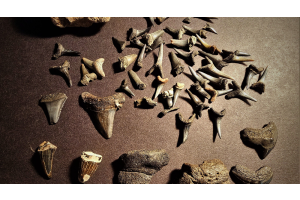
Let’s start with a visual. You, holding a fossilized monster of a tooth, serrated and ancient, straight out of the jaw of a beast that once ruled Earth’s oceans. This isn’t a replica or a museum piece tucked behind glass. This is the real thing. An actual fossil that predates the evolution of humans. It is simply sitting there. Waiting to be your collection's jewel in the crown.
Now let’s add a location. That tooth was pulled from the depths of geological time in Aurora, North Carolina. If you’re even mildly fascinated by prehistoric life, you might recognize that region as a goldmine for fossil hunters. This is the home of the famed Aurora Megalodon tooth—a fossilized fragment of Earth’s untamed past. Yes, we’re serious. You can own that.
And not just any old fossil. We’re talking about a lower jaw anterior Meg tooth with a flawless bourlette, sharp serrations, and a root so clean it feels like it was custom-designed for collectors. This isn’t the dusty relic you’d find buried in a box somewhere. It’s the fossil equivalent of a Rolex that’s never left the case.
Let’s dig into what makes this so special—and why collectors (and even casual prehistoric fans) are eyeing these rare Aurora specimens like treasure hunters spotting a glimmer in the sand.
Aurora, North Carolina: A Fossil Hunter’s Dream
We love a good origin story, and this one’s straight out of the Miocene epoch. Roughly 14.5 million years ago, during a time when monstrous marine predators roamed the Atlantic, a now-extinct apex predator called Otodus megalodon was king.
Its teeth, which could grow over seven inches long, were built to crush whales like we crack sunflower seeds. That alone should make your inner collector sit up straighter.
Now fast-forward to the present day. The phosphate-rich sediment of the Pungo River Formation, exposed in places like the old Lee Creek mine in Aurora, has preserved some of the most exquisite Megalodon teeth ever discovered. And unlike many dig sites that are now closed to the public or thoroughly picked over, the legacy of these finds lives on—through carefully curated collections made available by fossil specialists like us.
Aurora Megalodon teeth are prized because of their unique preservation. We’re not exaggerating when we say some of these fossils look sculpted rather than weathered. The teeth are often symmetrical, with sharp edges, striking coloration, and rich bourlettes that collectors dream about. The best part? They’re not locked away in museums.
The Collector’s Flex: When History Becomes Personal
Let’s not sugarcoat it. There’s a difference between saying, “I love fossils,” and casually having a 14-million-year-old Megalodon tooth on your desk. It’s a statement. A conversation starter. A power move, if we’re being honest.
But beyond the wow factor, these fossils offer a real connection to a time long before humans ever walked the Earth. Every chip, every serration tells a story. Some teeth show feeding damage. Others are nearly pristine. You’re not just buying a fossil—you’re holding a literal piece of Earth’s biological timeline in your hand.
This isn’t mass-produced decor. This is singular, irreplaceable, and 100% authentic.
And when it comes to Aurora Megalodon teeth, quality matters. That’s why we go out of our way to source specimens with no restoration or repairs. What you get is raw, natural, and exactly as nature intended—minus the 14 million years of waiting around in the ground.
Why Aurora Teeth Are in a League of Their Own
Let’s pause and address the elephant-sized shark in the room. There are Megalodon teeth—and then there are Aurora Megalodon teeth. Not all fossils are created equal.
Here’s what sets them apart:
1. Geological Sweet Spot
The Pungo River Formation, from which these fossils originate, is a remarkable example of preservation. The minerals in the sediment not only fossilize organic material but also do so in a way that enhances color and sharpness.
2. Condition and Aesthetics
Collectors often rave about bourlettes (that dark area between the tooth crown and root), and Aurora teeth often have them fully intact. The root integrity and serration sharpness are next-level, especially when the tooth is from a principal anterior position—like the one we’re featuring here.
3. Scarcity
Access to the Lee Creek mine has been restricted for years. What’s on the market now? It’s legacy stock. That means every new addition to your fossil display is not just rare—it’s increasingly harder to come by.
4. Authenticity You Can Trust
We don’t believe in replicas or filler fossils. When we say it’s real, we mean it. Our Aurora Megalodon teeth come without repairs, reconstructions, or any synthetic tampering. You get the fossil, and only the fossil.
So, Who Buys a Megalodon Tooth?
If you’re wondering whether this kind of fossil is just for paleontology nerds or wealthy collectors, the answer is no. We’ve seen everyone from marine biologists to interior designers, teachers to TikTok creators, fall in love with these ancient beauties.
Some people mount them in shadow boxes. Others keep them on their work desks, next to family photos and coffee mugs. We’ve even seen them worn on custom pendants.
Because at the end of the day, this isn’t just about collecting. It’s about owning a piece of time, turning Earth’s prehistoric past into something deeply personal and tactile. Whether you’re gifting it, showcasing it, or keeping it as a secret indulgence, one thing is certain—this fossil speaks volumes.
And yes, you can take it home.
What We Offer: Real Fossils, No Fluff
At our shop, we don’t just throw teeth on a digital shelf and call it a day. We curate.
Every listing includes detailed images and descriptions, including color, root integrity, serration status, measurements, and more. We want you to know exactly what you’re getting.
And if you’re into specifics, here’s a little teaser of what an actual specimen might look like:
● A tan crown with a deep chocolate brown bourlette
● Serrations still sharp enough to make you flinch
● A pristine root with minimal hydration cracks
● Natural grooves that whisper stories of ancient seas
We’re constantly adding to our collection, so if you don’t see the exact Aurora Megalodon tooth you’re dreaming of, hang tight—or better yet, reach out. We love helping fellow fossil fans find their perfect match.
Why This Isn’t Just a Tooth—It’s a Trophy
We all have our things. Maybe you collect vintage guitars, comic books, or mid-century furniture. But owning a fossil like this? It hits different. Because no matter how niche or cool your other collectibles are, this one predates everything.
It predates humanity. It predates the continents as we know them. It even predates saber-toothed cats, woolly mammoths, and the dinosaurs’ closest descendants.
It’s humbling. And impressive. And just weirdly fun to say, “This tooth is older than humanity.”
Final Thoughts: Bring the Ocean’s Apex Predator Home
You’re not just scrolling past another prehistoric artifact. You’re face to face with something wild, something rare, something born from the ancient ocean floor of North Carolina and molded by time itself. A fossil that has endured for millions of years is just waiting to be appreciated by someone like you.
The Aurora Megalodon tooth isn’t just something to gawk at—it’s something to own. And when you hold it for the first time, when your fingers trace the serrated edges and you feel the weight of it in your palm, you’ll understand.
This isn’t a novelty. This is nature’s most epic relic. And yes, it really can be yours.
We’re here to help you take it home.