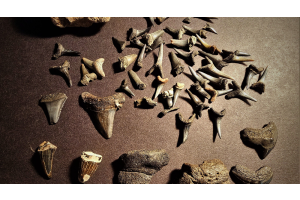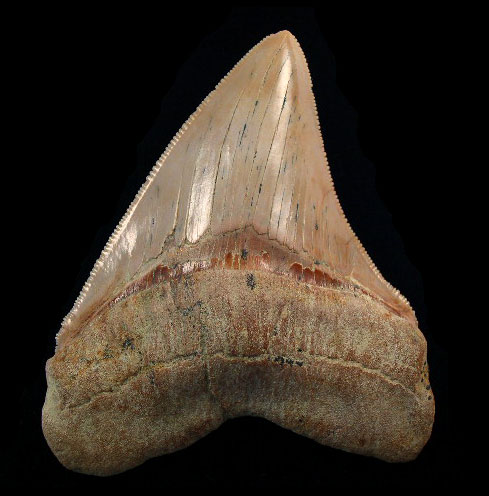
Far beneath the rolling hills of central California lies a place where history lingers in stone and sediment. This area once formed part of a thriving seabed, a thriving ecosystem where enormous creatures roamed the waters millions of years ago. Within these layers of earth rests a relic that has captured the fascination of collectors and enthusiasts alike—the Sharktooth Hill Megalodon tooth. This single fossil not only connects us to a giant predator but also tells the story of shifting oceans, geological change, and the enduring mysteries of prehistoric life.
As we begin to explore, imagine the world as it was, where towering sharks ruled with ease, and every discovery in the soil uncovers another page of the planet’s vast history.
The Setting Of Sharktooth Hill
Sharktooth Hill, located near Bakersfield, California, holds one of the richest fossil beds in the world. The site was once covered by warm seas during the Miocene epoch, nearly 15 million years ago. Over time, currents and sediments carried the remains of marine creatures to the seabed, preserving them for countless generations to come. Today, the hill is recognized as a national natural landmark and continues to inspire researchers and fossil hunters alike.
The site itself is layered with clues, each stratum containing a record of life, death, and transformation. It is more than a dig site—it is a glimpse into a vanished ecosystem teeming with whales, fish, sea lions, and of course, massive sharks.
The Legendary Megalodon
At the heart of this history is the Megalodon, a colossal shark estimated to have grown over 50 feet in length. Its jaw was capable of crushing bone with effortless force, and its serrated teeth were specialized for hunting large prey. These teeth, preserved in fossil form, remain some of the most tangible connections we have to this marine giant.
A Megalodon tooth from Sharktooth Hill does more than showcase scale; it represents the dominance of a creature at the top of the food chain. Unlike many other fossils, these teeth carry visible features—sharp ridges, robust enamel, and remarkable size—that offer a clear sense of the shark’s strength and adaptability.
Fossil Formation And Preservation
The story of how these teeth came to be preserved is equally fascinating. As Megalodons shed thousands of teeth over their lifetimes, many drifted to the seabed. Covered by layers of sediment, they underwent mineralization, transforming from organic structures into stone-like relics. The unique conditions at Sharktooth Hill enabled the extraordinary preservation of fossils, resulting in an abundance of scientifically valuable specimens.
This natural process ensured that what we see today is not merely a fossil, but a durable artifact —a window into the life of one of history’s most iconic predators.
Why Collectors Value These Fossils
Collectors and enthusiasts prize these fossils not only for their rarity but also for the stories they hold. Each specimen is unique, with its own coloration, wear, and shape influenced by millions of years of underground development. Holding one is to have a tangible fragment of prehistory, an object that traveled across time untouched by human hands until recently.
Some collectors appreciate them for their aesthetic beauty, while others value them for their scientific significance. Either way, the value lies not only in the fossil itself but in the connection it creates between the modern world and an ancient ocean.
The Scientific Importance Of Sharktooth Hill Fossils
Beyond collection, fossils from Sharktooth Hill remain vital to paleontologists. They provide evidence of ancient food chains, climate conditions, and the evolutionary paths of marine species. Researchers analyze the enamel composition of Megalodon teeth to gain insight into their diet, migration patterns, and even the chemistry of prehistoric oceans.
Every fossil unearthed is not simply an artifact—it is data. This puzzle piece helps reconstruct a lost environment, providing a clearer picture of how ecosystems have shifted over millions of years.
A Glimpse Into Prehistoric Oceans
Imagine standing by the coast during the Miocene period, watching enormous marine mammals swim through rich waters while a Megalodon glided silently beneath. The tooth of such a shark captures that moment—a relic from a world that feels distant yet still connected to us.
The fossil reveals the immensity of natural history, demonstrating that life has continuously evolved, shifted, and adapted in ways beyond imagination.
Collecting With Care And Respect
Those interested in acquiring fossils from Sharktooth Hill must do so with respect for both science and the site's history. These pieces are treasures, not commodities to be handled lightly. Responsible collecting preserves their integrity and ensures they remain available for both educational and personal appreciation.
Holding one in your hand is more than a display of ancient beauty—it is an act of honoring the deep timeline of life on Earth.
Why Sharktooth Hill Megalodon Tooth Resonates Today
In the middle of any fossil collection, the Sharktooth Hill Megalodon tooth often becomes the centerpiece. Its resonance lies in its balance of size, history, and symbolism. To look at it is to remember a time when oceans teemed with giants, and Earth’s rhythms were vastly different from those of today.
Collectors, researchers, and casual admirers are drawn to these fossils not simply because of their scale, but because of the connection they forge to an era where nature’s boundaries were far wider than we can easily imagine.
Bringing History Home
For those drawn to history, the opportunity to own such a fossil can be a significant find. It transforms a shelf into a museum, turning curiosity into lifelong wonder. Every glance reminds you of Earth’s extraordinary past and the mysteries still buried beneath its surface.
A Sharktooth Hill fossil is more than an object—it is a bridge between worlds, a narrative that continues to evolve as discoveries are made.
Conclusion: A Connection To Ancient Oceans
In conclusion, the Sharktooth Hill Megalodon tooth is more than a fossil; it is a chapter in Earth’s immense story. It holds the memory of oceans long gone, creatures that once dominated, and the slow passage of time that preserved them for us to see today.
If you are captivated by history, fascinated by fossils, or searching for something that brings the depth of prehistory into your hands, this is a discovery worth exploring. We invite you to take a closer look, embrace the story it carries, and bring a piece of natural history into your life.
Start your journey into ancient seas today and make your own connection with Earth’s remarkable past.