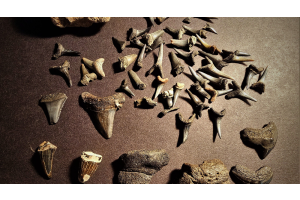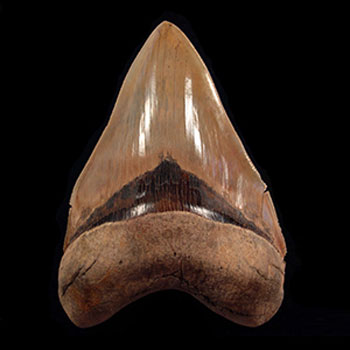
For millions of years, the oceans were ruled by a colossal predator that continues to inspire awe even today. The megalodon was no ordinary shark—it was an ancient giant with jaws large enough to engulf small boats and teeth designed for crushing bone with ease. Fossilized remains of these apex predators continue to surface across the globe, and among them, a single discovery captures the imagination more than most: the largest megalodon tooth ever found. It is not only a fossilized remnant of history but also a symbol of the ocean’s forgotten dominance.
Before delving deeper into this extraordinary find, it’s worth remembering that these teeth represent more than paleontological treasures—they are relics of a creature that once reigned with unmatched presence. Now, let’s explore how a single fossilized tooth reshaped our perspective of marine history.
A Glimpse into the Megalodon’s World
The megalodon is believed to have lived between 23 and 3.6 million years ago, patrolling warm coastal waters and preying on massive marine creatures such as whales. Its name, translating to “big tooth,” hardly does justice to the awe inspired by these enormous fossils. Unlike skeletal remains that often erode or vanish, the teeth of megalodons endured the test of time, preserved within layers of sediment and stone.
Each discovery offers a window into prehistoric seas, where the megalodon stood at the very top of the food chain. Their teeth, often triangular and serrated, could reach lengths exceeding seven inches. Holding one in your hand is like cradling a fragment of Earth’s ancient story, a link between modern curiosity and a predator that once shaped entire marine ecosystems.
Discovering Ancient Giants Beneath the Earth
Teeth of this magnitude are not found scattered casually along shorelines. Many have been unearthed by divers braving riverbeds and submerged fossil layers, while others were revealed during the careful excavation of ancient seabeds that have turned to stone. Some of the largest specimens have been discovered in the Eastern United States, particularly along river systems in South Carolina and Florida, where fossil hunters wade through sediments in search of treasures.
What makes these discoveries so striking is the range of conditions that preserved them. Some remain sharp and serrated, as though the predator had only recently vanished from the seas. Others bear smooth edges, polished by millions of years of water movement. Regardless of their condition, each tooth carries an untold story of survival, predation, and natural history.
Why the Largest Tooth Matters
The fascination surrounding the largest megalodon tooth ever found is not only about its sheer scale. A tooth of exceptional size challenges paleontologists to rethink estimates of the creature’s maximum length and strength. Larger teeth suggest megalodons that may have reached lengths of over sixty feet, rivals to modern whales in size.
Such a specimen provides insight into feeding patterns, growth cycles, and even migration paths. The study of its serrations, wear patterns, and fossilization process becomes a puzzle that links us back to an ocean that no longer exists. More than a record of size, it becomes a testament to the biological possibilities of life on Earth.
A Collector’s Treasure and a Scientist’s Tool
Beyond scientific inquiry, the allure of owning one of these fossils cannot be overlooked. Collectors often describe holding such a tooth as holding time itself—an ancient relic that bridges epochs. Unlike gemstones or minerals, these fossils are part of a predator’s body, which adds a depth of fascination that is rare among natural artifacts.
For scientists, however, the tooth is more than a relic. It is a data point, a tangible piece of evidence that allows reconstructions of marine ecosystems long gone. Each tooth, large or small, contributes to a growing body of knowledge about how megalodons lived, hunted, and eventually disappeared from Earth’s oceans.
The Ongoing Mystery of Extinction
While discoveries of massive teeth fuel excitement, they also remind us of the megalodon’s fate. This apex predator eventually succumbed to the forces of climate change, shifting sea levels, and competition with smaller, faster sharks. The oceans, which it once dominated, grew colder, and prey populations shifted. As the environment evolved, even a predator of such immense strength and size could not survive.
In this way, the tooth serves as both a marvel and a warning. It illustrates nature’s resilience, but also its relentless cycle of rise and decline.
Stories Hidden in Fossil Collections
Those fortunate enough to see or own such fossils often find themselves sharing the story again and again. Guests marvel at the sheer size and the thought of a creature so immense roaming the seas. A fossilized tooth becomes more than an object—it becomes a conversation starter, a piece of natural history preserved in stone.
Some collectors frame them in glass cases, while others keep them close at hand, unable to resist the weight of history in their palms. The fascination is universal: we all long to connect with worlds that existed long before us.
Bringing the Past into the Present
When you imagine the ocean today, filled with sleek sharks and migrating whales, it is hard not to wonder how different it would feel with a megalodon silently moving beneath the surface. Holding or viewing a massive fossilized tooth bridges this gap. It is the closest we may come to experiencing the sheer scale of prehistoric oceans without traveling through time.
In the end, the significance of the largest megalodon tooth ever found is not only about its dimensions. It is about the way it ignites imagination, sparks questions, and reminds us of the mysteries still buried beneath the Earth.
Conclusion
The ocean holds countless secrets, but few inspire such fascination as the fossilized remains of ancient predators. Among them, the largest megalodon tooth ever discovered continues to capture the attention of generations. It represents a world where giants roamed freely, and every discovery brings us closer to understanding the scale of life millions of years ago.
We may never encounter the living version of this shark, but through fossils, we connect to its legacy. If you are ready to hold a relic of history, explore collections that bring these prehistoric wonders within reach. Each tooth is more than a fossil—it is a story waiting to be told.
Take the next step today and explore authentic fossil collections to experience the wonder of prehistoric oceans for yourself.