The enduring fascination with fossilized shark teeth has brought many collectors, researchers, and educators to explore how the geologic record safeguards the credibility of prehistoric specimens. In our work, we frequently assist those seeking a real megalodon tooth for sale, and we emphasize that authenticity is best demonstrated through geologic context. Whether an individual is a seasoned fossil enthusiast or an academic researcher, geologic indicators remain the most reliable tools for verifying a tooth’s origin and integrity.
Why Geological Context Matters for Megalodon Teeth
Authenticating a fossil requires far more than visual inspection. Megalodon teeth have been reproduced frequently, and replicas can sometimes appear deceptively natural to newer collectors. The most dependable approach involves placing each tooth within its precise geologic setting. Sedimentary layers, mineral replacement patterns, and depositional environments all provide crucial institutional markers that help us validate a specimen.
When researchers examine teeth that come from formations like Sharktooth Hill, Bone Valley, or Lee Creek, they rely on the established stratigraphy of each site. These formations are well documented, with clearly defined geologic timelines that align with the Miocene and Pliocene epochs during which Otodus megalodon lived. In each of these localities, sediment composition and fossil associations allow us to determine whether a tooth aligns with the depositional environment expected of authentic Megalodon remains.
Stratigraphic Layers as a Reliability Indicator
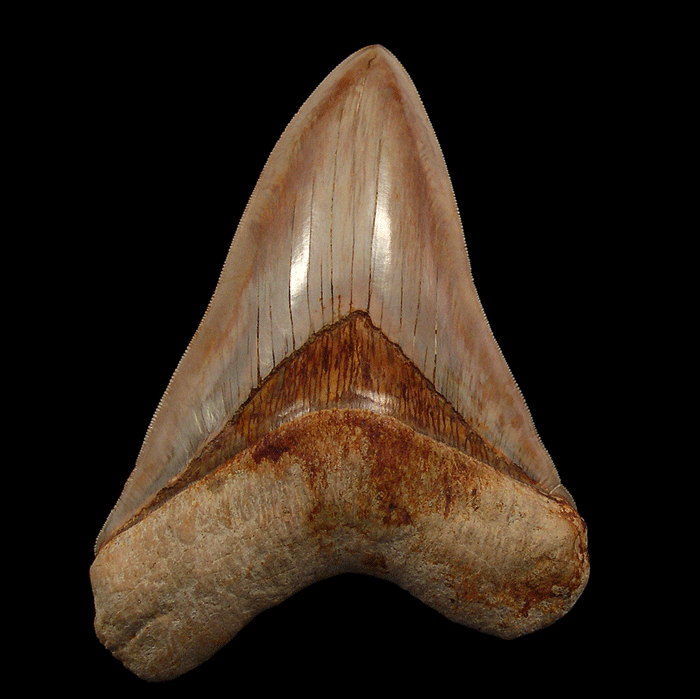
Stratigraphy is an exciting cornerstone of paleontology, playing a vital role in uncovering the stories of our planet's past. A fantastic example is the Lee Creek formation in North Carolina, known for its beautifully preserved layers of marine sediment. Each stratum tells a unique story of prehistoric marine life, weaving together a fascinating tapestry of ancient ecosystems. Among its treasures, you'll find a stunning Megalodon tooth—a remarkable piece that showcases intriguing mineralization patterns formed over millions of years. These layers not only illuminate the dynamic history of the region but also offer us incredible insights into the diverse life forms that once roamed the ancient seas. It’s thrilling to think about the knowledge we can gain from these natural wonders!
Similarly, the stratigraphic consistency of Sharktooth Hill in California provides evidence that teeth found there come from a densely fossiliferous Miocene marine bed. When we review teeth from this region, we often find complementary species—such as ancient whale remains or marine mammal bones—that strengthen the contextual authenticity. This association is scientifically valuable because Megalodon frequently fed on large marine mammals, and shared deposition lends credibility to the tooth’s age and origin.
Bone Valley in Florida provides yet another example. Its phosphate-rich sediments contribute to uniquely vivid coloration in teeth found there. These distinct mineralogical markers serve as indicators that help collectors and researchers identify specimens originating from this formation. When customers inquire about a real megalodon tooth for sale, we often demonstrate how these geologic identifiers confirm legitimacy.
Sediment Composition and Mineral Replacement
Authentic Megalodon teeth undergo mineral replacement—a process in which original organic material is replaced by minerals found within the surrounding sediment. The mineral composition of a tooth often reflects the particular environment of deposition. Teeth from the phosphate-rich Bone Valley formation, for instance, display colors ranging from bright oranges to deep greens due to prolonged exposure to phosphate minerals.
In contrast, teeth from Sharktooth Hill may take on tan or brown hues, resulting from the silty and sandy sediment prevalent in the region. The mineralization process offers data that is difficult for counterfeiters to reproduce accurately because it involves millions of years of chemical exchange within a specific environment.
Depositional Environments and Authenticity
Depositional environments also reveal important clues. Megalodon teeth found in coastal marine deposits with associated marine fauna exhibit contextual integrity. If a tooth is extracted from a river or dredge locality, researchers analyze whether the tooth’s discoloration, abrasion, or mineralization aligns with the known processes of that environment.
For example, river finds often display distinctive rolling wear, where sediment action smooths tooth edges over centuries. A lack of such wear in a supposed river find may raise questions about authenticity or misdocumentation. By evaluating these environmental factors, we can accurately determine whether a real megalodon tooth for sale retains its contextual identity.
Applying Geologic Context in Our Authentication Process
As a company deeply committed to educational value, scientific integrity, and collector confidence, we use rigorous criteria when evaluating our Megalodon inventory. We do not rely solely on appearance; instead, we trace each specimen’s origin back to its specific locality whenever possible. Using established geological reports and depositional studies, we ensure that the tooth’s features match the characteristics expected from its stated formation.
Our extensive catalog—spanning fossils from Florida, Georgia, the Carolinas, Peru, and Chile—includes specimens sourced from well-documented fossil beds. Because of this, we are able to provide detailed locality information, which supports academic, curatorial, and private research efforts. For collectors seeking a scientifically grounded acquisition, contextual accuracy is essential.
Importance to Researchers and Educators
Academic researchers depend on contextual accuracy to conduct paleobiological studies. The size, serration pattern, and mineralization of Megalodon teeth provide clues about the shark’s developmental stages, migratory behavior, and ecological interactions. A tooth disconnected from its geologic context loses much of its scientific utility.
For geology educators, authentic specimens also serve as teaching tools that illustrate sediment layering, fossilization processes, marine paleoecology, and Earth system history. When students can examine real specimens with traceable origins, the educational experience becomes more robust and meaningful.
Guidance for Serious Collectors
Advanced collectors often pursue specimens with strong provenance, preferring teeth that include documented localities. When acquiring a Megalodon tooth, collectors should consider the following:
• Whether the stated formation aligns with the tooth’s coloration and mineralization
• Whether the sediment type corresponds with documented geologic data
• Whether the seller demonstrates familiarity with stratigraphy and depositional processes
We take pride in supporting collectors who value scientific accuracy. Our commitment is to provide access to specimens that meet high academic and curatorial standards, while also accommodating the needs of beginners exploring the fascinating world of paleontology.
Conclusion: Confident Collecting Through Geological Insight
For anyone seeking a scientifically credible real megalodon tooth for sale, a firm understanding of geologic context is essential. By examining stratigraphy, sediment composition, and depositional environments, collectors and researchers can distinguish genuine fossils from replicas and ensure that each specimen contributes meaningfully to scientific study or personal collection. We invite you to explore our carefully authenticated selection and experience firsthand the value of owning a verified Megalodon specimen that reflects both natural history and geological integrity.