

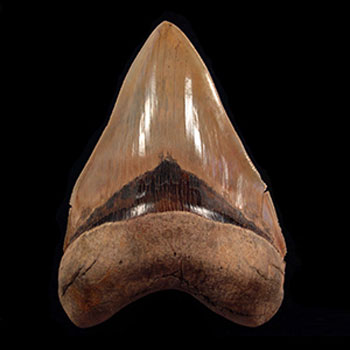
Shark teeth have always fascinated scientists, fossil hunters, and collectors alike. Yet few specimens spark as much awe as the fossilized teeth of the mighty Megalodon, the prehistoric shark that once ruled Earth’s oceans. Among these prized fossils, the Black Megalodon tooth holds a special place, not only for its striking appearance but also for the extraordinary history it carries. These teeth are more than just relics of a giant predator—they are windows into a time when the oceans looked very different from what they do today.
The Giant Behind the Tooth
The Megalodon shark, whose name translates to “big tooth,” lived during the Miocene and Pliocene epochs, approximately 23 to 3.6 million years ago. Measuring up to 60 feet in length and weighing more than 50 tons, this shark was one of the largest predators in Earth’s history. Scientists estimate that Megalodon’s bite force could reach up to 180,000 newtons, allowing it to crush the bones of whales and other massive marine mammals with ease.
Unlike modern sharks such as the Great White, Megalodon was truly global in its range. Fossilized teeth have been discovered in every ocean, from the coasts of North and South America to Europe, Africa, and Asia. While the shark itself vanished millions of years ago, its teeth remain abundant—an evolutionary gift, since sharks continually shed and replace their teeth throughout their lives.
Why the Teeth Survived When the Shark Did Not
One question many ask is: why do we find so many Megalodon teeth but not entire skeletons? The answer lies in biology. Like modern sharks, Megalodon’s skeleton was made primarily of cartilage, which does not fossilize well. Over time, those skeletal remains dissolved into the ocean. The teeth, however, were composed of enamel and dentin, making them dense and highly durable. These structures fossilized over millions of years, leaving behind the iconic triangular specimens we find today.
The coloration of a fossilized tooth, including the striking black seen in some specimens, depends on the minerals present in the sediment where it was buried. A Black Megalodon tooth is often the result of fossilization in iron-rich or mineral-heavy environments, creating a natural contrast that adds to its visual allure.
Anatomy of a Prehistoric Weapon
Megalodon teeth are easily recognizable. They are large, heart-shaped, and have serrated cutting edges that allow the shark to shear through flesh and bone efficiently. While most teeth average around 4 to 5 inches, some extraordinary specimens exceed 7 inches—larger than a human hand.
The serrations were a key evolutionary feature, helping Megalodon tear into thick-skinned prey such as whales. In fact, paleontologists have found prehistoric whale bones with clear bite marks matching the size and shape of Megalodon teeth. These fossils provide direct evidence of the shark’s dominance in the food chain.
A Timeline Hidden in Stone
Fossilized shark teeth are more than relics—they are records of environmental change. Each tooth offers clues about ocean chemistry, sediment layers, and even the climate millions of years ago. Scientists analyze these specimens to study how prehistoric marine ecosystems functioned and how they responded to shifts in global temperature and sea levels.
For example, researchers have identified ancient Megalodon nursery grounds off the coast of Panama. Many of the teeth found there belonged to juvenile sharks, suggesting the area once provided a protected environment for young Megalodons to grow. By studying these sites, scientists gain insights into shark behavior, population dynamics, and the challenges that eventually led to extinction.
Why Teeth Come in Different Colors
One of the most fascinating aspects of Megalodon fossils is their variety of colors—black, brown, gray, and even bluish hues. This color variation is not due to the shark itself but the fossilization process. When a tooth is buried, minerals from the surrounding soil and water replace the organic material in the tooth over millions of years.
For instance:
● Teeth fossilized in phosphate-rich sediments often appear brown or tan.
● Those preserved in iron-rich deposits may turn jet black.
● Rare conditions may even produce bluish or greenish tones.
The Black Megalodon tooth is especially prized by collectors because of its dramatic appearance, symbolizing both the power of the shark and the geological story written into its surface.
Where Megalodon Teeth Are Found
Because Megalodon was a global predator, its teeth have been discovered in coastal deposits around the world. In the United States, some of the richest sites include:
● North and South Carolina: Riverbeds and coastal sediments often yield large, well-preserved teeth.
● Florida and Georgia: Known for producing colorful specimens with distinctive mineral patterns.
● Sharktooth Hill in California: Famous among fossil hunters for its abundance of prehistoric shark teeth.
Beyond North America, Megalodon teeth have also been recovered from South America, Europe, Africa, and Asia, reflecting the shark’s dominance in ancient seas. Each locality contributes its own mineral fingerprint, which shapes the color and texture of the fossils found there.
From Dragon Tongues to Scientific Treasure
Before the rise of modern paleontology, fossilized shark teeth puzzled people for centuries. In medieval Europe, they were often called “tongue stones” or “dragon tongues,” believed to be mystical relics or petrified tongues of serpents. It wasn’t until the 17th century that scientists correctly identified them as shark teeth.
This revelation transformed how we view Earth’s history. These fossils were no longer curiosities but tangible evidence of prehistoric life. Today, Megalodon teeth continue to inspire awe, serving as both scientific tools and cultural symbols of power, mystery, and time itself.
The Collector’s Perspective
For collectors, owning a Megalodon tooth is like holding a piece of deep time in the palm of your hand. Each specimen is unique, shaped not only by the shark it once belonged to but also by the millions of years it spent underground. Collectors often evaluate teeth based on size, symmetry, serrations, and condition. Larger, well-preserved specimens are rarer and thus more highly valued, while smaller teeth are more accessible to beginners.
Collectors also prize the geological story told by each tooth’s color and preservation. A Black Megalodon tooth, for example, is admired not only for its fossil integrity but also for its bold aesthetic—a piece of prehistory that doubles as natural art.
What Scientists Still Learn from These Fossils
Even today, Megalodon teeth remain central to paleontological research. Because no full skeletons exist, these fossils provide the only physical evidence of the shark’s anatomy and biology. By analyzing wear patterns, researchers can infer diet and hunting strategies. By studying isotopes in tooth enamel, they can reconstruct ancient ocean temperatures and migratory behaviors.
Every tooth adds a data point to the puzzle of Earth’s past, allowing us to understand how ecosystems have changed and what lessons they hold for the present.
Final Thoughts
When you look at a Megalodon tooth, you’re not just seeing the remnant of a prehistoric predator—you’re holding a fragment of Earth’s story. These fossils capture the drama of evolution, the power of ancient oceans, and the forces of geology that preserve life’s traces for millions of years.
More than any other fossil, the Black Megalodon tooth represents a perfect blend of science and wonder. It is a true time capsule, reminding us that the ocean once belonged to giants and that even after extinction, their legacy continues to surface in the most tangible way—one tooth at a time.






