

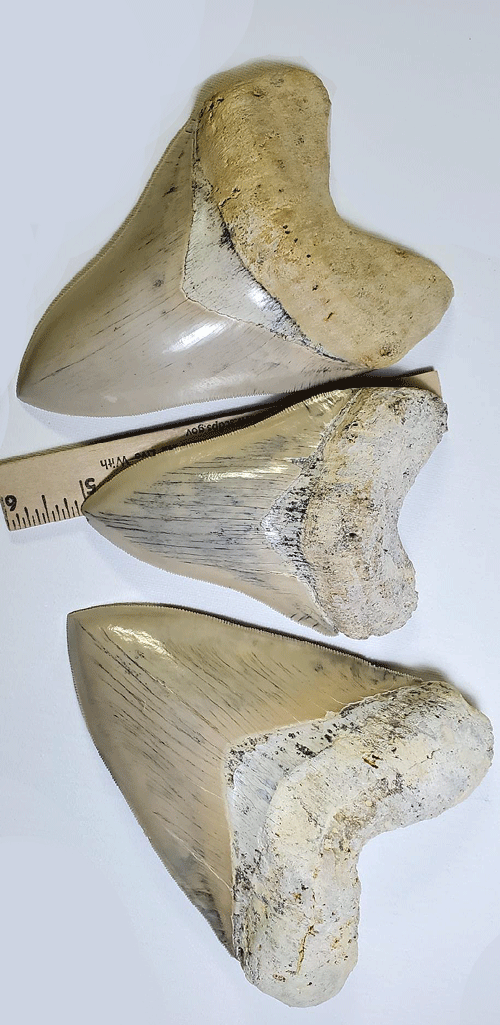
Some things leave us in awe not because of their beauty, but because of the mystery they carry. Among the most fascinating relics of Earth’s ancient past is a stark reminder of one of the largest predators to have ever existed—the Megalodon. A single glance at an actual megalodon tooth can stir questions that stretch back millions of years. But how can we be sure what we’re holding is the real thing?
Let’s take a slow dive into the world of these ancient giants, uncover how to tell the real from the replica, and why it even matters to collectors and curious minds alike.
Fossil or Fake? Here's Where to Begin
Before we delve into identifying signs of authenticity, it's helpful to understand what you're dealing with. A Megalodon tooth is not simply a relic—it’s a preserved piece of a prehistoric predator. However, with demand rising and lookalikes flooding the market, it’s essential to approach with a careful eye.
Your journey starts with observation. Don’t be quick to judge—replicas are often cast with impressive detail. Instead, begin with texture and temperature. Fossilized teeth typically feel heavier and denser than resin models, and their texture is coarse due to the mineralization that occurred over millions of years.
Examining the Root and Enamel
Take a moment to examine the root of the tooth. In genuine Megalodon fossils, the root typically exhibits a worn, porous appearance, due to the prolonged fossilization process. It will rarely look smooth or plasticky. The enamel should have a fine sheen, but it won’t be flawless. Natural imperfections, such as slight chips or discoloration, often confirm authenticity.
When enamel and root are joined seamlessly yet irregularly, it’s a good sign. But if it looks too clean, too polished, or uniformly perfect, it’s time to ask questions.
Color Speaks Volumes
Many assume that a Megalodon tooth should be jet black or dark brown in color. While dark shades are common, the color of a fossil depends entirely on the minerals present in the surrounding sediment during its formation. You may encounter hues ranging from bluish-gray to tan or even rusty red. These variations add character—but if a tooth is bright white or has a plastic sheen, it’s likely synthetic.
Natural wear and mineral staining give each fossil its unique palette. If the color looks flat or artificially even, trust your instincts. It might be a reproduction.
Size Isn’t Everything, But It Does Say Something
Megalodon teeth vary significantly in size—some barely three inches, others over seven. While larger teeth tend to be rarer and more valuable, it’s not the only thing to consider. Remember, the size should match the proportions expected in these prehistoric sharks. An enormous tooth with unrealistic detail may raise eyebrows.
When evaluating size, also consider symmetry. Authentic teeth often exhibit slight asymmetry, unlike mass-produced replicas, which tend to be uniform in design and finish.
Test the Tooth's Density
Real Megalodon teeth are surprisingly heavy for their size. That’s because over time, the organic material has been replaced by dense minerals. Holding one should give you a sense of its age—its weight speaks of its journey through time.
Lightweight models made from resin or polymer often give themselves away instantly. If possible, compare the weight with a known authentic sample. A genuine tooth will always feel more substantial.
The Telling Signs of Repair
Repairs on real teeth aren’t uncommon. Collectors often restore broken tips or chipped roots. What matters is transparency. Sellers should disclose any repairs made. Use a magnifying glass if necessary—look for tiny lines of adhesive, gloss differences, or inconsistent texture.
A repaired real tooth holds more value than a completely fake one, but knowing the extent of the restoration helps determine its place in your collection.
Check for Locality Information
Most reputable sellers provide locality data—details about where the tooth was found. Megalodon teeth have been unearthed in locations such as Florida, North Carolina, and Morocco. Fossils from specific regions exhibit different colors and textures, reflecting the local geology. If a seller avoids offering this information or gives vague answers, that’s a red flag.
Ask questions. Where was the tooth found? Has it been altered? How long has it been in the seller's possession? Reliable answers build trust.
Certificates and Authenticity Claims
While a certificate doesn’t guarantee the tooth is real, it does add credibility, especially when it comes from a well-regarded paleontological source. That said, anyone can print a certificate. Use it as a supporting piece of evidence, not the deciding factor.
When possible, verify the source's credentials. Are they affiliated with a known institution? Do they have a history of fossil sales or paleontology expertise? An actual megalodon tooth is a rare find; its legitimacy should be backed by a credible track record.
Why Authenticity Matters
Owning a genuine Megalodon tooth is more than a conversation starter. It’s a link to an ancient marine predator that ruled the oceans millions of years ago. A real fossil is irreplaceable in its historical value. For collectors, educators, and marine enthusiasts alike, authenticity ensures that what they hold is a piece of the Earth’s deep past—not a replica of its memory.
Misrepresenting such a fossil disrespects the science behind it and the journey it’s taken through time. A fake might be cheaper, but it will never carry the weight—both literal and symbolic—of a true fossil.
Bringing the Experience Home
Imagine sharing the story behind a tooth that once belonged to a creature longer than a city bus. Real fossils possess subtle curves, edges shaped by the passage of time, and a quiet power that replicas cannot replicate. They stir the imagination. They bring us closer to the Earth’s primal moments.
So if you're in the market for one, make the experience count. Ask questions, feel the weight, study the details. Don’t rush into the decision. Let your curiosity lead, and let knowledge keep you from being misled.
Final Thoughts and a Gentle Nudge
Whether you're a curious buyer or a passionate collector, identifying an authentic Megalodon tooth is part science, part observation, and part storytelling. It’s not only about having a fossil—it’s about owning a slice of a story that’s still being written.
If you’re ready to explore these prehistoric wonders and want guidance in finding your own authentic fossil, we’re here to help you through every step of the process.
Start your journey toward owning a real piece of Earth’s deep history. Explore responsibly, ask boldly, and revel in the thrill of discovering something truly ancient.






