

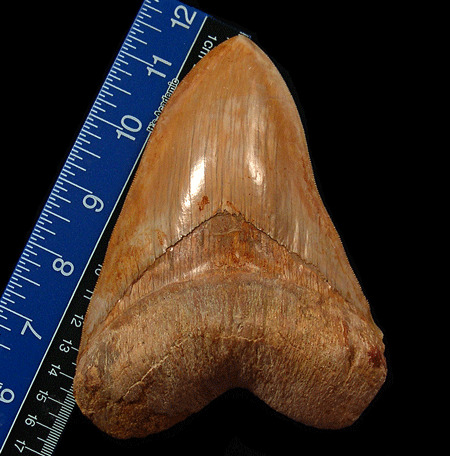
Megalodon (Otodus megalodon) has always fascinated scientists and fossil enthusiasts. In our work, we have seen how this colossal shark, which lived between approximately 4 and 20 million years ago, continues to capture imaginations. It left behind its most tangible legacy in the form of massive, triangular teeth. From these fossilized remains, researchers have been able to piece together a remarkable picture of how enormous this prehistoric predator might have been.
For many, the first question is how big a megalodon tooth is, because this measurement is the foundation of understanding its full scale. In the absence of complete skeletons, tooth size has become the primary reference point for estimating Megalodon’s overall body length.
Measuring Megalodon Teeth: Slant Height as the Standard
The most common metric for assessing Megalodon tooth size is the slant height, which is the straight line distance from the tip of the tooth down to the longest edge of the root. This measurement has provided consistency across specimens, accounting for variations in tooth wear and curvature, and it allows fossils to be compared more reliably. Slant height has become the standard method scientists can use when correlating tooth size with shark body length.
What Typical Megalodon Teeth Look Like
Although Megalodon teeth can reach astonishing sizes, the largest specimens that exceed seven inches are exceptional rather than representative. Most teeth are found in the 4 to 5 inch range. Six-inch teeth, while not the absolute maximum, are still considered exceptionally large. From these dimensions, scientists have been able to apply scaling relationships established by studying modern sharks to infer total body length. Megalodon is often estimated to have reached over 50 feet in length, and these figures are supported almost entirely through tooth-based extrapolations.
The Rarity and Appeal of Six-Inch Teeth
Six-inch Megalodon teeth can hold a special place in both paleontological circles and among fossil collectors. They represent a rare middle ground, more common than the ultra-rare seven-inch giants, yet still far from ordinary. Their appeal may lie not only in their size, but also in their quality. Broad crowns, serrated edges, and complete roots combine to create specimens that capture attention.
High-quality teeth that manage to retain these features are especially valued because many fossil teeth have been worn, polished, or damaged in ways that reduce their usefulness for both science and collecting. For anyone wondering again how big a megalodon tooth is, these six-inch examples show how extraordinary its dimensions could be.
From Tooth to Total Body Length
Scientists are able to estimate Megalodon’s body length through regression formulas that connect tooth size with shark length, using modern shark species as models. By measuring slant height, researchers can apply these formulas to extrapolate overall size. While the exact formulas are not provided in the article, estimates have consistently placed Megalodon at more than 50 feet in length. This supports the conclusion that it was one of the most dominant predators ever to have existed in the oceans.
Why Condition and Authenticity Matter
When evaluating Megalodon teeth, condition, rarity, and authenticity must be considered. Larger teeth provide stronger data for estimating body length, but their value depends on how well preserved they are. Teeth with intact serrations, complete roots, and minimal damage are the most reliable for measurement. Wear, chips, polish, or enamel loss can obscure accuracy and reduce their overall value.
Natural, unrestored teeth remain far more helpful for both science and collecting, while restored or altered specimens may distort measurements and conclusions. Although many specimens on the market show wear or repairs, premium examples with sharp serrations, intact enamel, and full roots continue to be highly credible for study.
The Power of a Tooth: Connecting to Prehistoric Giants
Each well-preserved Megalodon tooth can serve as a tangible link to a time when massive sharks dominated ancient oceans. In addition to providing size estimates, these fossils reveal detailed anatomy from serrations to the bourrelet near the root. They also act as historical artifacts, offering insight into a predator that likely hunted whales and other large marine animals.
At the same time, they allow scientists and collectors to build evolutionary and ecological narratives from millions of years ago. Given its estimated length of over 50 feet, Megalodon was likely the largest shark in history. Its teeth, therefore, hold both scientific data and symbolic importance, connecting modern observers with life forms of extraordinary scale.
Collecting Megalodon Teeth: Factors to Prioritize
For those who are interested in acquiring Megalodon teeth, several considerations should be prioritized to preserve both scientific and collector value. The most reliable specimens are measured using slant height, and they retain intact serrations, enamel, and roots.
Authenticity is also critical, as unrestored specimens are the most valuable. Reconstructed teeth may not provide reliable data, so working with reputable sellers who guarantee authenticity and provenance is essential. These steps help ensure that fossils remain both scientifically credible and collectible.
Are Six-Inch Teeth the Norm?
The answer is clear. Four to five-inch Megalodon teeth are the most common, six-inch specimens are huge and highly regarded, and seven-inch teeth are extraordinary and extremely rare. Measured through slant height, each tooth can contribute valuable data toward determining the actual size of Megalodon. These fossils are not only prized by collectors but also essential for reconstructing the biology of a prehistoric predator.
Final Thoughts
Scientists have relied on measurable features, particularly the slant height of Megalodon teeth, to estimate the colossal size of this ancient shark. Without complete skeletons, teeth remain the primary evidence that can shed light on its massive proportions. Six-inch teeth hold a special role in the fossil record: they are larger than most, but not unattainable.
When preserved in excellent condition with serrations, enamel, and roots intact, they provide tremendous scientific and collector value. Megalodon teeth continue to inspire and inform. For anyone still asking how big a megalodon tooth is, the answer lies in these rare fossils, which serve as both scientific evidence and fascinating connections to a world where giants once roamed the seas.






