

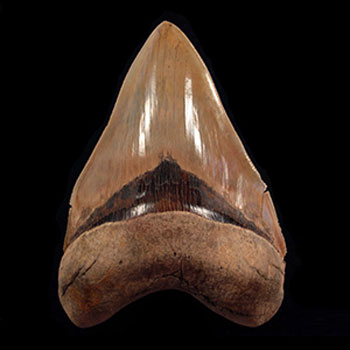
When we hold a real megalodon tooth, we are holding a tangible piece of Earth's ancient oceans, a striking relic that can stir wonder and inspire awe. In our collection, these fossilized teeth are carefully preserved, and they often become treasured family heirlooms.
Their enduring appeal can be found in history, rarity, and beauty that continue to captivate generation after generation.
A Majestic Legacy of Size, Power, and Prehistoric Grandeur
Megalodon was one of Earth's largest predators, estimated to have reached lengths of up to 60 feet and weighed 50 to 75 tons. Its bite force, measured at up to 18 tons per square inch, could crush massive prey such as whales. Its teeth were correspondingly enormous, often measuring 6 to 6½ inches, and occasionally approaching 7 inches.
A well-preserved Megalodon tooth can serve as more than an artifact. It may become a dramatic reminder of oceans once ruled by giants. Families can continue to pass down such relics as symbols of strength, survival, and ancient history. Passing a tooth from one generation to another ensures that a piece of natural wonder remains close, no matter how much time moves forward.
Rare Fossils of Size and Preservation
Although sharks continually shed teeth, not all can become preserved fossils. The specific conditions required for fossilization were rare, which makes high-quality specimens especially valuable. Among these, large specimens that exceed 5 inches are particularly scarce.
Teeth that remain intact, with razor-sharp serrations and complete roots, are considered remarkable
finds. Some may come from unique fossil sites such as Sharktooth Hill in California, copper-colored deposits in North Carolina, or fossil beds in Peru and Chile. Once such fossils enter family collections, their rarity can increase their significance both sentimentally and financially. A family heirloom of this nature is unlike jewelry or artwork—it is a slice of Earth’s history that cannot be recreated.
A Window into Ancient Seas
A Megalodon tooth is more than hardened stone. It has represented millions of years of natural history. As sharks constantly lose and replace teeth throughout life, the sheer volume of Megalodon teeth produced would have been immense. Yet, only a small fraction could fossilize under the right conditions.
These fossils may narrate a story of prehistoric oceans, predatory dominance, and evolutionary adaptation. A tooth can act as a direct link to a predator that once controlled the seas. For families, possessing a real megalodon tooth can be a legacy piece that sparks curiosity and fascination across generations. Children and grandchildren may grow up hearing tales about how these sharks once hunted whales, creating excitement and respect for the mysteries of the past.
Authenticity, Condition, and Provenance
Not every Megalodon tooth holds the same value. Collectors often look for authenticity, condition, and origin. Natural coloration from minerals, intact enamel, and undamaged serrations may signal a genuine and desirable fossil.
Provenance can also play an important role. Teeth from closed fossil beds or restricted sites may carry a higher demand because supply has become limited. With time, authentic specimens may become increasingly difficult to acquire, which ensures that a family-held tooth grows into a more meaningful heritage object. Families that pass down such fossils are not only sharing an object but also ensuring the next generation inherits something of rarity and importance.
Aesthetic and Educational Appeal
Megalodon teeth can be visually captivating. Their broad, triangular crowns and serrated edges may display colors ranging from charcoal black to shades of red, silver, and gold. Some fossils are noted for extraordinary qualities such as copper tones, glossy finishes, or multi-colored enamel.
Premium specimens are often paired with custom display stands, transforming them into striking centerpieces suitable for homes or private collections. They can serve both as conversation pieces and as teaching tools that encourage children and adults alike to learn more about Earth’s history. Objects that combine beauty with education are well-positioned to be kept as family heirlooms. Displayed in a study, office, or living room, they often become the centerpiece of conversations during gatherings, connecting people to both science and heritage.
The Stories They Carry
Every Megalodon tooth has a story. From being shed in an ancient ocean, buried in sediments, fossilized over millions of years, and then rediscovered, each tooth embodies both time and place.
When a fossil like this enters a family collection, its narrative continues to grow. It becomes tied to personal histories and memories. Stories of when it was acquired, how it was displayed, and where it originated can be shared with each passing generation. As these stories accumulate, the fossil evolves into more than an object. It becomes a vessel of both natural history and family heritage. Heirlooms gain their meaning through connection, and few objects hold as much connection to Earth’s distant past as a real megalodon tooth.
Conclusion
A real megalodon tooth can represent far more than an ancient fossil. It may serve as a symbol of natural power, a rare relic preserved against the odds, and a tangible reminder of prehistoric oceans. With authenticity, rarity, and striking beauty, these teeth often transform into treasured family possessions.
When carefully preserved and proudly displayed, they may grow in symbolic and personal value, ensuring they remain significant for future generations. That lasting blend of rarity, history, and meaning explains why a real megalodon tooth often becomes a cherished family heirloom. As one collector once said, “Holding a Megalodon tooth is like shaking hands with history.”






