

Shark teeth have fascinated scientists and collectors alike for centuries. But few comparisons spark more curiosity than the difference between a Megalodon tooth and a Great White shark tooth. While both predators have left their mark in ocean history, their fossilized teeth tell distinctly different stories of scale, power, and time.
In this post, we’ll break down how these two giants of the deep compare, from size and shape to structure and significance. And if you’ve ever asked yourself, how big is a megalodon tooth, we’ll answer that too—alongside insights into rarity, value, and the collecting world.
A Tale of Two Apex Predators
Let’s begin with the sharks themselves. The Megalodon (Carcharocles megalodon) ruled the seas from about 20 to 4 million years ago. This enormous predator could grow over 50 feet long—more than three times the size of today’s Great White shark (Carcharodon carcharias), which usually maxes out around 20 feet.
While these species never coexisted, they are often compared because of their similar body shapes and carnivorous lifestyles. Yet, the key to understanding their legacy lies in their teeth—one of the only fossilized remains left behind by sharks, whose skeletons are made mostly of cartilage.
Size Matters: The Shocking Difference in Tooth Length
The most striking contrast between a Megalodon and a Great White tooth is size. Great White shark teeth typically measure about 1.5 to 2.5 inches in height. They’re sharp, triangular, and serrated—perfect tools for slicing through flesh and bone.
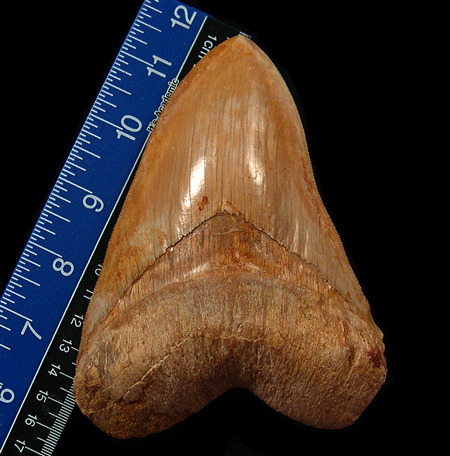
Now let’s talk about the Megalodon. How big is a Megalodon tooth? On average, they range between 4 and 5 inches. But some incredibly rare specimens exceed 6 inches, and the largest ever discovered tops out at just over 7 inches. That’s nearly triple the length of a Great White’s tooth—and exponentially more massive when you consider overall volume.
This size isn’t just impressive; it’s practical. A shark the size of a city bus needed giant teeth to subdue whales, giant sea turtles, and other enormous prey. These teeth were designed for power, not just cutting.
Shape and Structure: Not Just a Bigger Version
It’s tempting to look at a Megalodon tooth and think it’s just a scaled-up version of a Great White’s. But there are subtle differences worth noting.
Megalodon teeth are broader and more robust, with thicker roots and wider crowns. The blades often appear slightly curved and are equipped with serrated edges, just like the Great White’s, but on a much larger and heavier scale. These teeth could exert forces strong enough to crush bone, far beyond the slicing function of a Great White’s bite.
On the other hand, Great White teeth are more slender and sharply angled. They’re built for quick, clean cuts through slippery fish and marine mammals like seals. Their form allows for a fast, slashing attack, whereas the Megalodon’s teeth were built for grip and domination.
Color and Texture: A Fossil Collector’s Dream
Another point of comparison lies in the color and texture of fossilized teeth. Great White shark teeth can occasionally be found as fossils, but they’re rarely older than a few hundred thousand years and often still white or off-white in color.
Megalodon teeth, in contrast, come in a range of hues—black, brown, gray, and even bluish tones—depending on the minerals present in the sediment where they fossilized. These colors and the tooth’s overall preservation (serrations, enamel condition, root integrity) play a massive role in value for collectors.
Rarity and Value: Why Size Isn’t Everything, But It Sure Helps
High-quality Megalodon teeth with full serrations, unbroken roots, and vibrant coloration can command thousands of dollars—especially when they hit or exceed that legendary 6-inch mark.
When it comes to fossil hunting and collecting, bigger usually means rarer—and more expensive. For Megalodon teeth, anything over 5 inches is impressive. But 6-inch teeth? Those are in a league of their own.
That brings us back to our core question: how big is a megalodon tooth, really? In truth, while many fall in the 4-to-5-inch range, a 6-inch tooth is considered exceptionally large and highly coveted. Finding one that is well-preserved, with minimal wear and no restoration, adds to the rarity.
By comparison, Great White teeth are far more accessible. They can be found regularly by divers and collectors around the world and don’t typically fetch high prices unless they’re unusually large or well-preserved.
What Do These Teeth Reveal About Each Shark?
Megalodon teeth are not just larger—they tell us about the shark’s hunting style, diet, and place in prehistoric ecosystems. The structure and placement of the teeth (in multiple rows across powerful jaws) helped Megalodon take down massive prey with crushing force.
Great Whites, on the other hand, exhibit tooth regeneration every few weeks—a trait shared by all sharks. Their teeth reflect their speed and precision, as they often bite and retreat, waiting for their prey to weaken.
Each tooth serves as a fossilized snapshot of evolution, strategy, and survival in the marine food chain.
Fossil Hunting: What Should You Look For?
For anyone fascinated by fossil collecting, Megalodon and Great White teeth are prized finds. But there’s a big difference in availability, value, and verification.
Here are a few tips if you're on the lookout for Megalodon teeth:
● Measure with slant height: This measures the longest diagonal edge from the tip to the root, providing the most accurate representation of tooth size.
● Check for serrations and enamel: Intact serrations and glossy enamel are signs of a high-quality fossil.
● Avoid over-polished specimens: Some sellers artificially polish teeth, which can reduce value.
● Seek authenticity: Always buy from reputable sellers who offer identification cards and don’t alter fossils.
For Great White teeth, condition matters, but the stakes (and the costs) aren’t nearly as high. They’re still an amazing addition to any collection, but won’t usually reach the dramatic pricing tiers of large Megalodon specimens.
So Which Tooth Is More Impressive?
That depends on what impresses you more—history or ferocity. A Great White’s tooth is razor-sharp and represents one of today’s top ocean predators. It’s sleek, deadly, and highly efficient.
But a Megalodon tooth? It’s a literal piece of ancient ocean history. Just holding one is like gripping a relic from a time when the seas were ruled by giants. The sheer size and strength behind it command awe.
And if you’re wondering again how big a megalodon tooth is, just remember: 4 to 5 inches is typical, 6 inches is rare, and 7 inches is a near-mythical find.
Wrapping Up
Both Megalodon and Great White shark teeth carry stories of survival, power, and evolution. But side by side, the Megalodon tooth dominates in size, mass, and fossil value.
From a collector’s standpoint, a pristine Megalodon tooth is the crown jewel of any fossil collection—especially when it reaches that 6-inch benchmark. These teeth are rare, captivating, and often valuable artifacts from a lost world.
Whether you’re a fossil hunter, shark enthusiast, or just someone intrigued by nature’s extremes, both types of teeth offer a window into the mysteries of the ocean. And if someone ever asks, how big is a megalodon tooth, now you’ll know—it’s not just big. It’s monumental.






