

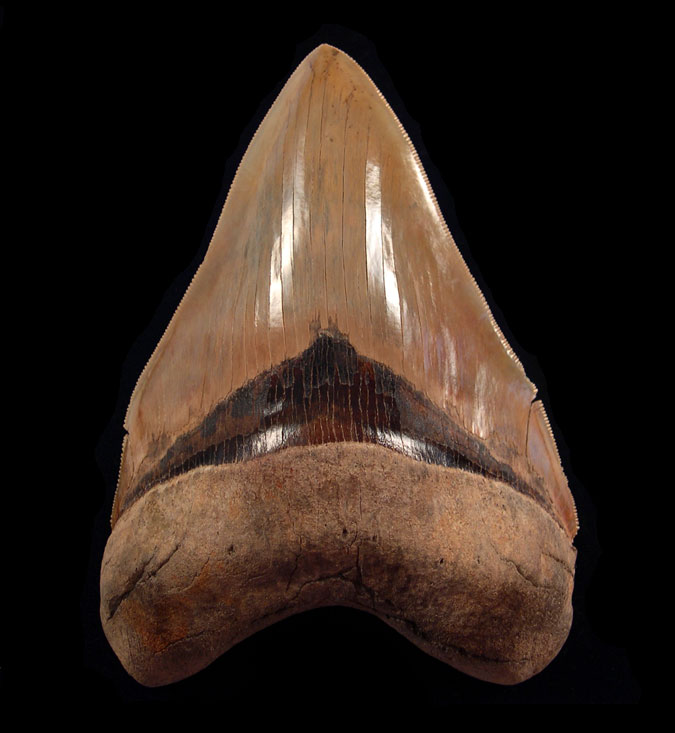
In our work with fossils, we often see how new discoveries reshape our understanding of prehistoric life. As we examine specimens, we find ourselves drawn into the details that reveal more about size, structure, and history. The fossil record of Otodus megalodon is dominated by its enormous, serrated teeth, and paleontologists have long used tooth size as a way to estimate body length.
Examples of 6-inch-plus megalodon teeth are described as evidence that body length most likely exceeded 50 feet. If a truly exceptional individual were to produce an 8-inch megalodon tooth, we would need to rethink the maximum shark size and what that means for growth models and physiological limits.
Tooth to Body Scaling
Tooth to body scaling has always provided the basis for estimating overall size in sharks. Researchers have observed that tooth size can correlate with body size, and regressions have been applied to extinct sharks using well-preserved specimens. It is explained that the most prominent examples of Otodus megalodon teeth exceed 7 inches in length and are extremely rare, and from that evidence, body lengths most likely exceeded 50 feet.
If a hypothetical 8-inch megalodon tooth were found, scaling upward from known 6-inch examples proportionally would give an estimated body length of more than 66 feet, or about 20 meters. That means the shark could have grown far larger than the immense individuals already documented with six or 7-inch teeth. Even if growth did not follow a strict linear path, an 8-inch specimen would still indicate a larger size than researchers have considered typical.
Comparisons with Known Specimens
Teeth measuring 6 inches or more are already rare and valuable, representing some of the most significant fossils available. Specimens exceeding 7 inches are considered extremely rare. An 8-inch megalodon tooth would therefore move well past this range, representing an increase of 14 to 33 percent compared to known 6 to 7-inch examples.
If proportions such as crown width, root thickness, and serration quality were consistent with smaller specimens, the supporting jaw and musculature would have had to increase in scale as well. The structural stresses on the root would have been intense, and the jaw would have needed to withstand those forces without failure.
Modern sharks provide insight into such limits. Their growth often follows biological restrictions rather than pure linear scaling. At extreme sizes, metabolic and structural constraints may begin to slow growth. An 8-inch tooth would suggest that these limits might have been more flexible than previously believed.
Growth Models
The appearance of an authentic 8-inch tooth could alter growth models and upper limits in several ways. Scaling relationships would need to be revised, as regressions built around 6 to 7-inch teeth would not account for such an extreme outlier. If the 8-inch example did not align with expected values, it could indicate that nonlinear growth patterns played a more significant role than once thought.
The upper bound of shark size would also need to be adjusted. The earlier estimate that body length most likely exceeded 50 feet would no longer suffice, and credible calculations could raise that limit into the 60 to 70 feet range. At such a size, feeding systems, locomotion, and tissue support would have required extraordinary efficiency.
Rarity would also be a critical factor. Teeth greater than 7 inches are already scarce, so an 8-inch specimen would imply that only a minimal number of individuals achieved such extraordinary growth. Growth models may need to account for this rarity, recognizing that extreme giants existed but were exceptions.
Finally, ecological implications would come into focus. A larger maximum size would suggest predation on bigger marine animals, reshaping how ancient ecosystems are reconstructed and understood. The role of megalodon as a top predator would take on even greater significance, influencing how energy flowed through marine food webs millions of years ago.
Caveats
Specific cautions must be acknowledged in any interpretation of an 8-inch megalodon tooth. Measurement conventions matter, since many fossil listings use slant height unless otherwise noted. Misinterpretation of this detail could exaggerate the size. Preservation and wear also play an important role, as large fossil teeth often show breaks or restoration. Any 8-inch specimen would need careful examination to confirm authenticity.
Extrapolation beyond 7-inch teeth increases uncertainty, introducing larger error margins. Biological plausibility is another factor, since the rest of the anatomy would need to support a tooth of that size. Some teeth may have grown disproportionately without representing a corresponding body length.
Broader Implications
The presence of an 8-inch megalodon tooth would have implications beyond size estimates. It would encourage new discussions about how marine predators evolve and push biological boundaries. Growth to such dimensions would require vast amounts of food, stable ecosystems, and environmental conditions that could sustain enormous predators. This, in turn, might reveal more about ancient oceans, prey availability, and the balance of marine life millions of years ago.
For fossil collectors and researchers, such a find would also highlight the importance of rare specimens in reshaping knowledge. Each discovery has the ability to add a new piece to the puzzle, challenging assumptions and opening new questions. A verified 8-inch tooth would not only push the limits of megalodon research but would also inspire more focused study of scaling, biomechanics, and the relationship between predators and their ecosystems.
Conclusion
An 8-inch megalodon tooth, if verified, would be larger than any specimen currently described, where 6 to 7-inch teeth are already considered exceptional. Since tooth size serves as the primary basis for estimating body length, such a find would require a significant reevaluation of scaling models and growth patterns. It would likely expand the upper limits of estimated size and spark new questions about physiology and ecology. At the same time, it would be necessary to confirm authenticity, apply consistent measurement methods, and assess biological feasibility.
The possibility of such a discovery invites a fresh perspective on the natural history of sharks. It illustrates how one remarkable fossil could reshape the story of an apex predator, challenge current limits of understanding, and provide a deeper appreciation for the complexity of life that once thrived in ancient seas.






