Starting your fossil-collecting journey is exciting, especially when you’re holding a tooth from one of the most legendary sharks to ever swim the ocean. As you grow your collection, you’ll hear a lot about spotting a fake megalodon tooth, which is especially important since replicas are more common now than ever. That’s why we want to give young collectors a clear, practical way to understand the difference—starting with weight.
Why Megalodon Teeth Matter to Young Collectors
Megalodon teeth are some of the most popular fossils on the planet. They’re big, bold, and full of prehistoric personality, which is why they’re the perfect beginner fossil for teen hobbyists. When you explore our collection at Buried Treasure Fossils, the first thing you’ll notice is how each real tooth carries millions of years of natural history. No two are alike, and each one has its own unique journey from the ocean floor to your hands.
But this popularity comes with a downside—replicas flood the market, and young collectors often struggle to separate the impressive real specimens from the convincing fakes. The good news? You don’t need special tools or advanced paleontology knowledge to learn the difference. One of the easiest tests you can try is simply picking up the tooth and feeling its weight.
The Weight Test: A Simple Trick for Beginners
Weight is one of the most reliable ways to tell a real Megalodon tooth from a fake one. Fossilized shark teeth, especially those from Megalodon, are incredibly dense. That density comes from the fossilization process itself—over millions of years, minerals replace the tooth’s original organic material, turning it into stone. This mineralization makes real Megalodon teeth significantly heavier than modern teeth or resin-based replicas.
When you hold a fossil, you’re lifting a piece of Earth’s natural geology. That’s why the weight feels solid, grounded, and older than anything man-made. Resin fakes, on the other hand, feel light and almost hollow by comparison. Think of it like the difference between picking up a river stone and picking up a plastic toy—the weight alone tells a story.
Why Fossilized Teeth Are Naturally Heavier
Understanding why real Megalodon teeth are heavier gives young collectors even more confidence when evaluating a specimen. Here’s what happens during fossilization:
● Minerals take over: Over millions of years underground, minerals such as iron, phosphate, and silica slowly replace the tooth’s structure.
● Organic material disappears: The original biological material decays and is replaced entirely by those minerals.
● The tooth becomes stone: What you hold in your hand today isn’t “just a tooth”—it’s a natural rock shaped by ancient seas.
Because minerals are denser than bone or dentin, fossilized Megalodon teeth feel weighty and substantial. A real tooth always has a “stone-like” heft to it. Resin fakes are typically produced by pouring plastic mixtures into molds, so they feel unnaturally light—especially if they’re large in size.
If you ever hold a big tooth that seems surprisingly light, that’s your first red flag.
Surface Texture: A Close-Up Clue for Young Collectors
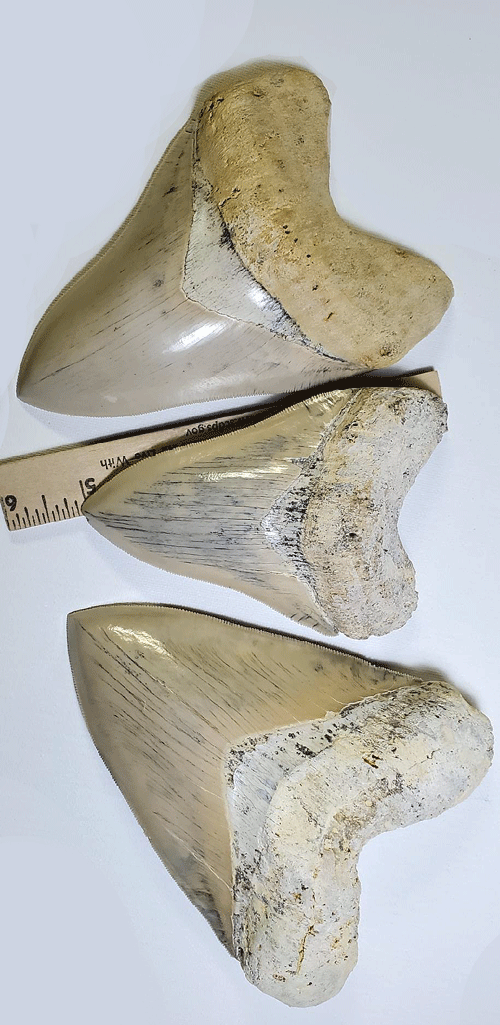
Weight isn’t the only factor, of course. Another way to separate a real tooth from a replica is by looking closely at the surface. Genuine Megalodon teeth have a mix of textures:
● Smooth enamel
● Slight pitting from exposure to minerals
● Natural imperfections around the edges
● Fine serrations that may be worn or uneven
Fake teeth often try to mimic these features but rarely succeed fully. Their surfaces tend to look too uniform, too shiny, or too perfect. If you can see identical patterns repeating on both sides of the tooth, that’s usually a sign it was produced from a mold.
The Importance of Serrations
Real Megalodon teeth were built for one purpose—cutting through massive prey. That’s why they originally had razor-sharp serrations along the edges. In fossils, these serrations often survive but show differences in wear and sharpness.
If the serrations look suspiciously sharp, perfectly even, or identical along the whole edge, the tooth may be a fake. Nature doesn’t do perfect symmetry after millions of years.
Color Variations That Reveal the Tooth’s History
One of the coolest things about real Megalodon teeth is how their color reflects the location where they were buried. Minerals from the surrounding sediment seep into the tooth, creating unique patterns and shades. Real teeth may show combinations of:
● Black
● Gray
● Brown
● Blue
● Cream
● Copper tones
Fakes usually have a more uniform color since resin is often dyed a single shade. If the color feels painted on or doesn’t look naturally blended, weight-test it again—your instincts are probably right.
The Role of Provenance and Why It Matters
Even with all your new skills, checking the source is always important. At Buried Treasure Fossils, we’ve built our reputation on providing legally collected, authentic Megalodon teeth from trusted dig sites around the world. Because we work directly with fossil hunters and field collectors, we can share details such as:
● Where the tooth was found
● How it was sourced
● What condition it was in before cleaning
● What makes it unique
Young collectors benefit tremendously from buying fossils with clear, trustworthy histories. A tooth with proper provenance doesn’t just look better in your collection—it's more valuable for long-term investment.
Comparing Real vs Fake: The Weight Test in Action
Let’s walk through a simple example. Imagine two 5-inch Megalodon teeth in front of you. They look similar at first glance, but once you pick them up:
● The real tooth feels heavy, solid, and dense. You can sense the mineralization when your fingers wrap around it.
● The fake feels noticeably lighter—sometimes shockingly so for its size. Even large resin replicas often weigh less than half of a real fossilized tooth.
This method works incredibly well for young collectors because you don’t need advanced equipment or years of fossil knowledge—just your hands and a bit of curiosity.
What Young Collectors Should Practice
We always encourage new collectors to:
● Hold as many real specimens as possible
● Ask questions about where the tooth was found
● Compare textures, colors, and serrations
● Pay attention to that unmistakable fossil weight
Over time, your instincts will sharpen, and spotting a fake becomes almost automatic.
Why We Make Fossil Collecting Beginner Friendly
Our goal is to make fossil collecting accessible, fun, and educational for everyone—especially young collectors. We offer entry-level Megalodon teeth alongside museum-grade specimens so no one feels left out of the hobby. Whether you're saving your allowance or building your first display shelf, we’re here to guide you with honest information and authentic fossils you can trust.
Conclusion: Trust the Weight, Trust Your Instincts
Young collectors are at the perfect stage to build smart habits in fossil identification. If you ever come across a fake megalodon tooth, remember that weight, texture, color, and provenance all work together to tell the truth. Real Megalodon teeth are heavier because minerals have completely replaced the original tooth, giving you the chance to hold millions of years of ocean history in your hands.
As you continue exploring, learning, and growing your collection, we’d love to help you take the next step. Browse our authentic specimens, compare real teeth up close, and build a collection that reflects your passion for ancient oceans and giant prehistoric sharks.