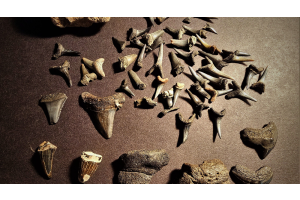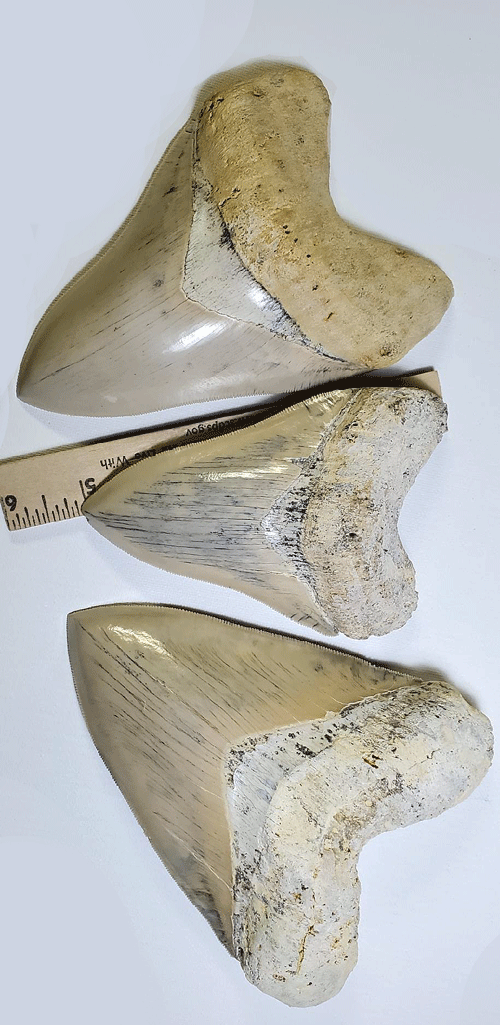
Few learning moments light up a child’s imagination quite like holding an ancient fossil in the palm of their hand. Within the first minute of exploring a real specimen, curiosity awakens, questions begin to tumble out, and Earth’s long-ago stories suddenly feel much closer. When students or young explorers get the chance to examine a big megalodon tooth, that moment becomes even more powerful because they’re touching a piece of a creature that ruled the oceans millions of years ago.
Why a Megalodon Tooth Captures Kids’ Imaginations
For middle-school learners, big concepts—like extinction, deep time, and evolution—can feel too abstract when presented only through textbooks or videos. But fossils instantly make those ideas tangible. A megalodon tooth isn’t just a rock; it's a preserved biological tool that once helped a massive ancient shark survive its marine ecosystem. When kids hold one, they’re not imagining history—they’re physically connecting with it.
At Buried Treasure Fossils, we’ve seen this spark firsthand. Families, teachers, and young fossil enthusiasts often share stories about how discovering authentic shark teeth helps children better understand science, Earth history, and even their own sense of wonder. When a fossil is large, well-preserved, and millions of years old, it becomes a natural starting point for countless educational conversations.
The Megalodon: A Gateway to Prehistoric Curiosity
A megalodon tooth offers more than its impressive size. It gives kids a glimpse into a world where oceans were warmer, coastlines were different, and giant predators shaped marine ecosystems. When children hold such a fossil, they can begin to imagine what the megalodon’s life must have been like—how it hunted, how it grew, and why it eventually disappeared.
The tooth’s serrations, density, and coloration each tell a scientific story. Those subtle details help kids practice observational skills, encouraging them to ask questions such as:
● Why are there tiny ridges along the edge?
● How did such a large shark develop these massive teeth?
● What kinds of prey lived during the same time?
● How do scientists figure out the age of a fossil?
Questions like these naturally guide them into deeper scientific thinking and encourage them to explore paleontology, evolution, and biology.
Understanding Fossilization Through Hands-On Learning
One of the hardest concepts for young students to grasp is the immense passage of time—millions of years. Holding a fossil transforms that abstract idea into something concrete. When kids feel the weight, shape, and mineralized texture of a tooth, they gain firsthand insight into how fossils form.
A real megalodon tooth has been changed slowly, layer by layer, through mineral replacement and geological pressure. The colors—ranging from deep blacks to sandy browns—reflect the minerals found in the ground where the tooth rested. Kids learn that nature itself “paints” fossils over time, turning once-living structures into enduring pieces of Earth’s history.
This tactile experience is especially important for middle-school learners, who often retain information better through hands-on engagement. Instead of memorizing steps of fossilization, they get to feel the outcome of that ancient process.
Bringing Marine Evolution to Life
A megalodon tooth also serves as an ideal tool for teaching marine evolution. The tooth’s size, shape, and serrations demonstrate how predators adapted to oceans filled with large marine mammals like ancient whales. Through comparison, kids can observe how tooth shape reveals feeding habits:
● Serrated edges indicate a predator that slices through flesh
● A wide root suggests a powerful bite force
● A triangular shape signals efficiency for tearing large prey
From there, kids can explore how sharks changed over millions of years—how some species grew larger, how others vanished, and how modern sharks evolved from ancient relatives. This understanding builds a strong foundation for future studies in evolution and environmental science.
Deep-Time Thinking: A Skill Kids Rarely Practice
Deep time—the idea of Earth’s history stretching across billions of years—is incredibly difficult for kids and adults alike to visualize. But physical fossils act like time machines. They shorten the distance between now and then.
Holding a megalodon tooth encourages children to think beyond their immediate world:
● What was Earth like when this shark lived?
● How were continents shaped differently?
● What creatures swam beside the megalodon?
● How many millions of years passed before humans appeared?
This practice helps students develop scientific perspective, an essential skill for building critical thinkers. The tooth becomes a bridge, linking relatable curiosity with profound concepts.
The Sensory Power of a Big Fossil
Children learn through multiple senses—touch, sight, and even imagining the sounds or environments associated with an object. A large fossil engages them on several levels:
Weight and Texture
A genuine tooth feels surprisingly heavy, allowing kids to sense its age and density.
Visual Details
Serrations, root structure, and enamel variations give them real scientific features to analyze.
Scale and Comparison
Placing the tooth in their hand makes them grasp the massive scale of megalodon compared to modern animals.
This sensory experience makes the science behind fossils “stick” more effectively than reading facts on a page.
Why Authentic Fossils Matter for Kids’ Learning
Replica fossils have their place, especially in classrooms. But authentic fossils inspire a deeper emotional connection. There’s something profound about knowing a specimen is real—knowing it traveled through time untouched by human hands.
At Buried Treasure Fossils, we prioritize authenticity, quality, and educational value. Families trust us because every piece we offer has been legally collected, carefully verified, and responsibly sourced. When a child holds one of our fossils, they’re holding the real thing—not a plastic mold. That authenticity can spark a lifelong love of science.
Encouraging STEM Learning at Home
Parents and teachers often look for meaningful ways to introduce STEM concepts outside of textbooks. Fossils make that easy. You can build simple, engaging activities around them:
● Have kids sketch the tooth and label its parts
● Compare a megalodon tooth to a modern shark tooth
● Create a timeline showing when different species lived
● Watch marine science videos after examining the fossil
● Explore how scientists determine the age of a specimen
These activities feel like play but deliver rich scientific learning.
Why We Love Sharing Fossils With Families
As fossil lovers ourselves, we want kids to experience the same excitement that first inspired us. For more than two decades, we’ve dedicated ourselves to making fossils accessible to families, collectors, educators, and young scientists. Our mission is not just to offer fossils but to ignite scientific curiosity and help people connect meaningfully with Earth’s past.
When a child holds a megalodon tooth we’ve supplied, we know we’re playing a small part in encouraging their imagination, their sense of adventure, and their understanding of the natural world.
Conclusion: A Tooth That Teaches More Than History
A big megalodon tooth is more than a fossil—it’s a teaching tool, a spark of curiosity, and a doorway into the awe-inspiring timeline of our planet. When kids hold one, they connect instantly with ancient oceans, evolving species, and the incredible processes that preserve life long after it disappears. If you’re ready to help a young explorer experience that excitement firsthand, we invite you to explore our authentic fossil collection and discover a specimen that can inspire learning, imagination, and true scientific wonder. Let us help you bring Earth’s deep history directly into your home or classroom—one fossil at a time.