

Imagine the sun warming your shoulders, the sand shifting beneath your feet, and the waves quietly whispering stories from millennia past. Then, just as you're about to head home, your eye catches something unusual—triangular, serrated, and darkly beautiful. It’s not just any rock. It might just be the fossilized tooth of the ocean’s greatest predator: the Megalodon.
Fossil hunting may sound like the work of scientists and paleontologists, but every year, ordinary people stumble across remnants of ancient giants. Among the most coveted? The North Carolina Megalodon tooth is a relic from one of the largest and most fearsome sharks to have ever roamed the seas.
What Was the Megalodon, Really?
The Megalodon, officially known as Carcharocles megalodon, was a massive prehistoric shark that ruled the oceans between 20 and 3 million years ago. With an estimated length of up to 60 feet and jaws powerful enough to bite through a small car, this predator dominated marine ecosystems during the Miocene and Pliocene epochs.
Unlike today’s great white sharks, which may grow up to 20 feet, the Megalodon had teeth as large as a human hand—some even reaching over 7 inches in length. These were not just big teeth; they were built for destruction. Fully serrated, triangular, and thick, they allowed Megalodon to bite through whale bones, large turtles, and other hefty prey with terrifying efficiency.
And that brings us back to the beach.
Why the Beach Could Be a Treasure Trove
Many people think fossils are found only in deserts or remote cliffs, but coastlines—especially those with known fossil deposits—can be full of surprises. North Carolina’s coastal areas, particularly around the now-closed Lee Creek phosphate mine in Aurora, have long been hotspots for fossil hunters. This location has yielded some of the finest specimens ever found, including stunning examples of Megalodon teeth.
Although the Lee Creek mine closed to collectors in 2008, old collections still surface in the fossil trade, and the surrounding areas continue to reveal hidden gems during storms and low tides. The North Carolina Megalodon tooth is known not only for its remarkable preservation but also for its variety of colors, from rich tans and browns to bluish grays, depending on the surrounding sediment in which the tooth fossilized.
What Makes a Megalodon Tooth Valuable?
Not all fossil teeth are created equal. Some are chipped, weathered, or even restored. Serious collectors, however, look for authenticity, condition, and context.
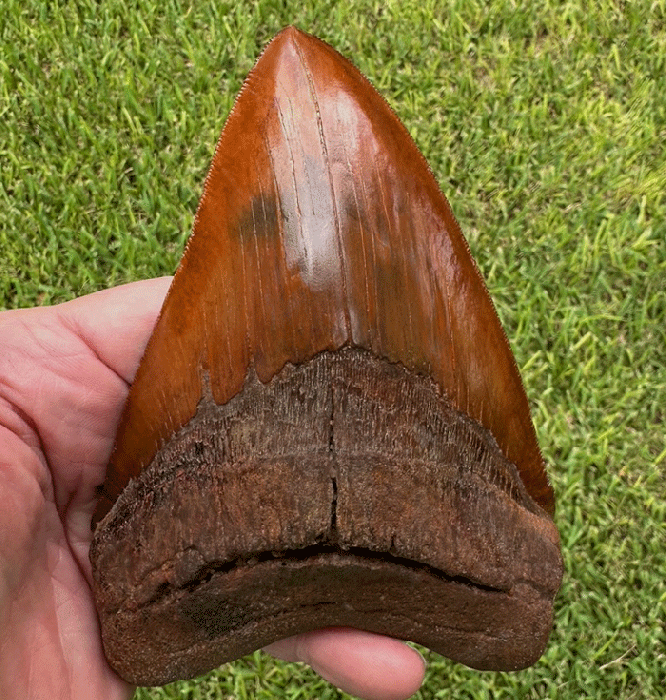
Take, for example, a Lee Creek Megalodon tooth from the Pungo River Formation. These are typically dated to about 14.5 million years ago and are often found in exceptional condition. A quality specimen might have a complete root, sharp serrations, and an intact bourlette (the dark band between the root and the crown). These details matter—not only for aesthetic reasons but also for scientific integrity.
One such tooth, taken from the lower jaw’s principal anterior position, shows a beautiful tan crown with an excellent brown bourlette. Though it’s missing its tip—possibly lost in a feeding frenzy—it retains incredibly sharp serrations and a complete root. The groove on the root lobes is an especially cool feature that excites collectors and paleontology enthusiasts alike.
And best of all? No repair. No restoration. Just pure, prehistoric authenticity.
The Power Behind the Bite
To fully appreciate the wonder of a Megalodon tooth, you have to understand the creature behind it. The Megalodon had the most powerful bite force ever estimated in the animal kingdom—up to 180,000 newtons. That’s enough to crush a car. Now imagine the kinds of prey this shark tackled: whales, large fish, and other marine mammals.
What gave the Megalodon its lethal edge wasn’t just size or muscle. It was its teeth—rows upon rows of them, constantly regenerating. Sharks, even today, lose and replace thousands of teeth over their lifetimes. Megalodons were no different. That means thousands of teeth ended up embedded in the sea floor, waiting to fossilize and be rediscovered.
Why Lee Creek Is Legendary
The Lee Creek phosphate mine isn’t just another dig site—it’s legendary. Known for producing some of the best-preserved Megalodon and Chubutensis teeth on Earth, it became a pilgrimage site for fossil hunters. The sedimentary layers here date back to the Miocene and Pliocene periods, and the chemical composition of the soil led to remarkable preservation.
Though collecting at the mine itself has been restricted since 2008, the legacy lives on. Collectors who once visited the site or sourced teeth from it now offer these pieces from old collections. Each tooth has a story—some bearing the scars of ancient battles, others near-perfect in form.
Midway through our fascination with these relics, it’s impossible to ignore the importance of the North Carolina Megalodon tooth in paleontology and fossil collecting. It represents not just a creature, but a time when Earth’s oceans were teeming with giant predators—and every beach walk might’ve come with a much deadlier surprise.
What to Look for on Your Beach Walk
Think finding a Megalodon tooth is a fantasy? Think again. Enthusiasts, amateur collectors, and lucky beachcombers have all found teeth along the shores of North Carolina, South Carolina, and Florida.
Here’s what to keep an eye out for:
● Shape: Megalodon teeth are broad, triangular, and often larger than other shark teeth.
● Serrations: The edges should be finely serrated (though some may wear smooth).
● Color: Depending on the minerals present during fossilization, they can be tan, black, gray, or brown.
● Root: Look for a solid, thick root structure. A missing root can reduce value, but it’s still a cool find!
A common giveaway? Their weight. Fossilized teeth are denser than typical rocks and have a unique texture when you run your fingers over them.
A Piece of History in Your Hand
Holding a Megalodon tooth is like holding time itself. It’s a tangible reminder of a world long gone—a glimpse into the prehistoric ocean, when apex predators ruled without rivals.
And it’s not just about the thrill. These fossils offer clues into ancient marine ecosystems, evolutionary biology, and climate history. For museums, scientists, and collectors, every tooth holds the potential to reveal something new.
For casual fossil hunters, however, it’s often the emotional connection that sticks. Finding a tooth isn’t just about adding to a collection—it’s about connecting with Earth’s deep past in a very personal way.
Wrapping Up
The idea that your next beach walk could end with a fossil from a 60-foot shark isn’t far-fetched. Whether you’re combing the shoreline after a storm or browsing through old collections from Aurora, North Carolina, there’s always a chance you’ll stumble upon something extraordinary.
The North Carolina Megalodon tooth is more than a collector’s item. It’s a link to the ancient world, a testament to the ocean’s former giants, and a rare treasure for those who know what to look for.
So the next time you find yourself wandering the beach, remember: keep your eyes on the sand. You never know what secrets the tide may reveal.






