

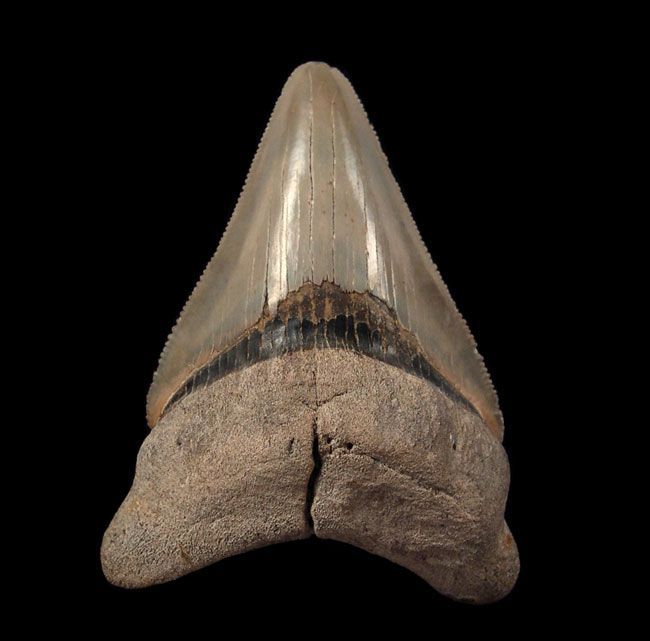
The ancient oceans once rumbled with the presence of a beast so massive, so powerful, that it could crush whales in a single bite. This predator was the Megalodon—an apex hunter that reigned supreme for millions of years. Today, all that remains of this legendary shark are fossilized teeth, each one a relic of prehistoric power. Among these, one specimen stands out for both its beauty and scientific value: the Aurora Megalodon tooth from the famed Lee Creek mine in North Carolina.
So, what secrets does this particular tooth still hold? Let’s take a closer look.
A Tooth from a Monster: How Big Was Megalodon, Really?
Megalodon (Otodus or Carcharocles megalodon) was no ordinary shark—it was a super predator. Estimates place its length at a staggering 60 feet, nearly three times the size of a great white shark. Its teeth were equally intimidating—massive, triangular, and fully serrated, measuring over 7 inches in some cases.
With a bite force estimated at up to 180,000 newtons, Megalodon could slice through the thickest bones and hide. Its primary diet? Whales and large marine mammals. These sharks didn’t nibble—they dominated.
But here’s the twist: although it once ruled the seas from the early Miocene to the end of the Pliocene (roughly 20 to 3 million years ago), only its teeth and a few vertebrae remain. Why just the teeth? Because a shark's skeleton is made of cartilage, which doesn’t fossilize as easily as bone.
Why the Lee Creek Mine Matters
The Lee Creek phosphate mine in Aurora, North Carolina, is one of the most renowned fossil hunting sites in the world. Over the years, this site has yielded some of the most beautiful and scientifically significant Megalodon teeth ever discovered. And among them, the Aurora Megalodon tooth has earned its place as a collector’s treasure.
This particular specimen was discovered in the Pungo River Formation, a geological layer dating back to the Miocene epoch—approximately 14.5 million years ago. While fossil sites often produce worn or fragmented teeth, Lee Creek was known for producing nearly pristine specimens with vivid color, sharp serrations, and well-preserved roots.
However, fossil collection at Lee Creek has been closed to the public since 2008, making specimens like this increasingly rare and valuable—not just monetarily, but scientifically.
What Can a Single Tooth Really Tell Us?
Surprisingly, quite a lot.
This Aurora Megalodon tooth is identified as a lower jaw principal anterior tooth. The tooth displays a beautifully preserved tan-colored crown, a striking brown bourlette (the transitional area between the enamel and root), and exceptionally sharp serrations—although its tip is missing, likely lost during a feeding frenzy. The root is a rich tan with few hydration cracks and even features a fascinating groove along the root lobes.
These subtle features tell us several things:
● Tooth Position and Function: Its position as a principal anterior tooth suggests it played a crucial role in grabbing and piercing prey. These front teeth would have inflicted massive wounds—ideal for hunting large animals.
● Feeding Behavior: The missing tip, attributed to a feeding frenzy, gives us a rare glimpse into the chaotic and violent feeding habits of Megalodon. It wasn’t just a solitary hunter—it may have competed with other predators, perhaps even other Megalodons.
● Fossilization Clues: The coloration of this tooth reflects the minerals present in the soil where it fossilized. The tan and brown hues are not just beautiful; they serve as geological markers that help scientists understand the conditions and age of the sedimentary layer.
Authenticity Matters: What Sets This Tooth Apart
In today’s fossil market, not all Megalodon teeth are created equal. Many are heavily restored—especially if they’re damaged or broken. However, this particular tooth stands out for its authenticity. It has no repair or restoration, which adds to its scientific credibility and collector value.
Restored teeth often involve gluing broken pieces or even fabricating missing sections. These are useful for display but less valuable for scientific study. With a completely natural specimen like the Aurora Megalodon tooth, paleontologists and collectors get a direct window into prehistoric life, unmarred by human alteration
The Bigger Picture: Why Megalodon Still Fascinates Us
So why does a single fossilized tooth from millions of years ago continue to capture our imagination?
Because Megalodon represents more than just a shark—it symbolizes nature’s raw power and mystery. It’s a reminder of how little we truly know about Earth’s ancient past. Every tooth found—especially one as well-preserved as this one from Lee Creek—adds a small piece to the puzzle.
Moreover, the fact that such teeth are now finite in number only deepens their significance. Since the closure of the Lee Creek mine to public fossil hunters in 2008, obtaining a tooth of this quality from that location has become increasingly rare. That adds an element of urgency for both collectors and researchers.
How This Tooth Connects Us to Prehistoric Oceans
Imagine holding this tooth in your hand—feeling the weight of it, tracing your finger along the serrated edge, observing the coloration created by millennia underground. It's more than a fossil; it’s a tangible link to a time when giants patrolled the oceans.
We often think of fossils as static, lifeless objects, but they’re anything but. They’re clues. They’re messengers. They’re voices from the past, still whispering secrets to those who are willing to listen.
And what does this Aurora Megalodon tooth whisper?
That somewhere, millions of years ago, a massive shark closed its jaws around a rival, a whale, or even a feeding opportunity gone wrong. That this very tooth—tan and brown, complete and real—was once embedded in the jaw of a ruler of the ancient seas.
Why the Aurora Megalodon Tooth Still Matters
In a world saturated with digital artifacts and synthetic materials, genuine relics from Earth’s ancient past are more valuable than ever. The Aurora Megalodon tooth stands as a rare and authentic piece of natural history—a fossil untouched by restoration and pulled from one of the most celebrated fossil sites in North America.
Its physical attributes tell a rich story of feeding habits, fossilization, and evolution. Its origin at the now-closed Lee Creek mine adds to its rarity. And its sharp serrations and beautiful bourlette remind us of the predator it once belonged to.
Even millions of years later, this tooth still speaks. And we're still listening.






