

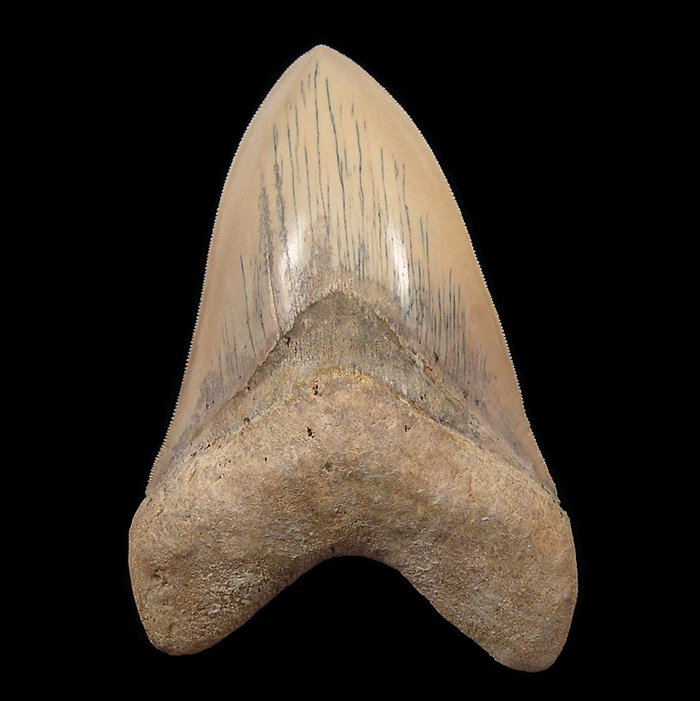
When it comes to prehistoric giants, few creatures capture our imagination as much as the Megalodon. This massive shark once dominated the oceans, with teeth large enough to dwarf a human hand and a bite force powerful enough to crush the bones of whales. While much has been uncovered about this apex predator, the truth is we may still have only scratched the surface. Fossils like the rare Carcharocles megalodon - Caribbean tooth provide tantalizing insights into its world, but could there be more clues hidden beneath rock, sediment, and ocean floor that we have yet to discover?
The Shark That Ruled the Ancient Seas
Megalodon, scientifically known as Carcharocles megalodon, was the largest shark to ever exist. Estimates suggest it could reach lengths of up to 60 feet, making it more than twice the size of today’s great white shark. With serrated triangular teeth that could exceed 7 inches, it had the perfect tools for tearing into large prey. Its menu likely consisted of whales, seals, and other marine mammals, which it could dispatch with a bite force measured at an astonishing 180,000 newtons.
Despite its dominance, what we know about Megalodon comes almost entirely from its teeth. Cartilage, which makes up the bulk of a shark’s skeleton, rarely fossilizes, leaving us with only scattered dental remains and occasional vertebrae. This means the complete picture of the Megalodon’s biology and behavior remains somewhat incomplete, keeping the door open to new discoveries.
Fossil Clues Hidden in Unexpected Places
Most Megalodon teeth found today come from riverbeds, coastal cliffs, and quarries. These fossils can vary greatly in size, color, and condition, depending on where they were preserved. Among the most intriguing finds are the Carcharocles megalodon - Caribbean specimens. Extracted from limestone quarries, these teeth often feature striking coloration and remarkable preservation.
Unfortunately, the same process that allows us to uncover them also risks destroying them. Because limestone is cut into blocks during quarrying, more than 99% of these teeth are damaged when struck by saw blades. The rare examples that survive intact—and sometimes with professional restoration—become highly prized among collectors and museums. Their survival reminds us that countless more teeth, and perhaps other fossilized remains, may have been lost to processes that erase history before it can be studied.
Could More Than Teeth Still Exist?
The biggest mystery surrounding Megalodon fossils is whether we might find more than just teeth and vertebrae. Sharks’ bodies are primarily cartilage, which typically decays long before fossilization can occur. Yet there have been rare instances in which exceptional conditions preserved soft tissue impressions or skeletal structures of other shark species.
If such extraordinary preservation were to occur for Megalodon, it could provide unprecedented insights into its biology—how it swam, how it grew, and even how it reproduced. Imagine uncovering a fossilized jaw structure or fin impression in deep-sea sediments. While unlikely, such discoveries aren’t impossible given the right conditions.
Lessons from Color, Texture, and Condition
Each Megalodon tooth is more than just a relic; it’s a record. The color of a tooth, for instance, often reflects the minerals present in the surrounding sediment. Caribbean specimens are particularly admired for their creamy tans, light charcoal patterns, and sharp serrations. Even the bourlette—the area between crown and root—can tell paleontologists about the environmental conditions where the shark once swam.
Examining wear patterns on teeth can also suggest diet and hunting behavior. Some teeth show evidence of stress fractures, possibly from biting into bone. Others reveal smoother serrations, hinting at differences in feeding strategies between younger and older sharks. These small but meaningful details help build a clearer picture of Megalodon’s role in ancient ecosystems.
What Modern Technology Could Reveal
Today’s advances in technology mean that fossils can be studied in ways unimaginable just a few decades ago. High-resolution CT scans, chemical analyses, and isotopic testing can provide new information from teeth that may look ordinary to the naked eye.
● Isotopic analysis of Megalodon teeth can reveal ocean temperatures, salinity, and even migration patterns of the shark.
● Microscopic studies can show growth rings within teeth, similar to tree rings, offering clues about how quickly Megalodons grew and how long they lived.
● Digital reconstructions allow scientists to model how these massive sharks swam and hunted, based on the proportions of their teeth and comparisons to modern relatives.
It’s entirely possible that fossils already collected hold secrets that technology has not yet extracted. Each new advance could bring us closer to solving mysteries long hidden in stone.
The Role of Rare Finds
Every once in a while, a fossil emerges that challenges what we think we know. A nearly perfect tooth, such as a rare Carcharocles megalodon - Caribbean specimen, can provide insights into preservation processes, growth patterns, or even the global distribution of the species. These rare finds highlight how much is still left to uncover—and how fragile the evidence can be.
Because so many Caribbean specimens are damaged during extraction, intact examples remind us of the delicate balance between natural preservation and human activity. They also serve as a reminder that our fossil record is incomplete, shaped by chance as much as by science.
Could the Ocean Floor Hold the Answers?
While quarries, riverbeds, and cliffs have given us many Megalodon teeth, the vast majority of the ocean floor remains unexplored. Sediments lie undisturbed for millions of years, and it’s possible that fossil-rich deposits sit hidden far beneath layers of sand and silt.
Marine paleontology is advancing, with new techniques for seafloor mapping and deep-sea sampling. While retrieving fossils from such depths poses enormous challenges, the potential for groundbreaking discoveries remains high. After all, Megalodon was a global species, and there may be entire regions where its remains lie untouched.
Why New Clues Still Matter
Finding more Megalodon fossils isn’t just about collecting impressive teeth. Each discovery helps fill gaps in our understanding of marine ecosystems from millions of years ago. By studying how Megalodon lived and why it disappeared, scientists gain perspective on modern ocean predators and the fragile balance of marine environments.
In an age where many shark species face threats from overfishing and climate change, Megalodon’s extinction serves as a powerful reminder that even the mightiest predators are vulnerable to shifts in their environment. Fossils act as both scientific evidence and cautionary tales.
Could We One Day Know More?
The story of Megalodon is far from complete. Teeth continue to emerge from quarries and riverbeds, and every so often, a specimen like the rare Carcharocles megalodon - Caribbean tooth raises new questions. Could we one day uncover a fossilized jaw? A preserved vertebral column? Or perhaps evidence of Megalodon’s reproductive habits?
While much of its body may be lost forever to time, the possibility of new discoveries keeps paleontologists searching. Each clue adds depth to our understanding of an animal that continues to capture human imagination centuries after its extinction.
Final Thoughts
Megalodon may no longer patrol our oceans, but the search for clues about its existence is ongoing. From the dazzling preservation of rare Caribbean specimens to the potential hidden deep beneath the seafloor, the evidence we have so far is only part of the story. Could Megalodon have left behind traces we haven’t yet uncovered? The answer is almost certainly yes.
As science advances and more fossils come to light, we may one day fill in the missing chapters of this prehistoric giant’s history. For now, the teeth—including those like the rare Carcharocles megalodon - Caribbean fossils—remain our most valuable keys to unlocking the mysteries of the largest shark to ever live.






