

Oceans have always held mysteries, but few are as captivating as the colossal predators that once roamed their depths. These giants shaped the rhythm of marine life, their presence influencing everything from the behavior of prey to the migration routes of their predators. Today, fossil remains provide glimpses into their legacy, sparking awe and curiosity in equal measure. Among the most famous of these predators, Carcharocles megalodon stands as a name that conjures both wonder and respect.
This remarkable shark is known not through complete skeletons but through the durable teeth it left behind. Each fossilized tooth is a story carved in stone, offering clues about an animal that once dominated prehistoric seas. To fully appreciate its enduring appeal, let’s travel back through time and retrace the story of this legendary marine hunter.
A giant in the ancient seas
During the Miocene and Pliocene epochs, oceans were a very different place. Warm waters stretched across continents, supporting an abundance of whales, seals, and fish. In this thriving ecosystem, megalodon reigned supreme. Reaching lengths estimated at up to 60 feet, it dwarfed most modern sharks, including the great white.
Its size wasn’t the only feature that defined its dominance. The shark’s massive jaws, lined with rows of sharp teeth, could exert a bite strong enough to crush bone. Fossil evidence shows deep bite marks etched into whale vertebrae, clear proof of its ability to take down the largest of prey. In these vast waters, megalodon was not simply another predator—it was the ultimate force shaping marine life.
Fossil teeth as windows to the past
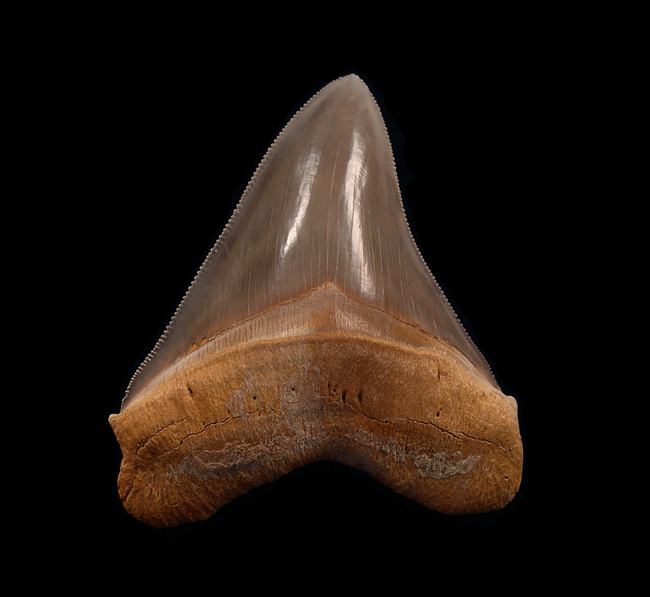
Sharks rarely leave behind skeletons because their frames are composed mainly of cartilage. What endures are their teeth, preserved for millions of years in sediment and stone. Megalodon teeth are extraordinary in both size and form—triangular, serrated, and sometimes measuring more than seven inches in length.
Collectors and scientists prize these fossils not only for their aesthetic appeal but also for the information they provide. The distribution of megalodon teeth across multiple continents tells us about its range. Fossils have been discovered in North and South America, Europe, Africa, and Asia, proving that this predator inhabited warm seas across much of the globe. Each discovery is like a puzzle piece, helping to reconstruct the life and times of this magnificent shark.
The global reach of a predator
Unlike many species that are limited to specific regions, the megalodon thrived in oceans worldwide. Its presence was not confined to a narrow range but spread broadly, an indication of both adaptability and abundance of prey. Scientists believe these sharks preferred coastal areas where large marine mammals were plentiful, making shallow waters an ideal hunting ground.
The global spread of its fossils also highlights how oceans connected continents millions of years ago. Seas that are now separated by land were once continuous highways for marine life, giving megalodon free access to thriving ecosystems across the planet. This wide distribution is one of the reasons the species has left such an extensive fossil record, making it accessible to both paleontologists and private collectors.
Clues hidden in bite marks
Teeth provide evidence beyond size and geography. Fossilized whale bones bear distinctive marks—wide, serrated grooves that align with megalodon’s teeth. These tell-tale signs show how it hunted: ambushing prey, immobilizing them with devastating bites, and consuming enormous amounts of flesh.
The patterns of these marks also help researchers understand behavior. Unlike some modern sharks that feed opportunistically, megalodon likely targeted specific areas of prey bodies to disable them. This strategic approach emphasizes intelligence paired with raw physical dominance, making it a predator finely tuned to its environment.
The puzzle of extinction
One of the greatest mysteries surrounding megalodon is how such a giant vanished. Several theories offer clues. Climate change during the Pliocene cooled global oceans, altering habitats and reducing populations of warm-water species. At the same time, the number of large marine mammals—the shark’s primary food source—declined.
Adding to these challenges was competition from other predators, including ancestors of the modern great white shark. More agile and better adapted to changing seas, these rivals may have outcompeted megalodon for scarce resources. By around 3.6 million years ago, the last traces of the species disappeared from the fossil record, marking the end of its reign.
Science meets imagination
Piecing together the image of megalodon requires careful science, but it also fuels imagination. With only teeth and fragmentary remains available, scientists reconstruct its size by comparing it to modern sharks. Computer models and scaling techniques offer realistic estimates, yet the creature remains shrouded in mystery.
This mystery fuels popular culture. The megalodon frequently appears in films, novels, and documentaries, often portrayed as an unstoppable survivor lurking in the hidden depths. While science assures us it is extinct, the fascination persists, blending fact with fantasy. Its enduring presence in culture speaks to our deep connection with stories of creatures larger than life.
Fossils as treasures
For many, holding a megalodon tooth is like touching a piece of history. These fossils, with their distinct shapes and colors, vary depending on where they were found and the conditions under which they fossilized. Some are dark and glossy, others pale and weathered, but each one is unique.
Collectors seek them as symbols of the ocean’s ancient mysteries, while researchers value them as scientific data. Beyond their scientific role, these fossils remind us of the passage of time, the shifting of continents, and the endless cycles of evolution. Owning or studying one is like keeping a tangible fragment of an era long gone.
Why fascination never fades
The appeal of megalodon lies not only in its size but also in the story it represents. Here was a predator that once dominated Earth’s largest habitat, and yet it eventually disappeared. Its extinction highlights the fragile balance of nature, showing that even giants are not immune to the forces of change.
This paradox—immense dominance followed by disappearance—keeps the fascination alive. It draws people into museums, fossil shops, and scientific discussions, fueling a collective curiosity about what life was like millions of years ago. Megalodon serves as both a reminder of the past and a symbol of nature’s shifting course.
Conclusion
The legacy of Carcharocles megalodon endures through every fossilized tooth, every reconstruction, and every story told about its reign. From its role as apex predator to its mysterious disappearance, this shark connects us to an ocean world that feels both distant and immediate. Its fossils serve as links across time, allowing us to hold a fragment of history in our hands.
Exploring the story of megalodon is more than science—it is an invitation to connect with the wonder of prehistoric life. If you’ve ever dreamed of experiencing a direct link to the past, fossil collecting offers that opportunity. Each specimen tells a story, waiting for someone to preserve and appreciate it.
Take the next step in your journey through ancient oceans—explore fossils, embrace their history, and bring a piece of the prehistoric world into your life through Buried Treasure Fossils.






