

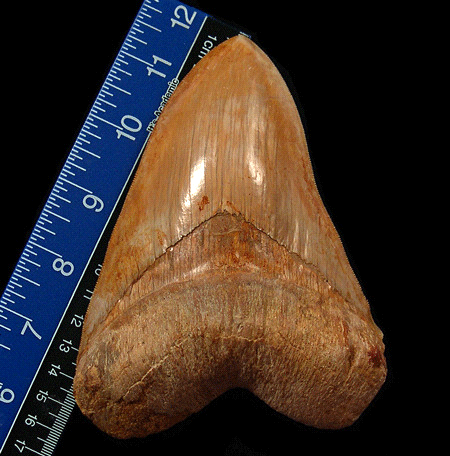
The Megalodon is a prehistoric marvel that still dominates our imagination, a shark so massive it dwarfs any marine predator alive. Its legacy lies most tangibly in its teeth, which serve as powerful reminders of an apex predator whose shadow once loomed over ancient seas. Among our fossilized relics, teeth measuring 6 inches or more have captured both scientific fascination and collector envy.
But how big is a megalodon tooth in reality? Are our 6-inch Megalodon teeth fossils the norm or the exception? Let’s explore the truth behind our impressive fossils.
The Spectrum of Megalodon Tooth Sizes
Megalodon teeth vary broadly in size, influenced by factors such as the shark’s age, its position within the jaw, and individual variation. While a handful of teeth have been found exceeding 7 inches, the vast majority of discovered teeth fall somewhere between 1.5 and 4 inches in length. Teeth reaching or surpassing 6 inches represent the extreme upper end of the size range, not your average find, but unmistakably awe-inspiring when unearthed.
These larger teeth belonged to fully grown adult Megalodons, individuals who had reached colossal sizes, sometimes estimated at over 50 feet in length. Juvenile Megalodons, which made up a significant portion of the population, shed smaller teeth that are far more common in the fossil record.
Why Are 6-Inch Teeth So Rare?
Several reasons contribute to the scarcity of 6-inch Megalodon teeth:
Population Distribution: Naturally, fewer sharks lived long enough to grow teeth of such immense size, meaning fewer of these large teeth were lost in the first place.
Fossilization Bias: The process that turns organic remains into fossils favors conditions that don’t always coincide with where large teeth were shed or lost. Environmental factors like strong currents, erosion, and sediment composition can prevent the preservation of these giant teeth.
Discovery Bias: Smaller teeth are more numerous and easier to spot, often outnumbering their larger counterparts by a significant margin in fossil deposits.
The Anatomy Behind Tooth Size Variation
To know about how big a megalodon tooth is? It totally depends on Megalodon’s teeth size or shape. Teeth at the front of the jaw tend to be broader and larger, optimized for gripping prey, while those further back are smaller and more specialized for cutting. As a shark grows, each successive tooth generation grows larger until full maturity is reached.
Because sharks continually shed and replace their teeth, a single Megalodon could lose tens of thousands over a lifetime. The majority of these shed teeth belong to younger sharks or less prominent jaw positions, meaning smaller teeth vastly outnumber giant 6-inch specimens in fossil deposits.
Geological Factors Affecting Tooth Discovery
The places where Megalodon teeth are found today, coastal fossil beds, riverbeds, and ancient seabeds, greatly influence what size teeth are discovered. Different sediment types and fossilization environments preserve teeth differently.
For example, softer sediments can protect smaller teeth well but may allow larger teeth to be broken or washed away before fossilization. Meanwhile, some fossil-rich areas have been extensively mined, increasing the chances of finding rare large teeth simply by the volume of material examined.
Why Smaller Teeth Are the Backbone of Collections
Most Megalodon teeth discovered fall between 2 and 4 inches in length. These teeth are abundant, easier to find, and considerably more affordable than their larger cousins, making them the foundation of most fossil collections worldwide.
They also serve as excellent educational tools, providing clear insights into Megalodon anatomy, feeding behavior, and evolutionary biology without the high cost of large specimens.
Scientific Value of Tooth Size and Shape
Scientists glean much information from Megalodon teeth beyond size. Detailed analysis of serrations, wear patterns, and root structure informs paleontologists about the shark’s feeding habits, growth rates, and even environmental changes during its reign.
Estimating the total size of a Megalodon based on tooth length has been a cornerstone of understanding these giants. For example, a 6-inch tooth suggests a shark exceeding 50 feet, underscoring the immense size of these predators.
Geographic Hotspots for 6-Inch Teeth
Certain regions have become renowned for yielding larger Megalodon teeth. Coastal states such as Florida, South Carolina, and parts of California in the U.S. are famous fossil hotspots. Internationally, teeth have been found in Europe, Africa, and Australia, though the distribution of sizes varies.
In these fossil-rich zones, the opportunity to find a 6-inch tooth increases, but even here, such finds are rare and celebrated.
What Does the Future Hold for Megalodon Tooth Discoveries?
Paleontological techniques continue to improve, and new fossil sites are being uncovered regularly. This means the discovery of 6-inch Megalodon teeth, while still rare, may become more frequent as exploration and excavation technology advance.
Moreover, digital modeling and analysis enable scientists to more accurately estimate the life history of Megalodon, using teeth of various sizes, thereby deepening our understanding of this extinct predator.
Conclusion
While our 6-inch Megalodon teeth fossils collection are iconic and awe-inspiring, they are far from the most common size found. The majority of how big a Megalodon tooth is discovered, falls within the smaller 2- to 4-inch range, reflecting natural population structures, fossilization biases, and patterns of discovery.
The rarity and impressive size of 6-inch teeth make them prized and valuable, cherished by collectors and scientists alike as symbols of one of history’s greatest marine predators. Whether large or small, every Megalodon tooth tells a story, a story of an ocean ruled by giants, a story millions of years in the making, and a story we continue to uncover with each fossil unearthed.
If you’re interested in learning more about our Megalodon teeth fossil collection, exploring fossil hunting, or even beginning your collection, feel free to reach out to us. There’s a whole prehistoric world waiting to be discovered.






