

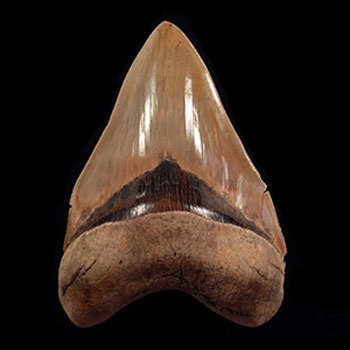
Millions of years ago, the oceans were ruled by a giant predator known as the Megalodon. This colossal shark, believed to have reached lengths of up to 60 feet or more, is legendary for its size and power. Although the Megalodon itself has long been extinct, one of its most enduring legacies is the fossilized remains of its teeth. Our collection of enormous 7 inch Megalodon teeth for sale continue to fascinate scientists, fossil hunters, and shark enthusiasts worldwide. But how exactly are these impressive Megalodon teeth fossils formed and preserved over such an immense span of time?
Let’s understand the fascinating journey of these prehistoric relics, from the moment a tooth falls out of a living Megalodon to when it is uncovered millions of years later as a treasured fossil.
The Biology Behind Megalodon Teeth
Megalodons, like modern sharks, had a remarkable dental system. Their teeth were constantly replaced in a conveyor-belt fashion, with new teeth growing in rows behind the functional ones. This adaptation ensured they always had sharp tools ready for hunting large prey. A single Megalodon could have had thousands of teeth during its lifetime, losing and regrowing teeth regularly as part of its natural biology.
These teeth were uniquely adapted for their role as massive predators. They had broad, triangular shapes with finely serrated edges designed to effectively cut through thick skin, muscle, and bone. This distinctive morphology not only made them powerful hunting tools but also means their fossils are relatively easy to identify, even millions of years after the shark’s extinction.
Where Megalodon Teeth Are Found and Why?
The vast geographical distribution of Megalodon teeth fossils reflects the shark’s wide-ranging habitat. Fossil discoveries from the coasts of the United States, including North Carolina, South Carolina, Georgia, Florida, and California, underscore the shark’s dominance in coastal and offshore waters. Other discoveries worldwide, from Europe to South America, Africa to Asia, confirm the Megalodon’s global reach.
Finding these fossils depends on geological and environmental factors. Coastal erosion, river sediments, and exposed seabeds serve as natural archives where fossilized teeth are preserved. Many fossil hunters scour beaches, riverbeds, and underwater sites, especially where sediment layers have been disturbed or eroded. These environments expose teeth that had been buried for millions of years beneath layers of sediment.
The Complex Journey from Lost Tooth to Fossil
Once a Megalodon tooth was lost, the journey toward fossilization began, a journey governed by a series of environmental and chemical factors.
Initial Conditions for Preservation
For a tooth to become fossilized, it must first avoid destruction. When a tooth sinks to the seafloor, it faces many threats: scavengers, physical abrasion, chemical dissolution, and biological degradation. Rapid burial in sediment is crucial to protect it from these threats. The sediment acts like a protective blanket, isolating the tooth from oxygen and slowing decay. Environments with fine-grained sediment, such as muddy seafloors or river deltas, are especially conducive to preserving organic remains.
Mineralization and the Role of Geochemistry
Over time, the tooth’s organic components degrade, but the mineral content remains. Groundwater rich in minerals such as silica, calcium carbonate, and iron infiltrates the tooth’s porous spaces. This process, known as mineral replacement or permineralization, slowly transforms the tooth into a stone-like fossil.
The chemical composition of the surrounding sediments influences the color and durability of the fossil. For example, iron-rich environments often produce dark or reddish fossils due to the presence of iron oxide deposits. The degree of mineralization varies, but typically, the hardest parts of the tooth are well preserved, maintaining the original serrated edges and shape.
Geological Forces and Fossil Exposure
After fossilization, geological events such as plate tectonics, sediment shifting, and erosion affect the fossil’s fate. Some fossils are buried deeper, remaining inaccessible for millions of years. Others are gradually exposed as softer sediment layers wear away due to waves, currents, storms, or human activity.
This constant reshaping of the Earth’s surface means that fossilized Megalodon teeth can turn up in unexpected places, sometimes far from their original deposition site. In fact, some fossil teeth are found embedded in ancient river sediments, indicating how prehistoric waterways transported remains from marine to terrestrial environments.
The Variety in Size and Shape of Megalodon Teeth
The range in size and shape of fossilized Megalodon teeth provides important insights into the shark’s biology and behavior. Teeth can vary in length from a few inches to over seven inches, with the largest ones typically found in the largest individuals.
Environmental and Preservation Influences
The sediment and mineral environment can alter fossil teeth over millions of years, sometimes affecting their size by chipping or wear. Also, larger teeth are more likely to survive the fossilization process intact, which could bias the fossil record toward bigger specimens.
Collecting and Studying Megalodon Teeth
Megalodon teeth are highly prized among fossil collectors, museums, and researchers. Finding a large, well-preserved tooth can be thrilling, whether it’s unearthed from a riverbank, dredged from the ocean floor, or uncovered in a fossil bed.
Some of the largest and rarest teeth, including 7 inch Megalodon teeth for sale, are particularly valuable and often featured in exhibitions and private collections. Their global availability means enthusiasts across continents can hunt for these fossils in their local coastal and river areas.
Protecting Fossil Sites and Ethical Collecting
As interest in Megalodon teeth fossils grows, it’s vital to practice ethical collecting and support conservation efforts. Many fossil sites are protected, requiring permits for excavation or collection. Responsible fossil hunting ensures that these ancient treasures remain preserved for future generations to study and enjoy.
Final Thoughts
Our fossilized 7 inch Megalodon teeth for sale are more than relics, they are enduring testimonies to a prehistoric era when giant sharks ruled the seas. The intricate journey from tooth loss, rapid burial, mineral replacement, to eventual discovery spans millions of years and involves a delicate balance of biological, chemical, and geological factors.
Next time you encounter our Megalodon tooth fossil, remember you are holding a tangible piece of natural history, shaped by an ancient ocean ecosystem and preserved through extraordinary natural processes.
Our fossil collections not only deepen the understanding of prehistoric life but also inspire awe for the powerful forces that preserve the past beneath your feet.






