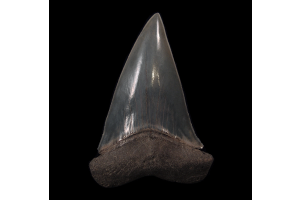
Some fossils are cool. Some are rare. And then there are the ones that make seasoned collectors freeze mid-scroll, whisper a reverent “whoa”, and contemplate reworking their budgets. This Otodus megalodon tooth from Sharktooth Hill falls squarely into that category. It’s not just a fossil; it’s the fossil.
If you’re wondering what makes this tooth so extraordinary, you’re not alone. Because in a fossil market teeming with replicas and overly restored teeth, finding a piece this genuine and this jaw-dropping is like stumbling upon a unicorn — in your backyard — wearing a name tag.
Let’s talk about why this tooth has collectors and paleontology lovers geeking out like kids in a candy store.
Sharktooth Hill Isn’t Just a Cute Name
California’s Sharktooth Hill, located near Bakersfield, isn’t your average fossil site. It’s a geological treasure chest from the Miocene epoch, around 15 million years ago. While it’s known for its dense concentration of marine fossils — including hundreds of shark species — actual Otodus megalodon teeth are painfully rare here.
Unlike the East Coast, where Meg teeth are relatively common, Sharktooth Hill doesn’t give them up so easily. The sediment here is different; the geological layers are more fragile, and erosion patterns are less forgiving. So when a Meg tooth does surface, and it’s in phenomenal shape, it’s not just a big deal — it’s an event.
This isn’t your standard fossil fair. This is a lottery-winner rare.
Condition? We’re Talking Envy-Worthy
Most fossilized shark teeth show their age — and rightly so. Millions of years underground will do that. But this tooth? It defies the usual wear and tear.
The enamel is still glossy, with a buttery-tan hue that looks sun-kissed rather than sun-bleached. The bourlette — that magical stripe between crown and root — is nearly 80% intact with a warm red-brown color, which is unheard of for a specimen this size. And don’t even get us started on the serrations.
Complete. Sharp. Uniform. There’s even a pristine tip serration that might make you forget this tooth hasn’t bitten into anything since the Miocene.
That Root? That Root!
Root quality is usually where even the best Meg teeth falter. Either they’re partially eroded or riddled with restoration. But not this one. The root is well-articulated and complete. No repair. No filler. Just raw, prehistoric authenticity.
If you know, you know. And if you don’t, here’s the cheat sheet: great root + intact bourlette + sharp serrations = collector’s dream.
Add in the Otodus megalodon - Sharktooth Hill provenance? That’s the holy trinity of fossil collecting right there.
Middle Miocene Marvel With a Twist
Here’s where things get really interesting.
This tooth dates back to the middle Miocene, meaning it belongs to a period when Megalodons were just getting into their stride. But this particular tooth still carries evolutionary whispers from its ancestor, Otodus chubutensis.
Notice those bumpy nodules at the base of the serrated edge? That’s a throwback feature, showing an intermediate stage between Chubutensis and full-fledged Megalodon. It’s a unique glimpse into shark evolution — right in the palm of your hand.
You’re not just buying a fossil. You’re buying a story, frozen in calcium phosphate.
Display-Worthy and Collector-Certified
This isn’t the kind of tooth that ends up in a forgotten drawer. It’s the kind you frame, light from above, and casually show off to dinner guests like, “Oh, did I mention I own one of the rarest Sharktooth Hill Megalodons ever found?”
We provide a custom display stand because, honestly, something this special deserves to be shown off properly.
It also comes with full authenticity verification. There’s no restoration here. No faked serrations or color touch-ups. This is 100% natural. And that’s increasingly hard to come by in a fossil market flooded with altered specimens.
Twenty-Five Years in the Shadows
Before you get too excited and rush to grab this piece, here’s another nugget that makes it special. This tooth hasn’t just emerged from the ground. It has been hidden in a private collection for twenty-five years. Tucked away. Untouched. Waiting.
That kind of provenance adds value — not just monetary, but historical. Fossils like this don’t pop up on the open market every day. Or every year. Or even every decade.
So when one does? You move fast. Because once it’s gone, it’s probably not coming back.
Why It’s a Unicorn (Let’s Break It Down)
No horns. No sparkles. Just fossil perfection.
So why are we calling this the unicorn of the fossil world? Let’s stack up the facts.
● Location: Incredibly rare for a tooth of this size and condition to come from Sharktooth Hill
● Age & Evolution: Middle Miocene, with transitional Chubutensis traits
● Condition: Flawless enamel, mostly intact bourlette, killer root, and deadly serrations
● Provenance: Locked away in a respected collection for a quarter-century
● Size: A stunning 5-1/8 inches, with impressive width and symmetry
And let’s not forget: it’s museum-worthy. Yes, really. If a major museum had this in a glass case, people would crowd around it. You could be the person who beats them to it.
We Know Fossils. And We Know This One’s a Star.
At Buried Treasure Fossils, we don’t throw around the term “ultra rare” lightly. When we say a piece like this is special, we mean it. We’ve spent years curating some of the finest fossil specimens out there, but every so often, a piece like this stops us in our tracks.
If you’re a serious collector looking to add a world-class fossil to your lineup, or just someone who understands the value of once-in-a-lifetime discoveries, this tooth is your moment.
And while we’d love to keep it on our shelf forever, it deserves a home where it’s properly appreciated — maybe even obsessed over.
Final Bite: When You Know, You Know
The fossil world is full of impressive finds, but only a few reach true legend status. This Otodus megalodon - Sharktooth Hill specimen isn’t just an ancient predator’s leftover. It’s a tangible connection to a time when nature built things bigger, bolder, and sharper.
If you’re reading this thinking, “This might be the one,” you’re probably right. Unicorns don’t come around often. And when they do, you don’t hesitate.
You claim them.