

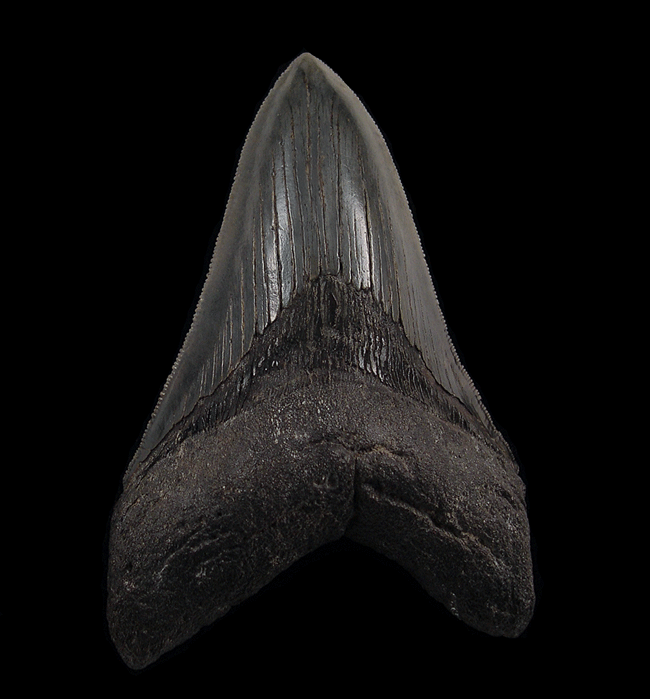
Some fossils tell stories. Others roar. That’s exactly what this 4¾-inch lower jaw tooth from South Carolina does. You don’t just admire it—you feel it. There’s a gravity to it, a serrated whisper from millions of years ago that says: I ruled the sea.
We’re talking about a show-stopping specimen of Otodus megalodon - So. Carolina origin. It’s not just “another Meg tooth.” This one has the kind of sharp, symmetrical serrations that make collectors pause mid-scroll. The enamel? Smooth and luxuriously preserved. And then there’s the bourlette—that inky black transitional patch near the root that fossil fans dream about.
Yes, it’s fossilized. No, it hasn’t lost one ounce of its prehistoric charisma.
Let’s take you on a closer look at why this South Carolina giant might just be the crown jewel of your collection.
That Crown Deserves a Coronation
First, the color. This particular tooth flaunts a deep, dark gray that could rival a storm-washed Atlantic sky. It isn’t just pretty—it’s moody in the best way. That dusky tone isn’t dyed, stained, or polished into submission. It’s natural, shaped by sediment, water chemistry, and time.
The color transitions gracefully into a glossy crown with almost glass-like enamel. When light hits it, you get a subtle sheen that sets off the fine detail of each serration.
And those serrations? They’re where this tooth earns its royal title.
Serrations That Slice Through Time
Tooth serrations are like nature’s engineering marvel. They’re the reason the Megalodon’s bite was more than a bite—it was a dissection. Now imagine having that precision preserved perfectly after millions of years. That’s what you’re getting here.
Run your eye (not your finger—unless you’re brave) along the edge of this tooth and you’ll notice each notch is clean, evenly spaced, and remarkably intact. It’s almost unsettling how sharp they remain.
From the cusp to the root, the serrations on this Otodus megalodon - So. Carolina fossils haven’t dulled. The tip is especially impressive—a strong, symmetrical point that somehow defied time, pressure, and geological chaos to stay nearly perfect.
This isn’t just a collector’s item. It’s a conversation piece with an attitude.
The Bourlette: Fossil Royalty’s Signature
Now let’s talk about the bourlette—the V-shaped patch just below the crown. This one is sleek and inky black. Not faded. Not spotty. It’s bold, defined, and textured just enough to show you where the crown meets the root like a fossil fingerprint.
The bourlette gives us a clue to the tooth’s preservation quality. Many Megalodon teeth are lost due to erosion or wear. When you find one that holds its shape and color this well, you’re looking at a tooth that’s thrived through the ages, not merely survived.
No Filler, No Fixes: This Tooth is Untouched
We’ve all seen fossil listings that need a few asterisks—minor repair here, restoration there. But this beauty? Zero restoration. Zero repair.
That’s huge. You’re looking at a raw, authentic piece of evolutionary history that’s been carefully excavated, not reconstructed in a lab. The texture, weight, and contour haven’t been tampered with or smoothed out. This is how the ocean left it.
And it’s rare to find a lower jaw tooth of this size and quality from the South Carolina coast. The lower jaw teeth tend to be more slender and symmetrical—designed for piercing prey like whales. This one wears its role proudly, as though it remembers every meal.
What Makes South Carolina So Special?
You might be wondering—why are so many jaw-dropping Megalodon teeth pulled from South Carolina?
It comes down to geology and luck.
The coastal rivers and tidal creeks of the Lowcountry happen to slice through marine deposits that date back to the Miocene and Pliocene epochs—roughly 3 to 20 million years ago. That’s right in Meg’s prime.
Add in the region’s unique combination of sandy sediment and mineral-rich water, and you get ideal fossilization conditions. The result? Stunning specimens like this one, which belong in the highest tiers of private or professional collections.
And yes, we’re a bit partial to the South Carolina finds. But can you blame us?
A Collector’s Dream (And Not Just for Beginners)
Whether you’re a seasoned fossil hunter or someone just dipping a toe into prehistoric waters, this is the kind of find that elevates a collection instantly.
At nearly 5 inches, with well-preserved enamel and intact serrations, it’s a showcase item. But it doesn’t scream “look at me” in a tacky way. It just commands attention. It’s the kind of piece you build a shelf around. The kind you tell people about even when they didn’t ask.
Collectors aren’t just buying fossils anymore. They’re buying focal points. And this one? It’s the kind that makes other teeth jealous.
We Don’t Just Sell Fossils. We Curate Time Travel.
You don’t need to be a paleontologist to appreciate the gravity of a piece like this. But when you shop with us, you get more than just a fossil in a box. You get access to expertly sourced, authentic specimens, each hand-selected for quality, rarity, and visual impact.
We believe in preserving the story. That’s why we offer full transparency—no restoration, no tricks, just clear, honest details about what you’re getting. And if you ever have questions, we're here to help guide you toward the right addition to your collection.
From Otodus megalodon - So. Carolina fossils to dinosaur relics and beyond, we help you hold history in your hands.
And if this particular tooth has already been snapped up? Keep your eyes peeled. We’re adding 15 new South Carolina Megalodon teeth in October 2024, each with its own quirks, colors, and cutting power.
The Takeaway: This One’s Got Bite
When you find a nearly perfect Megalodon tooth from South Carolina—especially one like this with pristine serrations, glossy enamel, and a deep black bourlette—you’re not just buying a fossil. You’re buying a moment that’s survived millions of years. You’re collecting a story with teeth.
This Otodus megalodon - So. Carolina tooth is more than an object. It’s a slice of prehistory so vivid you can practically hear the ocean swell behind it. Whether you’re here for the science, the display value, or just the thrill of owning something ancient and powerful—this piece doesn’t disappoint.
And remember, our collection of South Carolina Megs is always evolving. We invite you to explore the rest, compare features, and find the one that feels like it’s been waiting for you all this time.
After all, when it comes to serrated majesty… why settle for anything less?






