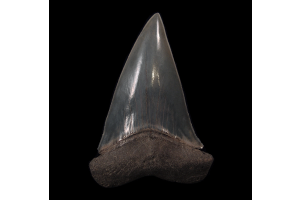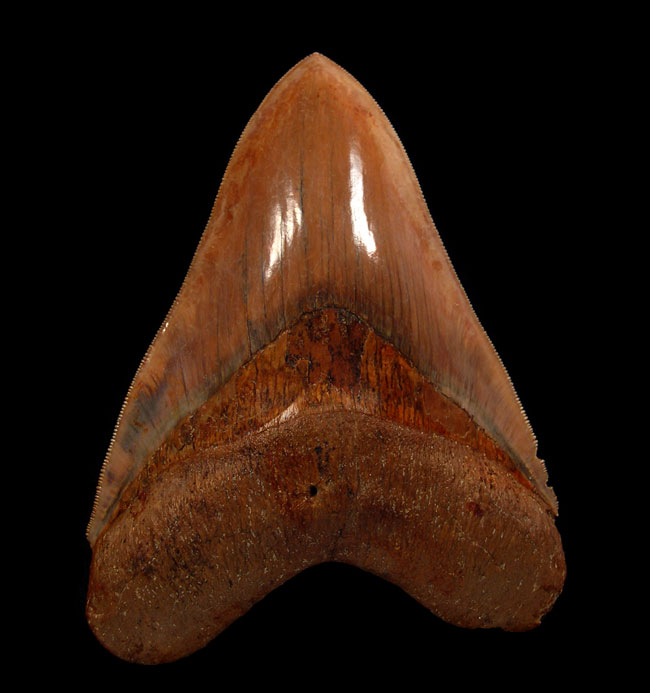
When we look at the extraordinary Indonesia Megalodon tooth discoveries from West Java, we see more than fossilized remains of an ancient predator. These specimens allow us to explore geological processes that shaped the region millions of years ago.
Our collection demonstrates how each tooth carries traces of its burial environment, preserved in the enamel, root, and striking coloration. By examining these details, we are able to uncover stories of mineral-rich seas, limestone protection, and natural preservation.
Color Palettes Forged by Minerals
Indonesian Megalodon teeth can display extraordinary colors that immediately capture attention. Shades of tan, gold, red, brown, blue, and black are often found in striking combinations. Some specimens may be dominated by a single bold color, while others can reveal complex blends and radiant contrasts. Among the most notable are the “Fountain design,” with its flowing, almost radiant look, and the “Tiger eye” bourlette, marked by vertical bands of red and gold.
These vivid appearances are created when minerals enter the tooth enamel during fossilization. The mineral content of West Java’s environment has played a direct role in this transformation, painting each fossil in unique hues. In this way, coloration becomes a record of the chemistry and mineral balance present millions of years ago.
Preservation Enhanced by Limestone
One of the defining qualities of Indonesian Megalodon teeth is their remarkable preservation. The enamel often remains glossy, with a surface described as having a glass-like clarity. This striking appearance is not a coincidence but the outcome of the limestone deposits where the teeth have been buried.
Limestone can provide a stable, protective environment, preventing erosion and reducing the risk of cracking. The result is enamel that has retained its brilliance while serrations and edges remain sharply defined. This clarity allows researchers to study enamel texture, growth lines, and surface coloration that might otherwise fade in less stable geological settings.
The Significance of Bourlettes
Bourlettes, the triangular area at the base of the enamel, also provides valuable geological insights. Indonesian specimens often display unusually large bourlettes marked by bold patterns and rich colors. The “Tiger eye” style, in particular, is characterized by its striped gold-and-red presentation.
These features are unique to the Indonesian deposits and reflect the distinct conditions under which fossilization has occurred. The mineral environment, combined with the protective burial matrix, has created bourlettes that are not only visually dramatic but also scientifically informative.
Serrations Preserved with Precision
Another hallmark of these fossils is the preservation of serrations. In West Java examples, serrations may extend further onto the root than in fossils from other regions. Their sharpness and visibility suggest that they have experienced minimal erosion, reinforcing the role of limestone in shielding the fossils over geological time. Serrations act as microscopic records of both the tooth’s original function and the preservation environment.
Geological Time Recorded in Enamel
The deposits in West Java where these teeth are found date back to the Miocene period, roughly 10–15 million years ago. In some contexts, the range can extend into the Late Miocene–Pliocene, approximately 4–10 million years ago. These ages place the teeth within dynamic geological shifts, including changes in sea levels and mineral-rich sedimentation.
Coloration and preservation patterns recorded in each fossil can therefore be linked to specific stages in the region’s geological history. The enamel essentially becomes a canvas on which mineral processes, water chemistry, and sediment conditions have been etched. Each Indonesian Megalodon tooth can therefore serve as both a biological relic and a geological record.
Distinctiveness Compared with Other Global Sites
Megalodon teeth from other locations are often marked by muted shades—commonly gray, brown, or off-white. In contrast, West Java specimens display bold coloration and striking designs that are rarely duplicated elsewhere. Their enamel can remain clear and glossy, while serrations and bourlettes are preserved with exceptional precision.
This combination of vibrant coloration and high-level preservation demonstrates the uniqueness of the Indonesian deposits. Collectors and researchers alike recognize the rarity of such specimens, both as geological artifacts and as visually captivating fossils.
Patterns as Geological Storytellers
When examined closely, the coloration and patterns found on these fossils can be read as geological narratives:
● Mineral Signatures: Each hue corresponds to the minerals present in the surrounding sediment during fossilization.
● Limestone Shielding: Protective burial has preserved fine details such as serrations and enamel texture.
● Regional Uniqueness: The appearance of designs like the “Fountain” or “Tiger eye” reflects mineralogical conditions specific to West Java.
● Chronological Imprint: Age estimates of 4–15 million years place the fossils within key transitions of the Miocene and Pliocene epochs.
Each tooth can therefore be considered a natural archive of its environment, recording not only the biology of a massive shark but also the mineral and geological processes of its burial site.
Fossils that Bridge Science and Aesthetics
While these fossils are often admired for display, they also carry significant geological importance. Their clarity, coloration, and structure provide evidence of mineral chemistry, preservation environments, and geological timelines. For researchers, they can serve as examples of how fossilization conditions vary across regions. For collectors, they represent specimens that combine natural beauty with geological depth.
Conclusion
The color patterns of Indonesian Megalodon teeth are not superficial ornamentation. They act as markers of geological history, evidence of mineral infiltration, and reflections of Miocene seas. The limestone matrix has preserved them in extraordinary condition, keeping enamel glossy and serrations sharp. Bourlettes exhibit patterns that speak directly to the region’s mineral signature, while serrations and enamel detail confirm the power of geological preservation.
Each Indonesian Megalodon tooth tells a story millions of years in the making. By studying their coloration and structure, the geological narrative of West Java is revealed—an ancient environment recorded not in words, but in fossilized enamel and mineral pigments.