

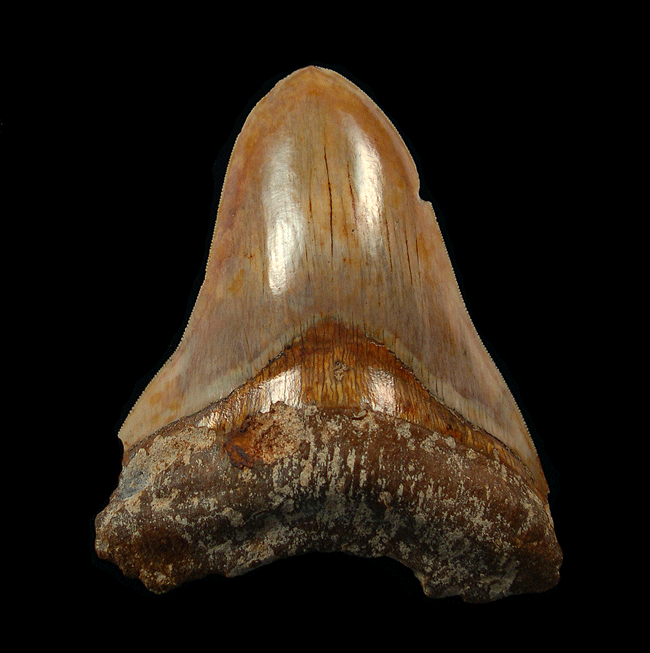
When we place one of the most prominent megalodon teeth into your hands, it can feel like holding a fragment of an ancient ocean, frozen in time. A massive, carefully preserved tooth from the prehistoric leviathan Carcharocles megalodon, the largest shark to ever exist, is not simply a fossil.
With our collection, it becomes a time machine. And when that tooth happens to be among the biggest megalodon teeth ever found, every detail it carries can transport us into Earth’s distant past. These extraordinary fossils are more than relics. They allow us to imagine a world where the ocean was ruled by a predator of unmatched scale and power.
A Portal to the Miocene and Pliocene Seas
The story of these enormous teeth can be traced back between 20 and 3 million years ago, during the span from the early Miocene through the end of the Pliocene. This was when the megalodon ruled over the world's oceans. Its very name evokes awe, as it translates to “big tooth.” Fossilized remains of this shark provide insight into an era when marine life was abundant and large predators thrived. Holding such a relic can create a direct connection to that lost world, a time when ecosystems were dominated by creatures unlike any alive today.
Pristine Preservation Through Limestone
One reason these fossils should be admired is their exceptional preservation, made possible by their burial in limestone deposits in West Java, Indonesia. The limestone environment has allowed the enamel to remain intact, producing a glass-like surface that gleams with clarity. Each tooth may retain both texture and tonal variation, capturing the conditions of the seas in which it once lay buried. Unlike other fossil finds that often appear weathered, these Indonesian specimens tell a different story. They remind us how geology can shape and safeguard history for millions of years.
A Kaleidoscope of Color and Pattern
These Indonesian fossils are also visually striking. They can display substantial color variations, including tans, golds, reds, browns, blues, and black shades. Many may reveal natural designs within the enamel, almost as if nature painted them with its own brush. Collectors often describe these designs with distinctive names, such as the “Fountain design.”
One of the most admired looks is known as Tiger eye, featuring alternating vertical lines of gold and red. Each tooth can be viewed as a miniature work of natural art, carrying colors and patterns shaped not by human hands, but by geological processes across millennia.
Geological Story of West Java
The fact that these fossils originate from West Java, Indonesia, adds another layer to their story. This region’s limestone deposits acted as a natural vault, protecting the teeth from erosion and damage. Over time, minerals seeped into the teeth, enhancing their color and ensuring their enamel survived with an almost glass-like sheen. This geological process not only preserved the fossils but also transformed them into visually remarkable specimens. To consider the layers of stone that cradled these teeth for millions of years is to appreciate how Earth itself becomes an archivist of history.
Serrations and Bourlette: Engineering of Nature
Two features may further enhance the fascination with these fossils: the bourlette and the serrations.
● The bourlette, a colored band at the base of the tooth, often appears large, complete, and patterned in unique ways. The Tiger eye variation, with its alternating hues, can be especially admired.
● The serrations on these Indonesian teeth are often sharp and nearly complete, with intact tip serrations. Remarkably, these serrations may extend unusually far onto the root, a feature not commonly found in other shark teeth. The limestone burial conditions have allowed these fine edges to remain intact in extraordinary detail.
These qualities highlight both the aesthetic and biological significance of each specimen, showing how evolution and preservation combine in remarkable ways.
Size That Commands Attention
Size can amplify the story of these fossils. While some specimens may exceed 7 inches in length, such giants are rare. Even the “extra-large” quality specimens often measure between 5 and 6 inches long and can reach 4 to 4½ inches wide. These dimensions do reflect the formidable presence of the shark itself, demonstrating its dominance in ancient seas.
To hold such a tooth is to realize the magnitude of the creature it once belonged to. It is in these oversized specimens that collectors see hints of the biggest megalodon tooth ever found, carrying awe as well as scientific importance.
Guaranteed Authenticity
Another aspect that should be noted is the assurance of authenticity. These teeth are offered with the guarantee of no repair or restoration. They are genuine, untouched, and preserved as they were discovered. This authenticity can strengthen the experience, grounding the connection to the Miocene and Pliocene eras in physical truth. There is something undeniably powerful about holding an object that has not been altered, one that survived both the passage of time and the geological pressures of the Earth without intervention.
The Time Machine Effect
When all these qualities come together, the tooth becomes more than a fossil. It can feel like a time machine in the hand.
● The age spanning millions of years can evoke the presence of ancient seas and ecosystems.
● The preservation of color and enamel can bring forward the artistry of nature, shaped by minerals and time.
● The serrations, precise and intact, may embody the evolutionary refinement of an apex predator.
● The size can remind us of the immense power once held by the megalodon.
● Authenticity can ensure the connection is genuine and unaltered.
Together, these factors may create an encounter with history that feels immediate and vivid. Each tooth carries its own narrative, one that encourages the imagination to picture a massive shark gliding silently through ancient waters. The fossil acts as a storyteller, giving us the ability to visualize scenes that no longer exist.
Final Reflection
The biggest megalodon tooth ever found can offer a rare connection to a chapter of Earth’s story that is both ancient and enduring. Its preservation, striking appearance, sharp serrations, and monumental size can create an experience that reaches far into history. It represents the passage of millions of years, the artistry of geological processes, and the legacy of one of the most extraordinary creatures to inhabit the oceans.
In this sense, the tooth is not only a fossil. It is a time machine, carrying the memory of oceans long vanished, placed directly into human hands today. As one collector might say, “Holding a megalodon tooth is like shaking hands with history itself.”






